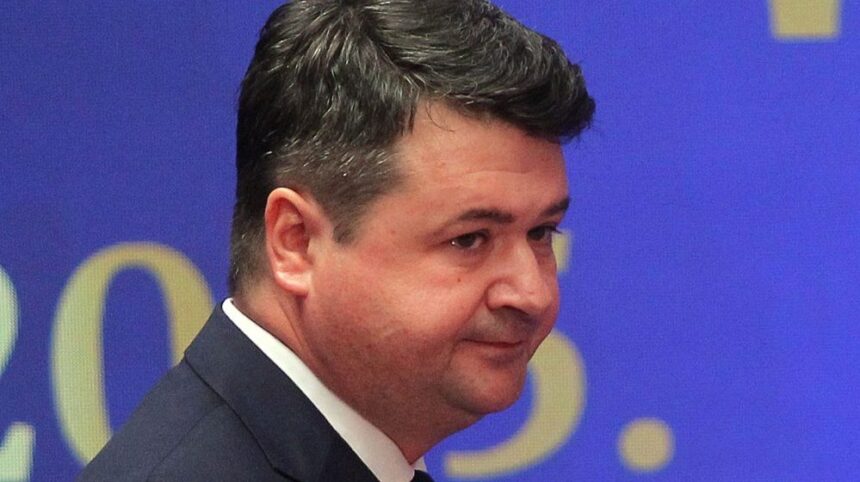
President of Serbia’s Constitutional Court Vladan Petrov has said that he initially criticized the 2013 Brussels Agreement over concerns about its compatibility with Serbia’s Constitution, but now believes the agreement has demonstrated broader significance for Serbia’s constitutional and state interests.
Speaking to Radio Belgrade, Petrov said the First Brussels Agreement, viewed strictly from the perspective of Serbia’s constitutional order, had been problematic in several respects and that he had been among those who initially criticized it.
“However, precisely from the perspective of the broader constitutional and state interest, in my view, it has stood the test of time,” Petrov said, stressing that he was referring to the significance of the agreement when it was concluded rather than its implementation.
Petrov says agreement was signed with the EU
Petrov emphasized that, in his interpretation, Serbia concluded the agreement with the European Union, rather than directly with Prishtina.
He said this distinction was particularly important for younger generations, arguing that the Brussels Agreement should not be viewed simply as an agreement between two equal parties.
“We signed that agreement with the European Union, not with Prishtina,” Petrov said, according to Beta.
He argued that the experience provided a broader lesson for future agreements: when entering into an important international arrangement, Serbia should carefully consider not only the substance of the agreement but also who is involved in guaranteeing or facilitating its implementation.
“I was not ready to understand its deeper significance”
Petrov said that, at the time the agreement was concluded, he had not fully understood what he now considers to be its deeper significance.
“Now, as someone with a certain amount of experience, I would be prepared to say that it was necessary to conclude such an agreement at the time, even if it merely remained in place and could perhaps be implemented under more favourable geopolitical circumstances,” he said.
In a separate discussion reported by Euronews Serbia, Petrov elaborated on his interpretation, saying that Serbia’s 2006 Constitution could, in his view, potentially accommodate the arrangements envisaged by the Brussels Agreement under the concept of “substantial autonomy.” He also noted that Serbia’s Constitutional Court has not ruled on the agreement’s constitutionality, having previously considered it primarily a political act outside the court’s jurisdiction.
Agreement remains central to the Kosovo-Serbia dialogue
The Brussels Agreement was reached in April 2013 as part of the EU-facilitated dialogue between Belgrade and Prishtina. Its provisions included arrangements concerning the integration of Serb-majority municipalities in northern Kosovo into Kosovo’s institutional framework and the establishment of an Association/Community of Serb-majority municipalities.
Implementation of key provisions has remained disputed, particularly over the proposed Association/Community of Serb-majority municipalities.
Petrov’s latest comments come amid continuing political and legal debate in Serbia over the agreement, its constitutional implications and the responsibilities of the parties involved in the EU-facilitated dialogue.