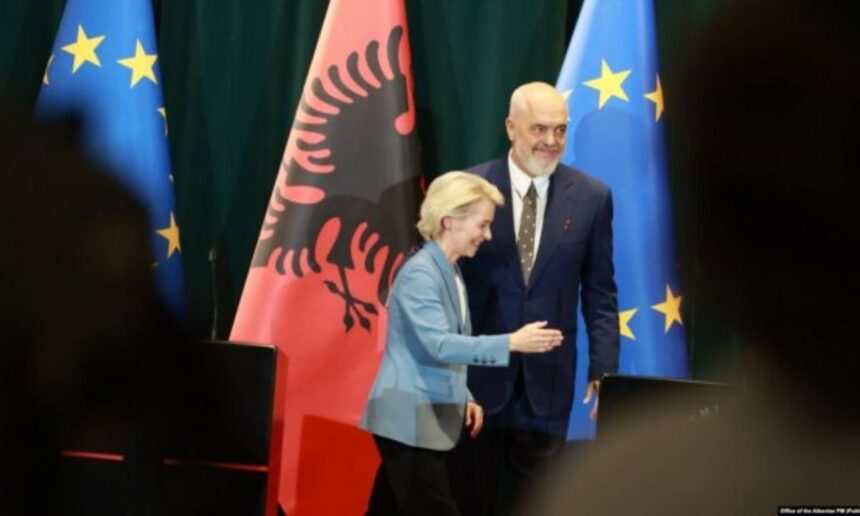
European Commission President Ursula von der Leyen called on Albania on September 30 to focus on implementing reforms across key areas, including justice, the electoral framework and environmental protection, while maintaining strong and continuous dialogue with civil society.
Von der Leyen began her tour of the Western Balkans in Tirana, where she met with Albanian President Bajram Begaj and Prime Minister Edi Rama. Speaking at a joint press conference with Rama, she described Albania as one of the leading countries in the European Union accession process.
“The objective is on the horizon,” von der Leyen said, while stressing that substantial work remains to be done.
She called for further reforms across all negotiating chapters that have been opened, particularly in the justice system, electoral framework and environmental protection.
“Adopting reforms is important, but it is equally important that they are fully implemented so that they bring real change for citizens. This requires genuine commitment beyond political divisions, as well as strong and continuous dialogue with society to address all of its concerns,” von der Leyen said.
Rama expressed what he described as an “iron will” to advance Albania’s EU accession process, saying the country has entered the phase of closing negotiation chapters.
He said he also discussed the fight against corruption and organized crime with von der Leyen, with both sides acknowledging progress made by Albania in these areas.
Investigations into senior officials and the Hyseni case
Asked about cases involving senior Albanian officials suspected or accused of corruption, von der Leyen said ongoing investigations demonstrate that the country’s system is functioning.
“When we see cases that are being investigated, this is proof that the system is functioning,” she said, describing the fight against corruption and organized crime as essential for Albania and the European Union.
Rama said that developments sometimes perceived in Albania as setbacks are viewed by the European Commission as evidence that the country is becoming a serious partner in the fight against corruption and organized crime.
“For the first time, this country has a system that has gained and continues to gain, day by day, self-correcting and self-cleansing capabilities,” Rama said, referring to the separation of powers and the ability of democratic institutions to hold one another accountable.
He stressed that officials under investigation bear individual responsibility, while his political responsibility is to ensure the continuation of judicial reform and the fight against corruption and organized crime.
Asked about the case involving former State Intelligence Service chief Vlora Hyseni, Rama said that, so far, no international partner had raised concerns with the government over potential threats to national security or Albania’s credibility in relations with its partners.
Hyseni is under investigation on suspicion of assisting a perpetrator of a crime and disclosing classified acts or information.
“The process will show whether there are or are not issues that have affected national security or the credibility related to our partners. But the news I have for you is that such a concern has not come to us so far from any partner,” Rama said.
Investigations by Albania’s Special Prosecution Office Against Corruption and Organized Crime (SPAK) have involved ministers, former ministers and senior officials at central and local institutions. The cases concern allegations including corruption, money laundering, abuse of office and other criminal offences.
Zvërnec project and environmental protests
Rama also said he briefed von der Leyen on developments surrounding the investment project in Zvërnec, which has sparked protests over environmental concerns.
“I informed her about the progress of the major investment project that has generated so much interest. We are now at the stage of awaiting the detailed environmental study, as well as the steps we have taken to significantly increase transparency with the Albanian public and government interaction with the public,” Rama said.
He pledged that all documents related to the project would be made public in the coming days.
As the meeting was taking place, dozens of protesters gathered outside the Prime Minister’s Office, calling on the European Union to listen to their concerns.
“Albania in the EU without Edi Rama” was among the slogans raised by protesters, who also called for the prime minister’s resignation.
The demonstrations initially focused on opposition to the Zvërnec project but later expanded to broader political demands, including the resignation of the government, the establishment of a transitional government and changes to the electoral system.
The Zvërnec project envisages the construction of a resort in the protected Pishë Poro–Nartë area and has prompted concerns over its potential environmental impact and land ownership issues.
In June, the European Parliament called on Albania to suspend new permits and works in protected areas until a comprehensive and independent assessment of their environmental and legal impact had been carried out. The resolution did not refer to any specific project.
EU enlargement and voting rights
Von der Leyen said the European Commission would present a review of its policies next week as part of preparations for future EU enlargement.
“We will look at our institutions, our policies, and our budget to make sure that the European Union is ready to enlarge and welcome other, new members,” she said.
According to von der Leyen, the EU will also establish roadmaps aimed at ensuring that commitments to democratic values and the rule of law continue to be respected after a country joins the bloc.
Asked whether the proposed changes would accelerate integration or restrict the rights of new member states, von der Leyen said she could not provide many details because the process was still under development.
She nevertheless emphasized the need for mechanisms to ensure that commitments remain respected after accession.
Rama, meanwhile, argued that the EU’s veto system does not serve the bloc well. He described Albania as having been affected by the mechanism and said the country would lose nothing if the veto were abolished.
The European Commission is expected to adopt its enlargement strategy on October 7. According to a draft document obtained by Radio Free Europe, candidate countries would have to meet strict membership conditions, while the EU would need to prepare institutionally, financially and politically to remain functional following enlargement.
The draft proposes mechanisms aimed at limiting the ability of new member states to block decisions during their first years of membership. It also envisages instruments that could be used if new members diverge from commitments undertaken during the accession process.
One of the most sensitive elements concerns potential restrictions on veto powers, described in the draft as a “temporary obligation concerning decision-making in the Council of the EU and the European Council.”
Under the proposal, future member states would commit not to oppose Council decisions in areas where unanimity is required. The measures remain draft proposals and have not been adopted as EU rules.
Von der Leyen did not specifically refer to the veto during her press conference in Tirana.
Following Albania, von der Leyen is scheduled to visit Kosovo and Montenegro on October 1, before concluding her Western Balkans tour in North Macedonia on October 2. According to the European Commission, visits to Bosnia and Herzegovina and Serbia have been postponed to a later date because of upcoming elections in those countries.