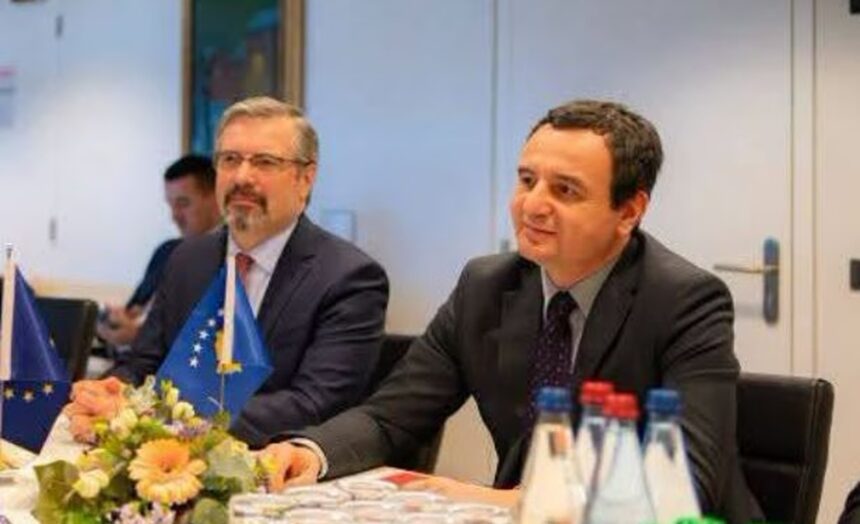
The reappointment of Agron Bajrami as head of Kosovo’s negotiating team for the technical dialogue with Serbia comes at a time when the process remains stalled, with no clear timeline for the resumption of talks.
Experts on the dialogue have differing views on its future, calling for a change in the European Union’s approach, the fulfilment of Kosovo’s obligations under previously reached agreements, and greater use of Bajrami’s diplomatic experience in relations with Brussels.
European integration professor Dritëro Arifi believes that the dialogue with Serbia should not continue unless the European Union changes its approach.
According to Arifi, Kosovo should implement the agreements it has committed to, but it must also change its approach to the process and communicate directly with the European Union. He argues that most technical issues have already been resolved and that the focus should now be on implementing the agreements reached.
“The appointment of someone like Agron Bajrami for the technical dialogue is not a problem in itself. Politically, either Mr Kurti does not understand the situation or does not want to understand it. In my view, dialogue with Serbia no longer makes sense. It should not take place until certain issues are clarified. The European Union cannot apply double standards. This must come to an end.
“Dialogue with the EU, yes. We do not need to engage in dialogue with Serbia while a minister from Milošević’s government is portrayed as a peacemaker. I have stated this position before and stand by it: you cannot build lasting peace with war criminals. History has demonstrated this time and again.
“We must therefore be clear, firm, open and honest with the European Union. We will implement all the agreements to which we have committed, but through our engagement with the EU. Our approach and narrative must change, especially following the Special Court’s decision. I believe the technical issues have largely been resolved. At least, what we have done in the north should be considered a closed chapter. What remains for us is to implement the agreement,” Arifi said.
Meanwhile, former diplomat Albert Prenkaj views Agron Bajrami’s reappointment as chief negotiator as an opportunity to maintain communication with Brussels, given his diplomatic experience and the contacts he established while serving as ambassador.
Prenkaj does not believe the appointment represents a downgrade in Kosovo’s level of representation. He argues that an ambassador represents all state institutions and can communicate with both European officials and the Serbian side.
“The ongoing institutional and constitutional crises in Kosovo, along with the electoral process in Serbia, have brought the negotiating process to a dead end. In other words, we are witnessing what could be described as a suspension of the dialogue with Serbia.
“However, in all communication Kosovo maintains with the international community, particularly with official Brussels, the EU’s High Representative for Foreign Affairs and Security Policy, Kaja Kallas, and European Commission President Ursula von der Leyen, the message is that Kosovo must assume its international responsibilities, which it undertook during the negotiations in Brussels and Ohrid in 2023.
“There are calls for us to return to negotiations. In this context, I view the reappointment of our ambassador in Brussels, Mr Bajrami, as a practical step. He already has diplomatic experience in Brussels and has established his network of contacts. The government believes that our ambassador in Brussels can serve as chief negotiator on issues that will be subject to ongoing negotiations,” Prenkaj added.
In February 2023, Kosovo and Serbia reached an agreement in Brussels on the path towards normalisation of relations. In March of the same year, the two sides agreed on an implementation annex in Ohrid.
However, in September 2023, an armed group of Serbs led by Milan Radoičić carried out the terrorist attack in Banjska, in the municipality of Zvečan.
Kosovo has accused Serbia of being behind the attack, while Belgrade has denied the allegations. Of the 45 people charged in connection with the Banjska attack, three are in the custody of Kosovo’s justice system. The remaining suspects, including Radoičić, remain at large. They are believed to be living freely in Serbia.
Radoičić was seen on Saturday at an election rally organised by a list led by former Serbian President Aleksandar Vučić.