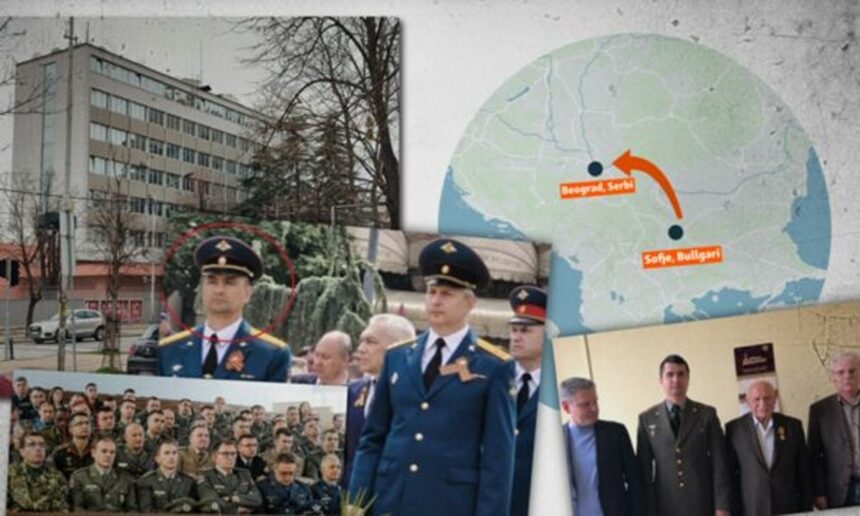
Russian diplomat Aleksandr Aleksandrovich Krasii was accredited in Serbia this year as an assistant to the military attaché, five years after Bulgarian media reported that he had been expelled from Bulgaria amid a major espionage scandal between Sofia and Moscow.
An investigation by Systema, the Russian-language investigative unit of Radio Free Europe/Radio Liberty (RFE/RL), found that leaked Russian databases indicate links between Krasii and Russia’s military intelligence service, the GRU.
Neither Bulgaria’s Ministry of Foreign Affairs nor its Prosecutor’s Office responded to RFE/RL’s requests for information about the case.
The investigation found that Krasii had been in Serbia for approximately a year after his expulsion from Bulgaria, but his name appeared on Serbia’s official diplomatic list as an assistant to the military attaché only in 2026.
His expulsion from Bulgaria took place during an investigation into a series of explosions at arms depots, in which Russian nationals were suspected of involvement. Moscow denied any role in the incidents.
Former diplomat and geopolitical and security consultant Nikola Lunić told RFE/RL that the case suggests Serbia’s institutions have not changed their approach to an issue that has been present for years.
“Security services must fulfil their constitutionally assigned duties and protect the state through security and counterintelligence measures. You [RFE/RL] highlighted this back in 2023, but the institutions took no action whatsoever,” Lunić said.
In a previous investigation published in 2023, RFE/RL identified three Russian diplomats who began diplomatic missions in Serbia after being expelled or blacklisted by European Union countries in the months following Russia’s full-scale invasion of Ukraine in 2022.
One was found to have links to a unit of Russia’s Federal Security Service (FSB) accused of cyberattacks against the US energy sector, while another had links to Russia’s Foreign Intelligence Service. One of the diplomats continues to serve in Serbia.
Bulgarian media identified the expelled diplomat
Bulgaria’s Foreign Ministry expelled another Russian diplomat in late April 2021. In a statement issued on April 29, the ministry said the expulsion was part of a series of such measures, while the Russian ambassador was summoned for talks.
Although the ministry did not publicly identify the diplomat, Bulgarian media named him as Lieutenant Colonel Aleksandr Krasii, who was serving as an assistant to Russia’s military attaché.
The private news agency Zona News and Bulgarian National Television reported the identification two days later. Zona News said it had obtained the information from its own sources, while later claiming that the public broadcaster had used its reporting without attribution.
According to Zona News, Krasii was required to leave Bulgaria by May 5 at the latest.
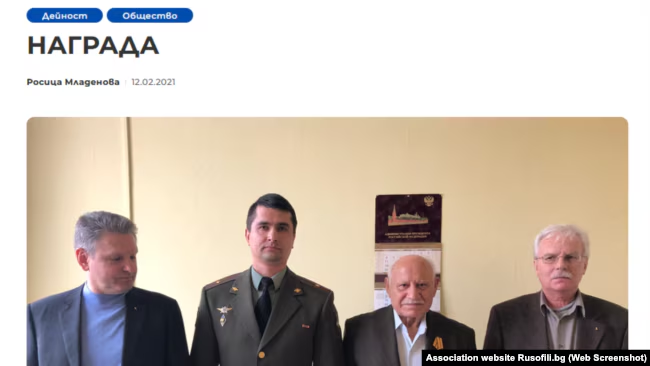
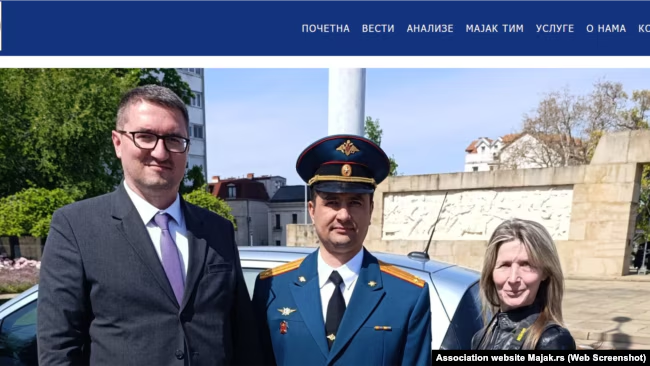
Bulgarian National Television reported that he had become a diplomat in late 2020 and arrived in Bulgaria in early 2021. During his four-month stay, he reportedly made only one public appearance: presenting a decoration on behalf of Russian Defence Minister Sergei Shoigu to an activist from a Bulgarian Russophile association.
The association published an account of the event and a photograph of Krasii with its members on February 12, 2021.
RFE/RL received no response from Bulgarian National Television or Zona News when asked how they had established Krasii’s identity. The Russophile association also did not respond to questions about his expulsion.
From Bulgaria to Serbia
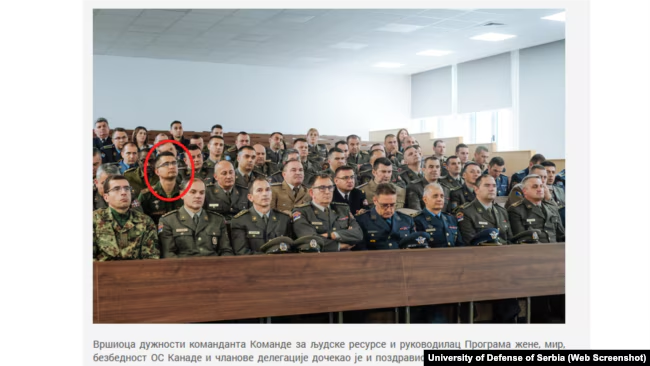
Just over a year after his expulsion, Krasii was photographed at an event at the University of Defence in Belgrade.
He appeared among instructors and participants attending advanced training at the National Defence School, a military educational institution. RFE/RL identified him partly through the insignia on his uniform, which bore the name “A.A. Krasii.”
His name appeared on Serbia’s official diplomatic list for the first time in 2026. The list, periodically updated by Serbia’s Ministry of Foreign Affairs, records accredited foreign diplomats.
That year, RFE/RL identified Krasii at two events in Belgrade.
In April, he attended a wreath-laying ceremony held ahead of a meeting of the Serbian-Russian Intergovernmental Committee for Trade, Economic, and Scientific-Technical Cooperation.
Several weeks later, in May, he was photographed participating in the “Immortal Regiment” march. The event originated in Russia, where it was first organised in 2012 to commemorate Red Army soldiers killed during the Second World War.
Serbia’s Foreign Ministry and the Russian Embassy did not respond to RFE/RL’s requests for comment on Krasii’s diplomatic assignment.
Expulsion amid investigations into explosions and poisoning
Krasii was expelled from Bulgaria while investigators were examining a series of explosions. Six Russian nationals were accused of involvement in blasts that occurred over a decade.
At the time, Bulgarian prosecutors said there were “reasonable grounds to suspect” that explosions at four arms depots and production facilities between 2011 and 2020 were connected to the 2015 poisoning of Bulgarian arms dealer Emilian Gebrev, as well as an explosion at ammunition depots in the Czech Republic in 2014.
A spokesperson for Bulgaria’s Prosecutor General said investigators could conclude that “the aim of the actions of the Russian nationals was to disrupt the supply of specialised products to Georgia and Ukraine.”
In 2015, Gebrev began vomiting during dinner at a restaurant in Sofia. He was taken to a military hospital, where he experienced severe hallucinations and fell into a coma. His son and the director of EMCO, the arms-trading company owned by Gebrev, also became suddenly ill.
Gebrev eventually recovered.
Investigators subsequently linked the case to the Czech Republic. In 2021, Czech authorities accused Russia’s GRU military intelligence service of orchestrating sabotage in October 2014 in the town of Vrbětice, where an explosion involving 50 tonnes of ammunition killed two people.
Bulgaria’s Prosecutor’s Office did not respond to RFE/RL’s questions about the status of the investigation or whether Krasii was also implicated.
Addresses point to possible links with Russian intelligence officers
According to Systema’s investigation, Krasii’s addresses in leaked Russian databases provide further indications of links to Russian military intelligence.
In several leaked databases, including Russia’s Gosuslugi government services database, records from the private laboratory network Gemotest and a health-insurance database, Krasii listed his residential address as 4 Devichye Pole Street in Moscow.
The address does not correspond to a residential building. It is the headquarters of the Combined Arms Academy of the Armed Forces of the Russian Federation, one of Russia’s principal military educational institutions.
Krasii appears to have provided a different address only on a limited number of occasions.
One example was his application for so-called COVID travel permits introduced in Moscow in 2020 during lockdown restrictions. Applicants were required to specify their departure and destination addresses.
In all five permits issued to Krasii in the spring of 2020, his departure point was an address on Marshal Biryuzov Street. The building number was omitted once, listed as number 2 once, number 7 once and number 4 twice.
Investigative journalists say the last address contains apartments for the families of officers studying at the Military Diplomatic Academy, informally known as the “Conservatory.”
Many officers and future GRU operatives have graduated from the academy and lived at the address. Among them was Anatoly Chepiga, who participated in the attempted poisoning of former Russian double agent Sergei Skripal in Salisbury, England, in 2018.
Bulgarian media reported that Krasii had already been assigned to Russia’s consulate in Bulgaria by late 2020, suggesting that the posting may have followed his studies at the academy.
Leaked records also indicate that Krasii spent almost two years, from 2013 to 2015, in the Russian town of Gorny in Zabaykalsky Krai.
Gorny is one of approximately 40 closed towns in Russia, where access requires special permission. Until 2002, it housed the 4th Strategic Missile Division of Russia’s Strategic Rocket Forces.
The division was subsequently disbanded. Official records indicate that several Russian military units remain in Gorny, none of which are currently linked to strategic missiles or nuclear weapons. Nevertheless, the town retains its restricted status.
This is not the first known case of a GRU officer serving abroad under diplomatic cover who previously lived in a closed Russian military town.
Yuri Mikheev, a GRU officer operating under diplomatic cover in African countries, lived from 2010 to 2015 in the closed town of Ozerny in the Tver region. Like Gorny, Ozerny has links to Russia’s Strategic Rocket Forces.
Another expelled Russian diplomat remains in Serbia
Krasii is not the only Russian diplomat to have taken up a post in Serbia after being expelled from an EU country.
Hundreds of Russian diplomats were expelled or blacklisted by EU member states in the months following Russia’s 2022 invasion of Ukraine.
RFE/RL found that at least three of these diplomats subsequently became accredited Russian representatives in Serbia, including two with links to Russian intelligence services.
Serbia did not expel Russian diplomats in 2022. Unlike most European countries, it did not impose sanctions on Moscow and has continued to maintain close relations with Russia.
Among the diplomats identified was Alexey Ivanenko, who appeared on Serbia’s diplomatic list after being expelled from Croatia in 2022.
Leaked Russian government databases indicate that Ivanenko worked as an “engineer” in military unit 71330, another designation for the Russian FSB’s 16th Centre.
Ivanenko remains on Serbia’s latest diplomatic list, published in September 2026.
Serbian authorities did not respond to RFE/RL’s investigation in 2023.
Serbia described as a potential hub for Russian intelligence activity
Former diplomat Nikola Lunić told RFE/RL that the presence in Serbia of Russian diplomats expelled elsewhere raises concerns that Belgrade is becoming a “hub for Russian intelligence activities.”
“Serbia has created an environment in which Russia can maintain diplomatic capabilities it is losing in parts of the European Union. As a result, Russia’s diplomatic presence is growing, which is generally accompanied by an expansion of its intelligence capabilities,” Lunić said.
RFE/RL’s 2023 investigation found that the number of Russian diplomats in Serbia had increased between 2022 and 2023, while EU countries were expelling Russian representatives in response to the invasion of Ukraine.
The number has since risen further.
Serbia’s diplomatic list for September 2026 includes 79 Russian diplomats, compared with 62 in 2023.