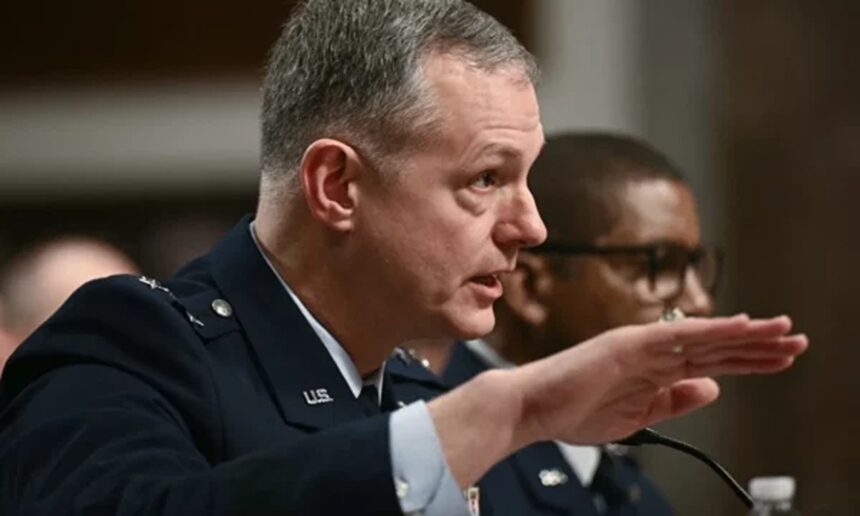
NATO’s Supreme Allied Commander Europe, US General Alexus Grynkewich, is expected to send a clear message to Russia on Monday, stressing that the Alliance is prepared to confront and defeat any potential attack.
NATO officials said Grynkewich will outline his concept of victory in the event of a possible attack during a security conference in Warsaw, as concerns over the Russian threat to Europe continue to grow.
The senior military commander’s remarks come as NATO seeks to send Moscow a message to halt what Western officials describe as a “hybrid” campaign of sabotage and interference targeting countries supporting Ukraine in its war against Russia.
Concerns have intensified in recent months following a series of high-profile incidents, including the discovery of a drone carrying explosives at a German airport. Western officials warn that such actions are becoming increasingly brazen and could result in mass casualties.
“The Supreme Allied Commander Europe’s theory of victory is simple: preserve NATO’s advantage, consistent with the Alliance’s deterrence and defence plans,” Colonel Martin O’Donnell, a spokesperson for the US general, said last week.
He added that, given the complex and volatile global security environment, the Alliance must establish the necessary conditions now to deter aggression and, if required, prevail in the event of an attack.
According to O’Donnell, the theory provides a framework for achieving that objective, Telegrafi reports.
Founded after the Second World War to counter the Soviet Union, NATO has traditionally kept its defence plans for a potential Russian attack classified.
For this reason, Grynkewich’s address is not expected to reveal many new details about the Alliance’s military strategy. Instead, it is primarily intended to send a signal to Moscow and reassure NATO’s eastern-flank members that their defence remains a priority.
The Alliance maintains that it is a defensive organisation and has no intention of attacking Russia.
However, Western officials warn that Moscow’s hybrid operations have become increasingly reckless, even as Russian forces continue to face difficulties in Ukraine. They say these actions could cause significant loss of life and increase the risk of uncontrolled escalation.
NATO, whose primary objective is to deter a Russian armed invasion, is struggling to determine the most effective response to incidents occurring in the grey zone between peace and open conflict.
Such activities may include sabotage, interference and other operations designed to weaken an adversary without necessarily triggering a direct military confrontation.
NATO Secretary General Mark Rutte has urged member states to remain calm and continue supporting Ukraine.
“We should not be naive about Russia, but they know that we are stronger,” Rutte said last month.
The increase in Russian activity comes as Europe faces uncertainty over the future of US military support.
European allies are preparing for the possibility of a reduced American troop presence on the continent, while the Pentagon reviews how its forces are deployed across Europe.
The findings of that review are expected to be made public towards the end of the year.
Meanwhile, European countries are accelerating efforts to strengthen their armed forces and expand their defence capabilities, amid growing doubts about the continuity and reliability of US commitments under President Donald Trump.
Grynkewich’s anticipated warning in Warsaw is therefore intended to reaffirm NATO’s military readiness at a time when hybrid threats, the war in Ukraine and uncertainty over US engagement are reshaping Europe’s security calculations.