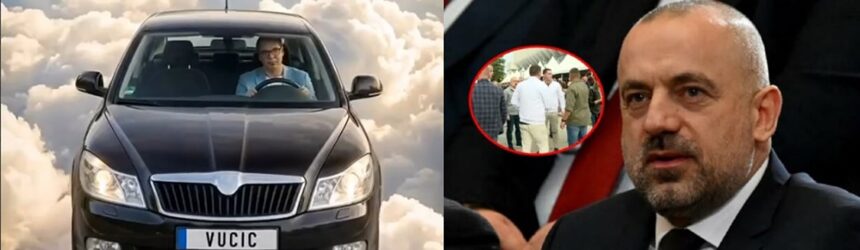
Aleksandar Vučić has turned a 2006 Škoda Octavia into the centrepiece of his election campaign, hoping to convince voters that, after years in power, he is just an ordinary man driving from town to town. But while Serbia’s political machinery works overtime to promote this image, more uncomfortable questions remain about his security convoys, the helicopter controversy and the people who continue to appear around his political circle.
The irony is difficult to ignore. Vučić wants the public to focus on an old car, while the wider picture includes black SUVs, flashing lights, heavy security and the continued public appearance of Milan Radoičić, the former deputy leader of the Serbian List who accepted responsibility for organising the armed group involved in the September 2023 Banjska attack.
And Radoičić’s latest appearance has made the contrast even harder to ignore.
On October 9, 2026, Serbian media outlet N1 filmed Radoičić at the Serbian Progressive Party’s (SNS) pre-election rally in Kragujevac, standing alongside Danilo Vučić, the son of Aleksandar Vučić. Danilo arrived with several vehicles displaying flashing lights, according to N1’s reporting. The footage places Radoičić in the company of the president’s son at a major ruling-party campaign event.
Radoičić is wanted by Interpol in connection with the Banjska case, in which Kosovo Police officer Afrim Bunjaku was killed. He accepted responsibility for organising the group involved in the armed confrontation. Yet his appearance at an SNS rally raises a basic question: how can a man wanted in connection with such a serious case appear publicly at a ruling-party event in Serbia while Kosovo continues to seek accountability?
The footage does not, by itself, establish the nature of Radoičić’s relationship with Danilo Vučić or prove that the Serbian leadership directed the Banjska attack. But it does make the public proximity between a wanted figure and the president’s family a legitimate matter of scrutiny. Kosovo’s government has described Radoičić’s presence at the rally as further evidence supporting its allegations of Serbian state involvement in Banjska, while Serbia has yet to bring an indictment against him in connection with that attack, according to Radio Free Europe’s reporting.
Against this backdrop, Vučić’s carefully staged Škoda videos look less like an innocent display of modesty and more like a distraction from questions his campaign would rather not answer.
The controversy over his journey to Kragujevac began after footage showed a helicopter landing near the FC Kolonija premises, followed by a protected individual heading towards several black vehicles. The person’s identity was not officially confirmed. Vučić denied travelling by helicopter and insisted that he had driven his Škoda, dismissing the allegations as lies.
Senior officials and pro-government accounts quickly joined the defence. The Interior Ministry and Serbian Army also issued statements saying Vučić had not used their helicopter. Vučić subsequently published videos of himself supposedly driving the Škoda, but the carefully framed footage did little to answer the wider questions about his travel arrangements.
There is another uncomfortable detail. According to publicly available asset declarations cited by Danas, Vučić did not report owning a car between 2012 and 2026. Meanwhile, KRIK’s database lists the Škoda as belonging to his brother, Andrej Vučić. These records raise questions about the ownership of the vehicle that has become such a prominent campaign symbol.
Residents have also challenged the carefully constructed image. Dragan, from Bačka Palanka, told Danas that he and others tried to see Vučić driving the Škoda but were prevented from doing so by police. Instead, he said, a convoy of more than ten black armoured vehicles with flashing lights passed through the area. They did not see the Škoda.
Political scientist Cvijetin Milivojević has described the campaign as improvised, arguing that Vučić is attempting to present himself as closer to ordinary citizens while relying on a political and media apparatus that amplifies his every move.
But the bigger question goes beyond a car. It concerns a political system in which the leader’s image receives extraordinary attention while questions about accountability remain unresolved.
Vučić wants voters to see a modest driver behind the wheel of an old Škoda. Yet the public is also seeing Radoičić, wanted in connection with Banjska, appearing at an SNS rally beside the president’s son. The two stories are not proof of the same thing, but together they expose a striking contrast between the image the ruling party promotes and the questions its critics continue to raise.
An old Škoda may help sell the image of an ordinary man. It cannot answer why Radoičić remains publicly present at ruling-party events, why accountability over Banjska remains unresolved in Serbia, or why citizens say they were prevented from seeing the president on the road.
Serbia’s voters deserve more than campaign theatre. They deserve clear answers about political influence, public resources, security arrangements and the people who continue to move freely within the ruling party’s orbit.