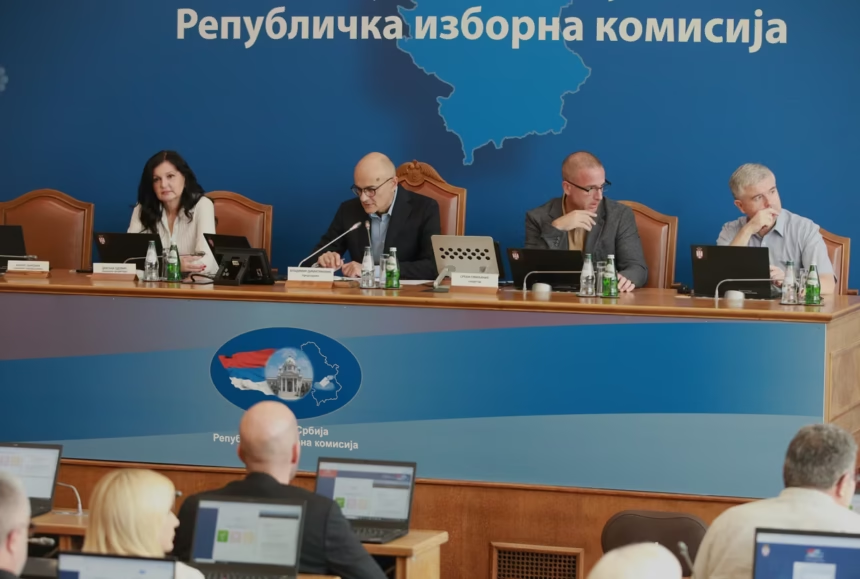
Serbia’s Republic Electoral Commission (RIK) has declined to include on its meeting agenda a proposal calling for the urgent collection of data from the Interior Ministry on valid identity cards and an explanation of discrepancies in official statistics.
The proposal, submitted by several RIK members, received eight votes in favour, one against and 20 abstentions during a meeting on Wednesday evening.
RIK member Tanasije Marinković criticised the decision, arguing that the proposal had been submitted on time and should have been included on the agenda.
“This is not an initiative; it is a formal proposal. We are obliged to put it on the agenda. Whether we adopt the proposed measure or not is a separate matter,” Marinković said. He added that RIK President Vladimir Dimitrijević had been obliged to include it.
RIK member Marko Živanović later explained the proposal under the miscellaneous agenda item. He said he wanted the commission to ask the Interior Ministry for information concerning data from the Electoral Register Audit Commission, particularly what he described as an unexplained increase in the number of identity cards held by adults between May and September.
According to Živanović, the number of identity cards rose from 5,988,000 in May to 6,225,000 in September—an increase of approximately 237,000.
He said the increase represented around five percentage points of the electorate if voter turnout reached four million people.
Živanović stressed that his proposal was intended to prevent further doubts about the integrity of Serbia’s electoral process.
“I do not know why there is an excess of identity cards. Perhaps there is a logical explanation. I have not prejudged the issue, but now it will become a problem,” he said, expressing disbelief that the commission had been unable to request the information from the ministry.
RIK deputy member David Krstić cited the case of a voter who received two polling notifications bearing different numbers from the voter register. He said the commission should contact the Ministry of Public Administration and Local Self-Government, which is responsible for maintaining the unified voter register, to establish how many similar cases exist.
Krstić criticised state institutions for failing to provide the commission with requested information, saying it was time to put an end to what he described as their disrespect towards RIK. He also told members of polling boards that they represented the last line of defence against irregularities in the voter register and could help prevent them by carrying out their duties conscientiously.
Marinković also asked when instructions on election-related training would be adopted, noting that this was among the priority recommendations of the OSCE Office for Democratic Institutions and Human Rights (ODIHR).
He further argued that acting Serbian President Ana Brnabić should already have called a presidential election. Marinković pointed out that the law governing presidential elections requires people appointed to election administration bodies to hold valid certificates confirming their qualifications to serve on local election commissions or polling boards.
“This may seem like a minor issue to you, but it is actually very important. It concerns how we are violating the law,” he said.
The dispute comes amid wider concerns over discrepancies in voter-related data and calls for greater transparency in Serbia’s electoral administration.