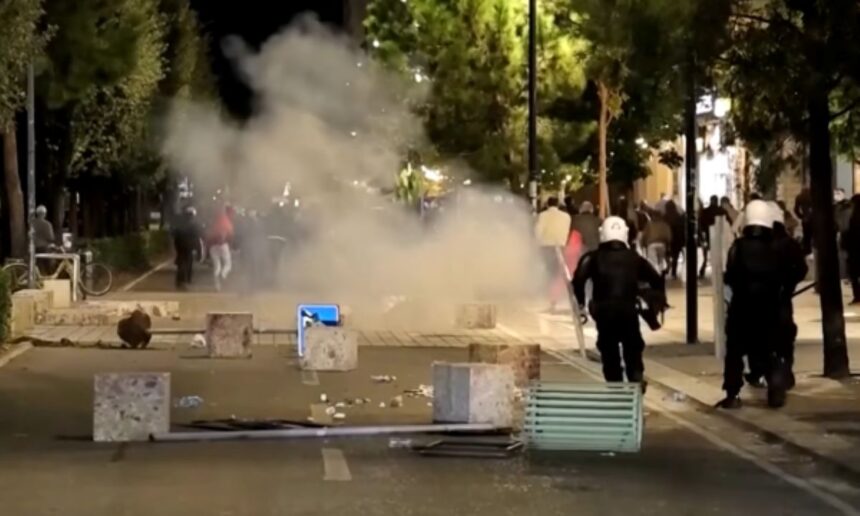
Tens of thousands of students took to the streets of Tirana, Albania’s capital, in protests against rising education costs and corruption, with demonstrators setting fire to a government building and two banks and throwing stones at police, according to The Guardian.
Police responded with water cannons and tear gas as protesters set fire to the Ministry of Education building, overturned rubbish bins and damaged the facades of local businesses. A nearby branch of Raiffeisen Bank also caught fire, the British newspaper reported.
Authorities said 23 police officers and six other people were receiving medical treatment for injuries, while 35 people had been detained, according to Sinjali.
Albanian President Bajram Begaj condemned the violence and called for calm, stressing that constitutional and legal principles must be respected by everyone.
“The Constitution and the law must remain the boundaries for everyone, without exception,” Begaj said.
The unrest marks the most violent escalation so far in protests against Prime Minister Edi Rama, who secured a fourth term in office in May 2025. His government has faced growing public discontent over perceived corruption involving senior officials.
The demonstrations follow a summer of largely peaceful protests against Rama, initially triggered by a proposed luxury resort development along Albania’s largely untouched southern coastline, backed by Jared Kushner, the son-in-law of US President Donald Trump. The project has been the subject of legal disputes.
“This is a revolution. We are tired of peaceful protests. We will not stop until Rama resigns,” Lora, a student who declined to provide her surname, told The Guardian while throwing stones at police.
Other demonstrators chanted “Resignation” and slogans accusing the police of being linked to crime.
Student organizers said the demonstrations were driven by concerns about university conditions, the rising cost of higher education, inadequate financial support and limited employment prospects after graduation.
Albanian media also reported that Wednesday’s protests had spread to universities in Elbasan and Shkodër.
The unrest comes amid a broader wave of student activism across Europe, where young people have been protesting over education standards and living conditions. In France, secondary-school students have organized weeks of demonstrations and school blockades, demanding more teachers and better facilities.
Government and EU call for restraint
The Albanian government condemned the violence while acknowledging the right to peaceful protest.
Deputy Prime Minister Albana Koçiu said demonstrations could not be used to justify violence or the destruction of public and private property.
“Protest is a legitimate right, but it cannot be used as a justification for violence, the destruction of the city or ugly street clashes,” Koçiu wrote on Facebook, urging students and citizens who support the right to protest to distance themselves from violence and vandalism.
Albanian police also called for calm, warning that anyone who used violence, set fires, destroyed property or attacked officers would be held individually accountable under the law.
The European Union, which Albania hopes to join, expressed concern over what it described as a “violent escalation” during the demonstrations in Tirana.
In a statement, the EU Delegation in Tirana said it had taken note of allegations of excessive police force against protesters and journalists. It called for a swift investigation and urged all sides to reduce tensions.
The protests highlight mounting public frustration over education costs, university conditions and allegations of corruption, while the clashes have raised further questions about the authorities’ handling of demonstrations and the protection of the right to peaceful assembly.