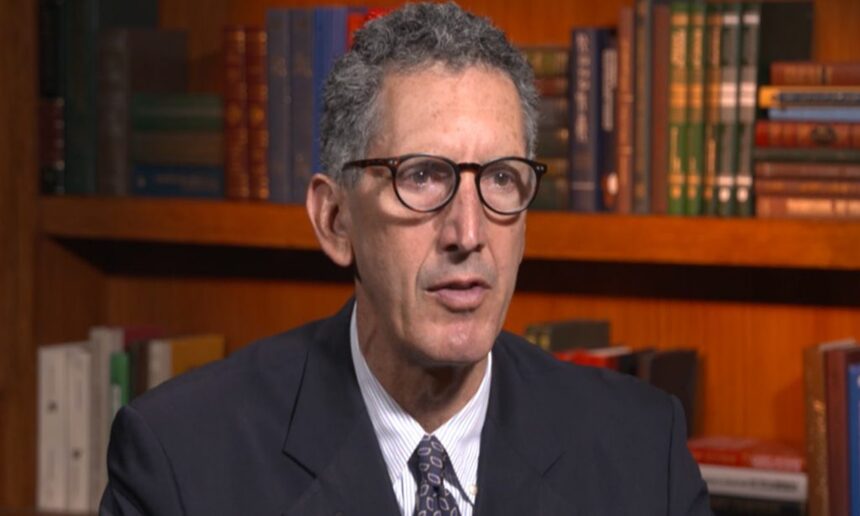
American professor Edward Joseph has said in an interview that the European Union should address its concerns over amendments to the Law on Specialist Chambers privately, while emphasizing that Kosovo has the right to criticize the court. Joseph also discussed Kosovo’s relations with the EU and the United States, the vote on the law, and the election of President Justina Shiroka Pula.
The American professor described the European Union’s public criticism of Kosovo over amendments to the Law on Specialist Chambers as misguided, arguing that such an approach makes dialogue more difficult and creates an opportunity for Serbia to gain political advantage.
“As I have stated publicly before, I believe that these public criticisms by the European Union are wrong. Marta Kos knows very well that Kosovo is engaged in a dialogue. The EU continues to push the dialogue forward, yet by publicly criticizing Kosovo’s right to criticize the Specialist Chambers, it is making that very process more difficult,” Joseph said.
He stressed that the European Union has the right to express concerns and raise objections regarding the law, but argued that these matters should be addressed through private communication.
“These issues should be handled privately. If the EU has concerns—and it is entirely legitimate for the EU to have concerns and objections regarding the law—then it should express them privately. It should do so behind closed doors, because Serbia is benefiting from these public criticisms and has also benefited from the verdict,” he stated.
Joseph also criticized what he described as the European Union’s lack of response to the celebration and glorification of convicted war criminal Ratko Mladić in Serbia.
“Meanwhile, the EU has done nothing about Serbia’s celebration and glorification of Ratko Mladić, who was the most notorious war criminal in the entire Balkans. The EU has an issue with Mladić and should address this matter before publicly criticizing Kosovo over this law,” Joseph emphasized.
Asked whether Kosovo’s relations with the European Union could be jeopardized by the issue, he said he did not believe the situation was that serious and that both sides should engage in discussions to find a solution.
“I do not think the situation is that serious. I believe Kosovo and the European Union should discuss this issue, and I think a positive outcome can, in fact, be achieved,” he said.
According to Joseph, mechanisms and established formats exist through which Kosovo and the EU can address their disagreements. However, Brussels must understand that the Specialist Chambers are not beyond criticism.
“I believe this issue can be moved forward because there are channels and formats through which these questions can be addressed. Nevertheless, there is one fundamental point the EU must understand: the Specialist Chambers are not above criticism. They are not above criticism,” Joseph stressed.
He added that Kosovo has the right to criticize the Specialist Chambers and claimed that European Commission President Ursula von der Leyen had also acknowledged Kosovo’s right to amend the law.
“ Kosovo has the right to criticize them. In fact, even European Commission President Ursula von der Leyen has stated here that Kosovo, as a sovereign state, has the right to amend its law. Von der Leyen has said this as well,” he stated.
Joseph underlined that it is legitimate to hold the institutions of the Specialist Chambers accountable and that their work should be open to questions and criticism.
“This is precisely the key point that must be understood in Brussels: it is legitimate to hold the Specialist Chambers accountable, and it is right to raise questions about their work,” the American professor said.
Commenting on the vote on the law, Joseph said it had received overwhelming support, although the Democratic League of Kosovo (LDK) did not vote in favor.
“The vote was carried by a very substantial majority in favor of the law. The LDK did not vote in favor of it, but there is nevertheless a broad national consensus, which is also reflected in the working group,” he said.
Joseph spoke positively about the work of the working group, saying it could contribute to a constructive process, while responsibility for addressing the issue rests with the Government of Kosovo.
“I believe the working group is a positive development and could prove constructive. It is now up to the Government of Kosovo to work professionally,” he emphasized.
He reiterated that the Government of Kosovo should initiate discussions with international partners, particularly the European Union and the United States.
“And, I repeat, I believe the key is for the Government of Kosovo to open a dialogue on this issue with the European Union, but also with the United States. I believe the United States is involved in this matter as well, and I think it may be receptive to the concerns and questions raised by Kosovo. I believe the EU should demonstrate the same willingness,” Joseph said.
At the end of his interview with Ekonomia Online, the American professor also spoke about the election of Kosovo’s new president, Justina Shiroka Pula, and the potential impact of her election on the country’s relations with the United States and the European Union.
Joseph expressed satisfaction with her election, describing it as a positive step for Kosovo. He revealed that he had had the opportunity to meet the president the previous day.
“I must say that I am very pleased. The election of President Shiroka Pula is a very positive step for Kosovo. I had the honor of meeting her yesterday in her capacity as President of the Republic of Kosovo. It was a great honor for me,” Joseph said.
The American professor added that he had formed a very positive impression of the new president and called on Kosovo’s citizens and political leaders to support her in carrying out her duties.
“I have a very positive impression of President Shiroka Pula, and I believe that the citizens and political leaders of Kosovo should support her in her role as president. I am confident that she will be a dynamic and trustworthy leader for all the citizens of Kosovo,” Joseph added.