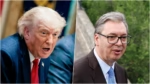
U.S. President Donald Trump said his decision to suspend certain sanctions against Russia was intended to keep Moscow engaged in negotiations to end the war in Ukraine.
“I am in the process of negotiating peace in the Russia-Ukraine war,” Trump wrote on his Truth Social platform, adding that he did not want to do anything that could, as he put it, “thoughtlessly” push Russia away from the negotiating table.
On Friday evening, Trump blocked a package of sanctions against Russia just two days before the measures were due to take effect. The decision came amid growing tensions between Trump and Ukrainian President Volodymyr Zelensky.
Speaking to NBC News on Sunday, Zelensky warned that siding with Russian President Vladimir Putin would be a “historic mistake.”
Russian envoy Kirill Dmitriev welcomed Trump’s decision, describing it as “an important and truly historic moment.” He argued that the sanctions, approved by the U.S. Congress and signed into law by the president in September, would have caused “serious damage” to the American economy and global markets.
U.S. Secretary of State Marco Rubio described the suspension as a 60-day pause during which officials would assess the potential impact of the sanctions on the U.S. and global economies, according to the BBC.
In his Truth Social post, Trump also accused Zelensky of not wanting to end the war, claiming that the Ukrainian president “may never have wanted to” reach peace. Trump added that Zelensky could have secured a better agreement two years ago than he could obtain now.
Zelensky has repeatedly called for an end to the fighting and maintained that Putin does not want peace. Russia launched its full-scale invasion of Ukraine in February 2022.
Relations between Washington and Kyiv have come under further strain following a reported controversial agreement last week involving U.S. imports of Russian diesel.
Despite international sanctions, Russia has continued exporting oil, primarily to China and India, often at significantly reduced prices. According to the Centre for Research on Energy and Clean Air (CREA), China accounted for approximately half of Russia’s crude oil exports, while India accounted for around 37 percent.
At a European Union summit, following Trump’s announcement concerning Russian diesel imports and his remark that Zelensky was “more difficult to deal with” than Putin, the Ukrainian president said he was pleased to be among “real leaders.”
The dispute over sanctions and energy trade underscores the continuing divisions among Western allies over how to maintain pressure on Moscow while pursuing negotiations to end the war.