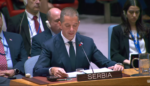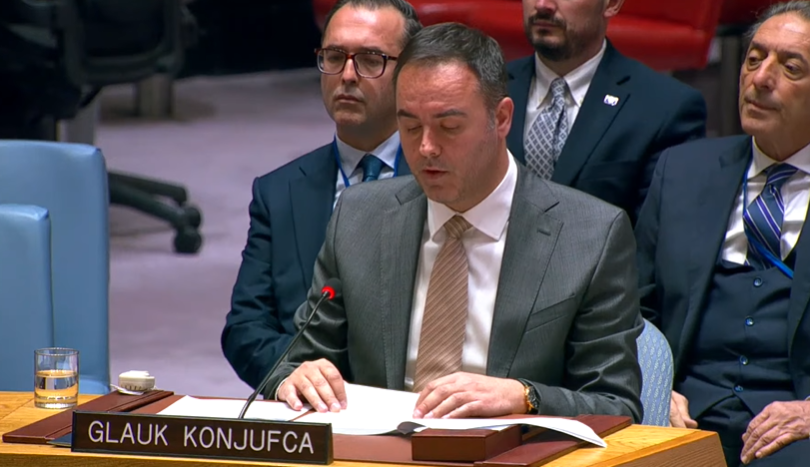
Kosovo’s Minister of Foreign Affairs and Diaspora, Glauk Konjufca, has sharply criticised the latest UNMIK report on Kosovo, describing it as biased and containing elements of disinformation that, in his view, echo Serbian propaganda.
Addressing the United Nations Security Council, Konjufca argued that the report misrepresents actions taken by Kosovo’s institutions to enforce the law, portraying them as ethnically motivated or as violations of the rights of Kosovo Serbs.
According to Konjufca, the report fails to adequately reflect improvements in the security situation in northern Kosovo. He noted that KFOR had optimised the deployment of its forces in response to improved security conditions, creating opportunities for Kosovo’s institutions to strengthen their presence and direct cooperation with Serb residents.
Konjufca Criticises Report’s Treatment of Banjska Attack
Konjufca expressed particular dissatisfaction with the report’s handling of the armed attack in Banjska on September 24, 2023. Kosovo’s institutions have accused Serbia of organising and supporting the attack.
“It is disappointing that many such cases addressed in the UNMIK report are based primarily on Serbian propaganda. It is unfortunate that even the paramilitary attack in Banjska, organised, orchestrated and supported by official Belgrade through Radoičić, is mentioned in this report as a violent incident rather than what it was — a terrorist attack,” Konjufca said.
He maintained that incidents presented in the report as politically or ethnically motivated did not necessarily have an ethnic dimension.
The minister also challenged the report’s characterisation of certain Kosovo Police actions as arrests or persecution targeting Serbs. He argued that the individuals involved had been taken into custody or questioned in accordance with applicable law.
According to Konjufca, some of the cases concerned the alleged misuse of festive and religious events to spread messages that he said encouraged hatred and division, undermining interethnic integration in Kosovo.
Dispute Over Reported Incidents at Religious Sites
Konjufca also criticised the report’s treatment of incidents reported at religious sites in Kosovo.
He said the Kosovo Police had opened investigations into every recorded incident but argued that there was no evidence demonstrating that the acts had been committed by Albanians or motivated by ethnic tensions.
On that basis, he questioned the classification of these cases as ethnic incidents, claiming that such characterisations relied heavily on reports from Serbia and its Office for Kosovo.
The minister argued that the report gave disproportionate attention to alleged incidents at several religious sites without sufficiently acknowledging the absence of evidence establishing either the perpetrators’ ethnicity or an ethnic motive.
Calls for UN Secretary-General Not to Endorse Report
At the end of his address, Konjufca called on the UN Secretary-General to exercise caution and refrain from endorsing the report, which he described as disorganised and one-sided.
“We call on the Secretary-General to exercise caution and refrain from endorsing a distorted, one-sided narrative in the UNMIK report that echoes Serbian propaganda. Accurate reporting is essential to ensure that this mission does no harm, despite having remained in place for so long,” Konjufca said.
He stressed that impartial and accurate reporting was crucial to preventing misrepresentations of the situation in Kosovo and ensuring that UNMIK did not negatively affect developments in the country.
His remarks highlight continuing disagreements between Kosovo’s authorities and UNMIK over how security developments, law enforcement and incidents involving religious sites are documented and interpreted in reports submitted to the Security Council.