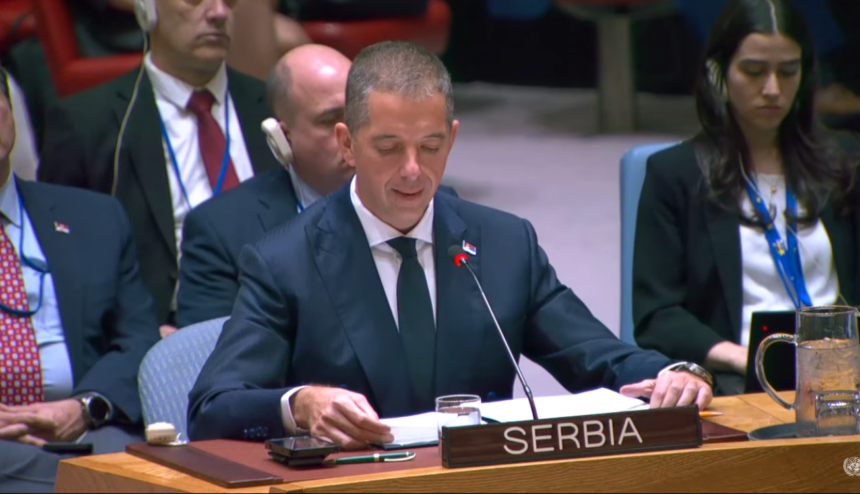
Serbian Foreign Minister Marko Đurić has called for justice for all victims of the Kosovo war while criticising Kosovo Prime Minister Albin Kurti and Albanian President Bajram Begaj for their reactions to the first-instance verdict against former Kosovo Liberation Army (KLA) leaders.
Addressing the United Nations Security Council meeting on Kosovo, Đurić referred to former Kosovo President Hashim Thaçi and former KLA commanders Kadri Veseli, Rexhep Selimi and Jakup Krasniqi, who were found guilty on September 16 of crimes against humanity, including arbitrary detention, torture, cruel treatment and murder, according to his remarks.
He said the verdict concerned, among other crimes, the killing of 96 people, adding that justice remained incomplete while many families continued to seek answers about their loved ones.
“Their names are known to this Council: Hashim Thaçi, Kadri Veseli, Rexhep Selimi and Jakup Krasniqi. The judges found them responsible for crimes against humanity, including arbitrary detention, torture, cruel treatment and murder,” Đurić said.
He argued, however, that justice had not gone far enough, pointing to other cases involving the killing and persecution of Serbs and non-Albanians in Kosovo, including the killings of Serb harvesters in Staro Gracko, the killings around Lake Radonjić, and the displacement of Serbs and other non-Albanian communities.
Đurić Criticises Reactions in Prishtina and Tirana
The Serbian foreign minister said the suffering of victims from different ethnic communities should not be reduced to a single national narrative, claiming that both Serbs and Albanians had experienced persecution, abductions, killings and displacement during the conflict.
He also referred to attacks on Serbian Orthodox churches, monasteries and religious heritage, arguing that the suffering of Kosovo Serbs should not be excluded from historical accounts for political reasons.
Đurić then criticised the responses of Kurti and Begaj following the verdict against the former KLA leaders.
“Instead of calling for reflection, some of the most prominent political figures in Prishtina and Tirana responded by attacking the verdict and celebrating the men who had been convicted,” he said.
Đurić cited Kurti’s description of the sentences as an unacceptable injustice and referred to Begaj’s statement that nothing could tarnish the KLA, alongside the slogan “Freedom Has a Name.”
“Victims have names, too,” Đurić said, arguing that their suffering should not be treated as secondary to national narratives.
He stressed that criminal responsibility was individual and that the verdict did not establish collective guilt for the Albanian people. He also acknowledged that Albanian families had suffered crimes committed by different actors, including members of the KLA.
However, he argued that defending the right to a fair trial was different from rejecting a court’s authority to convict individuals regarded as national heroes.
Serbia Raises Concerns Over Specialist Chambers
Đurić also criticised amendments adopted by Kosovo’s Assembly that he said sought to restrict the mandate of the Kosovo Specialist Chambers.
He referred to the European Union’s reported concerns that such actions were inconsistent with Kosovo’s international obligations, emphasising the importance of judicial independence and witness protection.
The Serbian minister questioned how witnesses who had risked their families’ safety to testify could trust the justice system if political leaders condemned court findings and then attempted to change the rules governing the institution.
He called on those who established and supported the Specialist Chambers to ensure that crimes against Serbs and other victims were not overlooked, witnesses remained protected, and political interference did not obstruct judicial proceedings.
Serbia Calls for Justice for All Victims
Presenting Serbia’s position, Đurić said Belgrade sought justice for every victim, regardless of ethnicity.
“Not a Serbian version of justice, not an Albanian version of justice. Justice that is the same for everyone,” he said.
He also referred to demonstrations held in support of the former KLA leaders following the verdict, including protests in Prishtina, The Hague, New York and other European cities.
During his address, Đurić cited a statement attributed to presiding judge Charles Smith, who he said had invoked historian Howard Zinn to argue that national flags could not shield individuals from responsibility for war crimes.
Đurić thanked UN Secretary-General António Guterres, UNMIK chief Peter Due and the mission’s staff for their work, arguing that UNMIK continued to play an important role by listening to people whose experiences, he claimed, were often insufficiently represented in international reports.
He concluded by referring to the report’s description of the situation in northern Kosovo as “calm but fragile.”