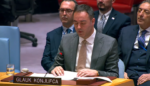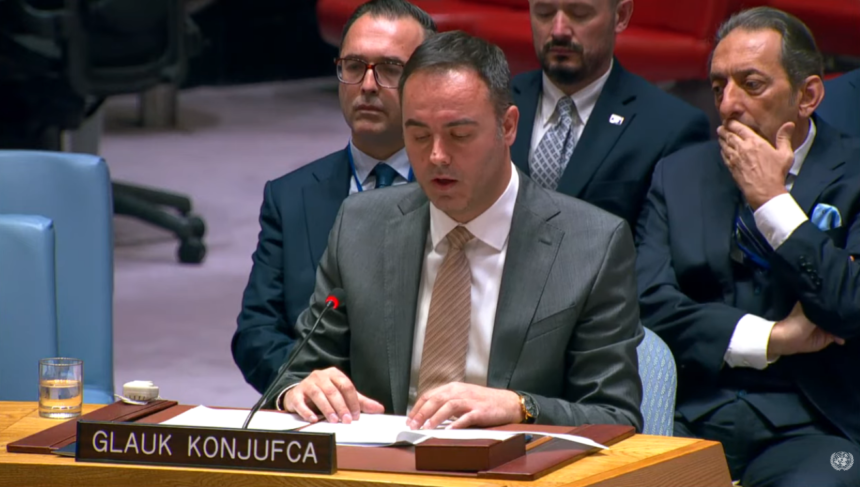
Kosovo’s Minister of Foreign Affairs and Diaspora, Glauk Konjufca, has accused Serbia of continuing to threaten Kosovo’s sovereignty, failing to ensure accountability for the 2023 Banjska attack and discriminating against ethnic Albanians in Serbia’s Preševo Valley.
Speaking at the United Nations Security Council meeting on Kosovo on Tuesday, October 20, Konjufca cited remarks attributed to Serbian Deputy Prime Minister Ivica Dačić, who reportedly said at an election rally that the Serbian flag would sooner or later fly over Prizren, a city in southern Kosovo.
“These statements reveal that Belgrade’s territorial ambitions are far from being a thing of the past,” Konjufca said.
He also referred to Milan Radoičić, whom Kosovo authorities accuse of organising the September 2023 armed attack in Banjska. Konjufca criticised Radoičić’s continued freedom and public appearances alongside figures associated with Serbia’s ruling party, arguing that the case demonstrated a lack of accountability.
“ Kosovo’s sovereignty is not negotiable, and neither is justice for the terrorist attack in Banjska,” Konjufca told the Security Council, calling on the international community to demand accountability.
Konjufca Raises Concerns Over Albanians in Preševo Valley
Konjufca also highlighted the situation of ethnic Albanians in Serbia’s Preševo Valley, alleging systematic discrimination and inadequate representation in public institutions.
Citing Serbia’s 2022 census, he said Albanians account for approximately 71 percent of the combined population of the region but remain underrepresented in public administration and political institutions.
He argued that these practices affect education, economic opportunities and civil rights, while potentially deepening interethnic mistrust.
Konjufca contrasted Serbia’s approach with Kosovo’s parliamentary system, which reserves 20 of the Assembly’s 120 seats for non-majority communities, including 10 for the Serb community.
“Why can Serbia not apply the same principle of guaranteed minority representation?” he asked.
Says Serbia Ignores Albanian War Victims
During his address, Konjufca criticised Serbian Foreign Minister Marko Đurić for what he described as an omission of Albanian victims of the Kosovo war.
“Under the Serbian flag, the Serbian state killed 12,000 innocent and unarmed Kosovo Albanian civilians in my country. Not a single word from Minister Đurić about the 12,000 Albanians killed,” Konjufca said, describing this as a denial of justice.
His remarks came during a broader exchange over the legacy of the Kosovo war and the recent first-instance verdict issued by the Kosovo Specialist Chambers against former Kosovo Liberation Army (KLA) leaders.
Defends Kosovo’s Cooperation With War Crimes Courts
Konjufca said Kosovo had cooperated with the International Criminal Tribunal for the former Yugoslavia (ICTY), UNMIK, the EU Rule of Law Mission in Kosovo (EULEX) and domestic courts in investigating and prosecuting war crimes, regardless of the perpetrators’ ethnicity.
He recalled that the Kosovo Specialist Chambers were established in 2015 following allegations of serious crimes involving former KLA members.
According to Konjufca, allegations concerning organ trafficking were not included in the recent indictment or verdict, and he argued that such claims had been used to discredit Kosovo’s liberation struggle and NATO’s humanitarian intervention.
He also maintained that the Specialist Chambers had rejected allegations of crimes against humanity and a widespread systematic attack against civilians. He argued that the KLA’s objective had been to liberate Kosovo from the regime of Slobodan Milošević.
Konjufca further said the court had clarified that the KLA as an organisation was not on trial and that the proceedings were not intended to undermine the legitimacy of Kosovo’s liberation struggle or its subsequent independence.
However, he expressed serious concerns about other findings and the sentences imposed on the former KLA leaders, saying Kosovo expected the appeals process to address what he considers factual, historical and legal errors.
“Justice must be impartial and must be seen and perceived as impartial,” he said.
Calls for Justice for All War Victims
Konjufca also highlighted the estimated 20,000 survivors of wartime sexual violence in Kosovo and said many perpetrators of war crimes had not been brought to justice.
He called for accountability for every victim and every crime, regardless of ethnic background, while rejecting what he described as attempts to equate guilt through alternative historical narratives.
“ Kosovo demands justice for every victim, every crime and every perpetrator,” Konjufca said.
His address reflected Kosovo’s continuing concerns over Serbia’s statements regarding its sovereignty, the accountability of those accused in the Banjska attack, the treatment of ethnic Albanians in southern Serbia and competing interpretations of the Kosovo war and its aftermath.