Authoritarian governments’ efforts to restrict citizens’ access to the internet, the misuse of laws governing online activity, and content generated by artificial intelligence have created new obstacles to freedom of expression and access to information.
This is the conclusion of a new report by Freedom House, which finds that internet freedom worldwide has declined for the 16th consecutive year.
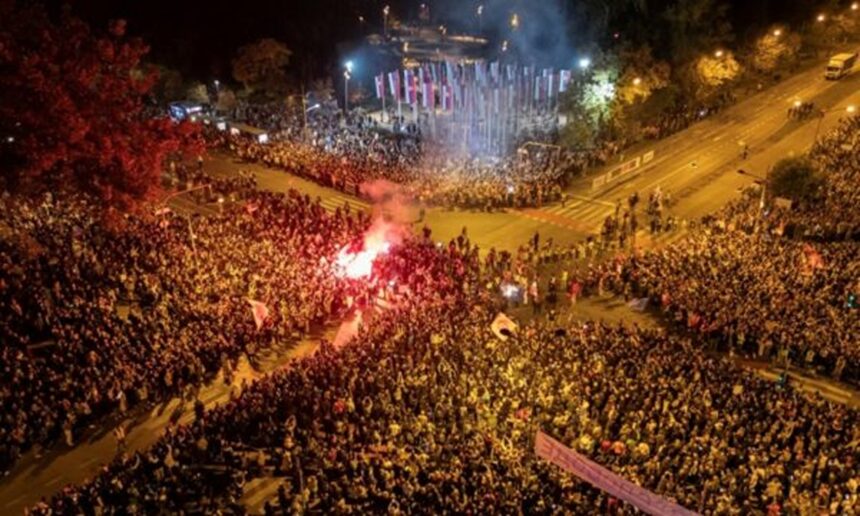
Serbia is also highlighted in the report. It recalls the student-led protests against the government that erupted following the collapse of a concrete canopy at a railway station in 2024, a disaster that claimed 16 lives.
“Authorities harshly suppressed the protests, many of which were organized with the help of digital tools,” the report states.
“Authoritarian regimes are turning the internet into a system of control, deciding who can connect, what they can see, and whether their voices can be heard,” said Kian Vesteinsson, the report’s author and Freedom House’s deputy director of research.
“Dictators are investing in keeping people offline. We must invest in making censorship fail,” he stressed.
Freedom House Executive Director Jamie Fly pointed out that “authoritarian actors are already weaponizing artificial intelligence.”
“We must ensure that frontline activists and human rights advocates have access to the most advanced technologies so they can counter these threats and accelerate the spread of freedom in repressive societies,” he added.
Freedom House found that over the past year, people around the world used digital tools to mobilize and organize protests against their governments.
The report does not mention other Western Balkan countries besides Serbia, which retained its status as “partly free” in terms of internet freedom.
Serbia has held this classification since 2024, having previously been rated “free.”
Internet freedom declines in nearly half of the countries assessed
Digital freedom deteriorated in 16 of the 38 countries assessed in the report.
Iran recorded the sharpest decline, joining China and Myanmar among the countries with the worst conditions for internet freedom.
Significant declines were also recorded in Jordan and Nigeria, while Georgia moved from the “free” category to “partly free.”
Freedom House attributed Georgia’s decline to authorities’ continued suppression of online activism and expression of views they considered critical of the ruling Georgian Dream party.
Improvements were recorded in eight countries.
Bangladesh made the greatest progress for the second consecutive year, following reforms introduced after Sheikh Hasina was ousted from power. Her decade-long rule was characterized by censorship and widespread surveillance.
The Gambia continued to make gradual progress in internet freedom following the departure of repressive leader Yahya Jammeh nearly a decade ago.
Meanwhile, only nine countries are considered free.
During the period assessed, Estonia had the freest online environment.
Iran: “Extreme internet censorship”
The report states that Iranian authorities brutally suppressed anti-government protests in January, which were organized partly through social media.
It recalls that, in response to the protests, Iranian authorities “killed thousands of people.”
“Approximately 50,000 people were imprisoned, including those who had merely criticized the authorities on social media or expressed support for the protesters,” the report states.
It also notes that following US and Israeli attacks in February, Iranian authorities imposed “extreme internet censorship.”
“Iranian authorities shut down the internet across the entire country for approximately 88 days, the longest shutdown of its kind recorded in the history of these Freedom House reports.”
The report further states that internet access was “reorganized” so that only “a privileged minority could access global platforms.”
“This system enabled Iranian authorities to maintain strict control over online information during a series of successive crises, while simultaneously meeting the demands of the country’s elites, who continue to enjoy the benefits of access to the global internet,” the Freedom House report states.
“Russia accelerated efforts to disconnect from the global internet”
Over the past year, Russia accelerated its efforts to disconnect from the global internet, developing repressive models to isolate its population in the digital age, according to the report.
Russian authorities expanded internet shutdowns and restrictions on virtual private networks (VPNs), while seeking to preserve access to state-approved services.
In September 2025, the authorities established a “socially significant services registry,” requiring internet providers to maintain access to listed services during connectivity disruptions.
The list included state media, platforms aligned with the government, and Max, a state-backed messaging application.
In November, the government adopted new rules defining “foreign influence on information” as a threat to the Russian internet.
These rules gave communications regulator Roskomnadzor the authority to implement various censorship measures in response to such threats.
In February, the government passed a law allowing the Federal Security Service (FSB) to shut down internet connectivity under a presidential decree, effectively giving Vladimir Putin the power to cut off the internet for any reason.
“In May 2026, ahead of Victory Day commemorations, authorities imposed widespread, short-term mobile internet disruptions across the country. Users reported that during these restrictions, they could not even access websites included in the ‘socially significant services’ registry,” the report states.
Age-verification laws
Globally, Freedom House found that age-verification laws have created new barriers to internet access and raised privacy and security concerns.
By June 2026, lawmakers in 10 of the 38 countries assessed had proposed, passed or begun implementing age-verification laws governing social media use or access to other non-pornographic online content, the report states.
Australia and Indonesia banned social media use by people under the age of 16. In Turkey, under a proposed framework, social media accounts would have to be linked to users’ real names through the government’s digital identity system.
The report warns that repressive leaders around the world are already attempting to exploit “so-called age-verification requirements for their own purposes, including the introduction of intrusive online surveillance.”
It concludes that more investment is needed in research to develop age-assurance methods that genuinely protect privacy and reduce cybersecurity risks.
According to Freedom House, policymakers should also allocate additional funding to combat online child abuse.
Misuse of artificial intelligence laws
Measures targeting AI-generated content addressed genuinely harmful phenomena, the report states.
However, it warns that these measures also raised concerns about censorship and potential government overreach.
“Governments introduced rules addressing impersonation, harassment and child protection, but authorities misused some of these laws to restrict freedom of expression online,” the Freedom House report states.
The report emphasizes that internet freedom must remain the guiding principle in the age of artificial intelligence.
“The rapid spread of agentic AI—tools that perform tasks autonomously—is already changing the internet.”
“Societies around the world will face questions about how to adapt the functioning of the internet to these changes. These efforts must preserve the open exchange of information and freedom of expression as fundamental values,” Freedom House concludes.
Combating internet shutdowns and censorship
Freedom House’s findings highlight the need to invest both in internet access and in protecting users.
“Tools to circumvent censorship must reach the people who nee