Beatings, cyberattacks and threats against critics are casting a shadow over Serbia ahead of the October 25 elections, with interviews with activists, student protesters and opposition politicians depicting an increasingly authoritarian political climate, Reuters reported.
Former Serbian president Aleksandar Vučić is seeking to extend his political dominance by running for prime minister in the upcoming elections. However, he faces his biggest political challenge since coming to power: a student-led protest movement that gained momentum following the deaths of 16 people when a railway station canopy collapsed in Novi Sad in 2024.
In its report, titled “Beatings, cyberattacks and threats cast a shadow over Vučić’s Serbia ahead of elections,” Reuters quoted Dragan Popović, director of the Belgrade-based Centre for Practical Politics, as saying that the pro-democracy movement was now better organised than at any time since the Serbian Progressive Party (SNS) came to power.
“Such good organisation on the pro-democracy side of society has not been seen since the Serbian Progressive Party came to power,” Popović said.
Reuters recalled that Vučić served as Serbia’s information minister in the late 1990s, when then-president Slobodan Milošević sought to silence critics of the war in Kosovo and the conflict with NATO. Vučić left the ultranationalist Serbian Radical Party in 2008 and now says he wants Serbia to join the European Union.
However, the country’s position on media freedom and corruption indicators has deteriorated, according to the report.
Serbia ranked 104th out of 180 countries in the 2026 World Press Freedom Index published by Reporters Without Borders (RSF), its lowest position to date and the worst result among countries in the Western Balkans and the European Union.
The report also noted that Serbia recorded its worst result in two decades in Transparency International’s 2025 Corruption Perceptions Index.
According to RSF data cited by Reuters, six Serbian journalists are living in exile because of threats to their personal safety linked to politically motivated attacks. Four of them left the country this year.
Data from the Slavko Ćuruvija Foundation showed that Vučić verbally attacked journalists and media organisations at least 182 times during the first nine months of this year. Experienced journalists say the situation is continuing to deteriorate.
Veran Matić, president of the Commission for Investigating Murders of Journalists, was attacked in June by a young man who seized his phone while Matić was filming a protest. He was also subjected to insults in the street. Matić blames Vučić for contributing to the climate surrounding such violence, pointing to the president’s public criticism of him.
“There is hardly a day, hardly a week, without an attack—not only against me, but against many other journalists,” Matić told Reuters.
Activists report intimidation and surveillance
The Reuters report opens with the account of Serbian activist Marko Marjanović, who said masked security personnel forced him into a car in Belgrade last year as he was returning from a shop.
He was taken to a basement at a police station, where he spent two days in solitary confinement under intense lighting, according to the report.
“How much corruption, how much destruction of everything that should and must have value here. Someone has to be held accountable,” Reuters quoted Marjanović as saying.
Marjanović is a vocal opponent of Vučić and has repeatedly faced lengthy restrictions on his social media accounts because of his posts, the agency reported.
Student movement members and other prominent government critics have also been targeted by cyberattacks. In September, the digital rights organisation SHARE Foundation reported that 14 people had been targeted with advanced spyware.
Reuters cited the account of protest movement member Jelena Kontić, whose phone was infected with Pegasus spyware, developed by Israeli company NSO Group, which sells the software exclusively to governments.
“They had access to my entire life. They knew when I exercised, when I slept, when I ate, when I drank water, how much water I drank, what I ate,” Kontić told Reuters.
Protesters describe police brutality
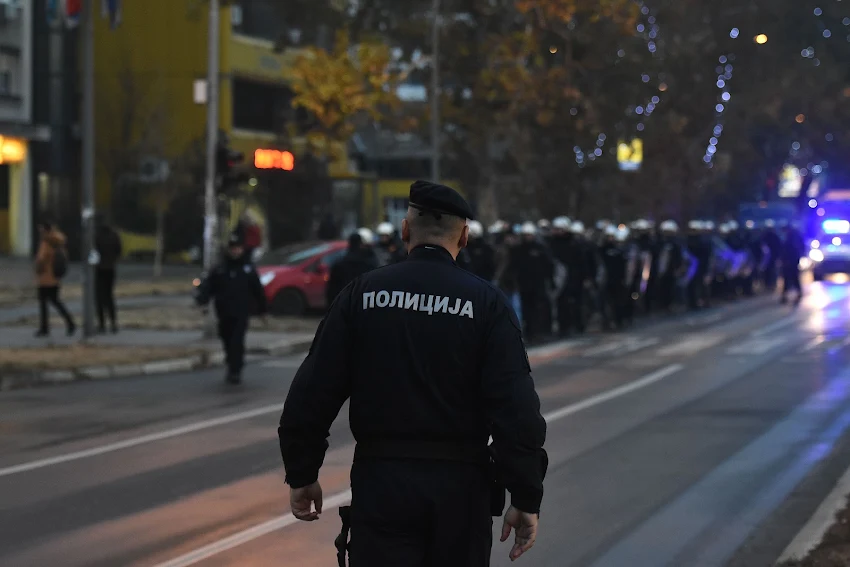
The report said concerns about violence are particularly visible on the streets, where demonstrators allege that police frequently use force against participants in peaceful protests.
Reuters described the case of Dušan Radović, a 26-year-old architect who said police officers beat him with batons while he was helping someone who had fallen during a police intervention at a protest in Valjevo in August last year.
“Ten of them surrounded me. They kicked me, spat on me, and at one point one of them put his foot on my head. They lifted me up and continued beating me, and I fell again,” Radović told Reuters.
Footage authenticated by Reuters reportedly shows Radović being beaten. According to the report, he needed two months before he could walk without limping.
Radović was among 25 people, including minors, who were allegedly brutally beaten that night, according to an independent report by forensic expert Đorđe Alempijević.
“The injuries were not the result of isolated incidents or necessary police self-defence, but indicate a clear, organised and systematic pattern of police brutality and torture,” Reuters quoted the report as stating.
The accounts and findings cited by Reuters paint a picture of mounting concerns over political intimidation, media freedom, digital surveillance and the use of force ahead of a crucial election. The vote is taking place as Vučić and the ruling SNS face growing pressure from a student-led movement demanding political accountability and democratic change.