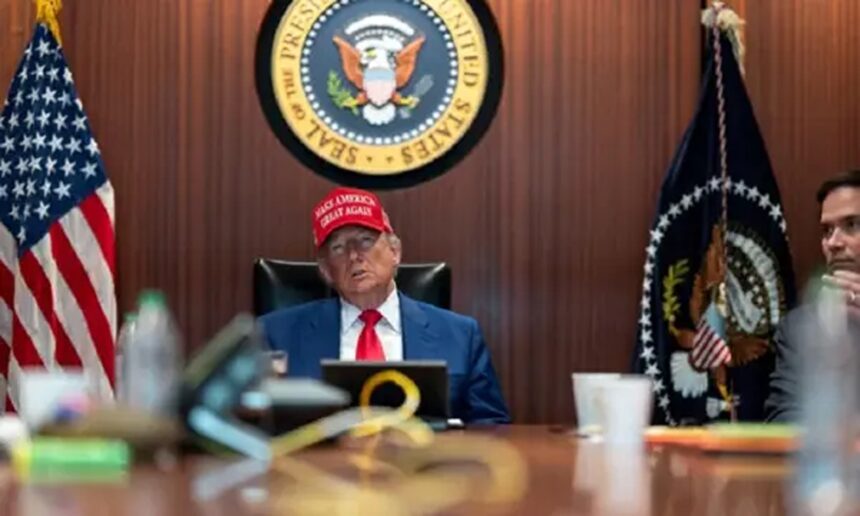
Admiral Brad Cooper, commander of US forces in the Middle East, met with President Donald Trump at the White House to present military options for possible new strikes against Iran.
The meeting took place as Washington considers resuming major military operations after the November 3 congressional elections, the Wall Street Journal reported.
The American news outlet Axios subsequently revealed further details about the meeting. According to two US officials, Trump personally asked the commander of US Central Command to assess the effectiveness of a naval blockade against Iran.
Discussions also covered ensuring the passage of oil tankers through the Strait of Hormuz, as well as exerting economic pressure on Tehran.
The meeting followed warnings from the United States to several Arab nations in the Persian Gulf, advising them to prepare for possible new US strikes after November 3, as well as potential Iranian retaliation.
For now, Trump has not made a final decision on whether to resume major military operations. He wanted to hear firsthand whether the blockade against Iran was working.
Axios reported that Trump wanted Cooper to brief him directly on whether the US naval blockade was delivering the expected results. The admiral also informed the president about an operation through which the US military facilitates the passage of oil tankers from the Strait of Hormuz to global energy markets.
The Wall Street Journal noted that Cooper’s in-person visit to the White House was unusual, as regional military commanders rarely report directly to the president on operational capabilities. In this way, US military leadership presented Trump with various options ahead of a decision on whether to continue the war.
According to Axios, the Trump administration is currently pursuing a two-pronged approach. On the one hand, it is seeking to reach an agreement with Iran, while on the other, it is maintaining military readiness to resume major combat operations after the US elections.
Trump adopted a similar approach before previous US operations against Iran, including strikes on Iranian nuclear facilities in June 2025 and the start of the US-Israeli war in February this year.
On Thursday, Iranian officials reiterated that they expect concrete concessions from the United States before resuming talks on Iran’s nuclear programme. Their demands include lifting the US naval blockade, unfreezing Iranian assets and allowing Iranian oil exports to resume.
Washington, meanwhile, insists that the talks must include Iran’s nuclear programme, which remains one of the main points of disagreement.
It remains unclear whether the negotiations will produce any results before the US elections on November 3.