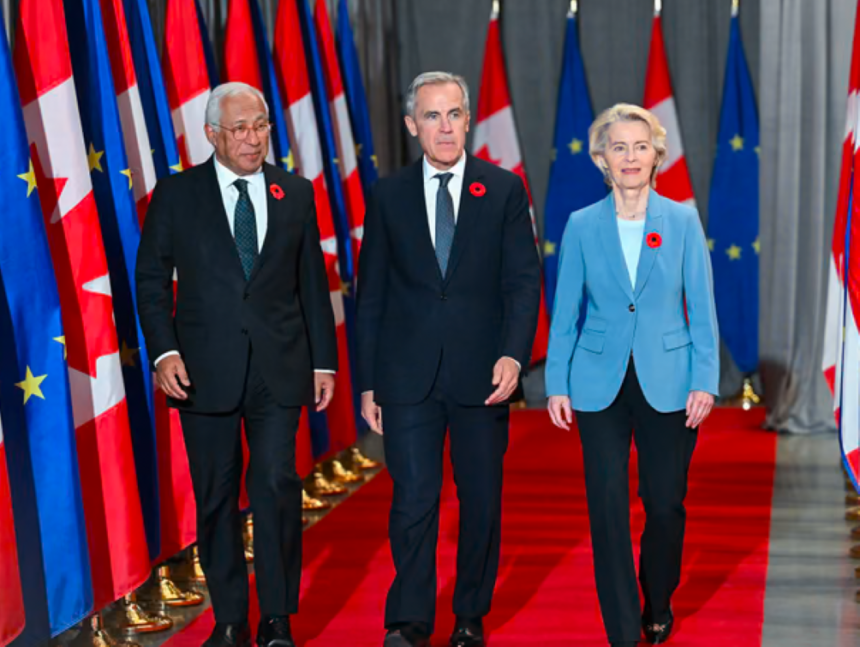
Canada and the European Union have announced a new partnership, named the “Alliance for the Future,” aimed at strengthening economic, political and security cooperation amid growing geopolitical uncertainty and trade tensions.
Canadian Prime Minister Mark Carney and European Commission President Ursula von der Leyen unveiled the initiative on Friday in Montreal, at the conclusion of a two-day summit.
Carney said societies were facing a new set of challenges, including the climate crisis, weakening democratic norms and the increasing use of trade as an instrument of political pressure.
Both leaders argued that closer cooperation between Canada and the EU’s 27 member states could create greater stability and new opportunities. They also stressed that the alliance would remain open to other countries sharing the same values.
One of the summit’s concrete outcomes was Canada’s commitment to contribute to the €90 billion loan package intended to support Ukraine.
The two sides also announced plans to explore a more integrated market, reduce trade and travel restrictions, and expand educational opportunities.
Cooperation on technology and artificial intelligence
Technology is expected to become another major area of cooperation. Brussels and Ottawa announced an agreement that will give Canada access to Europe’s network of supercomputers, which are used to train artificial intelligence models.
Carney also highlighted the proposed combination of Canadian AI company Cohere and Germany’s Aleph Alpha as a step toward reducing dependence on major U.S. technology companies.
The Canadian government has indicated that it could invest up to C$1.6 billion in Cohere.
Carney has repeatedly raised concerns about Canada’s reliance on U.S. companies, particularly in the defense sector. He has argued that critical technologies should not depend on decisions made by companies or political actors whose interests may conflict with Canada’s own.
Canada could seek closer ties with the EU
The leaders also discussed the possibility of Canada obtaining an associated membership status within the European Union.
Von der Leyen described the proposal as a new form of cooperation, emphasizing that the partnership was not intended to target any other country but to strengthen the capabilities of both sides.
Further discussions on the proposed status are expected at the 2027 summit, as the idea has reportedly encountered reservations among some EU member states.
European Council President António Costa described Canada as “the most European of non-European countries,” referring to the shared values and interests underpinning the relationship.
Political tensions in Quebec
The summit also exposed domestic political tensions in Canada.
Quebec Premier Paul St-Pierre Plamondon, leader of the separatist Parti Québécois, boycotted the meeting after the federal government refused to allow him to deliver a public speech during the event.
He criticized Ottawa over what he described as the inadequate representation of Quebec’s interests, arguing that the province was being marginalized in discussions about Canada’s international relations.
The new alliance comes as Canada and the EU seek to strengthen their economic and strategic cooperation at a time when both face growing pressure to diversify partnerships, secure critical technologies and reduce vulnerabilities in trade and defense.