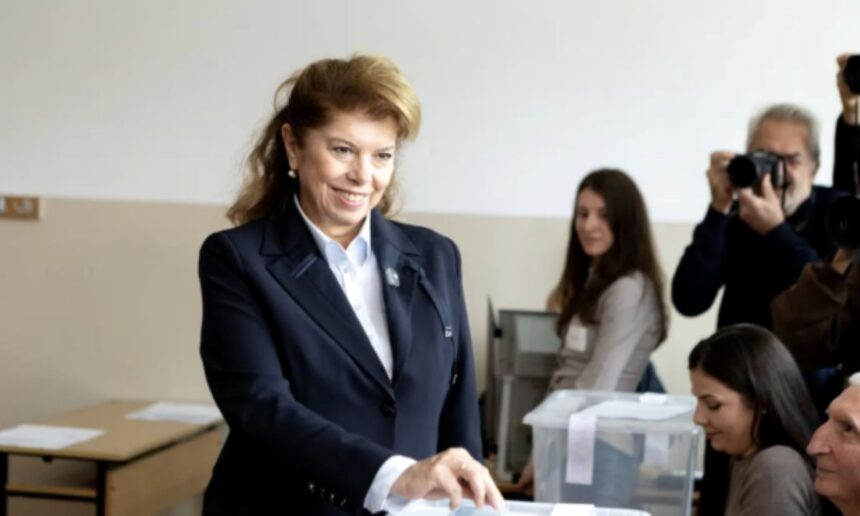
Iliana Yotova has won Bulgaria’s presidential runoff, according to preliminary results, putting her on course to become the first woman directly elected president in the country’s history.
With 98.43 percent of polling-station protocols processed, Yotova had secured 57.64 percent of the vote, compared with 39.40 percent for her opponent, former caretaker Prime Minister Andrey Gyurov, according to figures reported on Monday. Official results are expected from the Central Election Commission. <Cite refs={[“turn390473search7″,”turn390473search6”]}/>
Earlier exit polls had also placed Yotova ahead, estimating her support at between 51 and 52.5 percent, while Gyurov was projected to receive approximately 43–45 percent. <Cite refs={[“turn390473search0″,”turn390473news12”]}/>
The election marked the first major electoral test for the Progressive Bulgaria party, led by Prime Minister Rumen Radev, which won 131 of the National Assembly’s 240 seats in April, securing a parliamentary majority.
Yotova, 62, assumed the presidency in January after Radev resigned to contest the parliamentary elections. She subsequently sought a full five-year mandate through a direct vote.
Her victory means the presidency is set to remain politically aligned with the governing majority. Political observers have raised concerns that the concentration of power in the hands of the same political camp could weaken institutional checks and balances. <Cite refs={[“turn390473news13″,”turn390473news14”]}/>
Yotova’s foreign policy priorities
Yotova is expected to continue the broad foreign-policy approach associated with Radev, supporting Bulgaria’s European integration while advocating improved relations with Russia and an end to Western sanctions against Moscow.
Following her vote on Sunday, she said she had voted for a Bulgaria capable of making its own decisions and maintaining a strong voice internationally.
“I voted for the unity of citizens through dialogue, for institutions that work in the service of the people, and for a strong state with an independent foreign policy within a strong Europe,” she said.
During a televised debate with Gyurov, Yotova argued that any agreement to end the war in Ukraine must involve both Kyiv and Moscow.
“Peace can only be achieved through negotiations,” she said, proposing a meeting of the six countries bordering the Black Sea to discuss an agreement to halt hostilities.
Gyurov, who was supported by pro-Western opposition parties, advocated closer coordination with NATO and European partners and a stronger commitment to supporting Ukraine. <Cite refs={[“turn390473search3″,”turn390473search4”]}/>
A largely ceremonial but politically significant presidency
Bulgaria has been a NATO member since 2004 and joined the European Union in 2007. Although parliamentary parties broadly support the country’s Western orientation, public opinion remains divided over relations with Russia, reflecting longstanding historical and cultural ties.
The Bulgarian president has a largely representative role and does not lead the government. However, the office carries significant constitutional responsibilities: the president serves as commander-in-chief of the armed forces, can return legislation to parliament for reconsideration, signs international agreements and appoints ambassadors.
The president is directly elected for a five-year term and may serve a maximum of two terms.
Yotova’s victory therefore marks a historic milestone in Bulgarian politics while also reinforcing the governing camp’s influence over the country’s main political institutions.