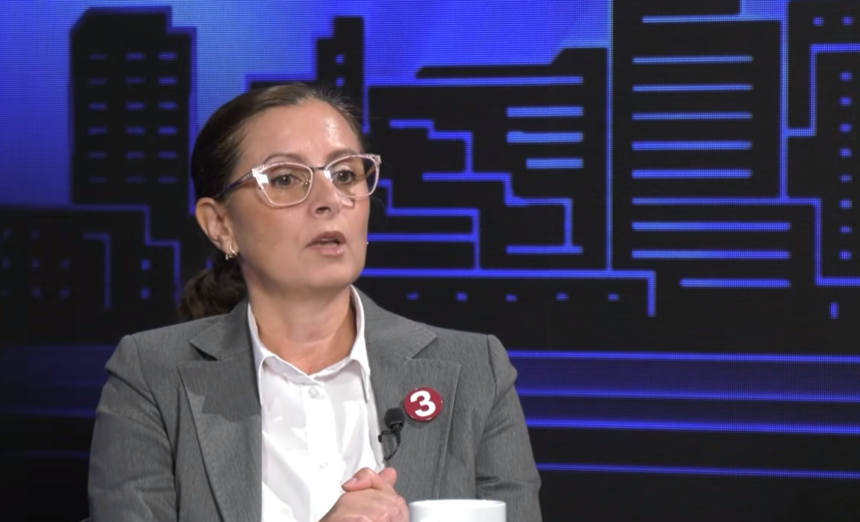
Milena Petrović, a professor at the University of Prishtina’s Faculty of Mathematics and Natural Sciences and a candidate on the “Students Win” electoral list, has accused the Serb List and the previous Serbian government of contributing to the deteriorating position of Serbs in Kosovo.
In a response to a statement issued by the expanded presidency of the Serb List on October 30, Petrović also alleged that the party was involved in electoral irregularities and warned against what she described as unlawful activities during the post-election period.
She said that employees who had carried out their duties lawfully and responsibly within institutions would retain their positions, regardless of their political affiliation, including those associated with the Serbian Progressive Party (SNS) and the Serb List.
“Everyone who has worked responsibly and in accordance with the law within our country’s institutions, regardless of their political affiliation, including the SNS and the Serb List, will remain in their jobs,” Petrović said.
She added that the incoming political leadership would end what she described as party-based employment practices and the use of temporary employment contracts to pressure workers.
Petrović alleges electoral irregularities
Petrović criticized the Serb List’s response to the preliminary results of Serbia’s October 25 parliamentary elections, accusing the SNS and its Kosovo-based political ally of manipulating the electoral process.
She claimed that buses carrying Albanian voters had transported people to administrative crossings, where they were transferred to buses organized by the SNS. According to her, this arrangement prevented some Serbian voters who wanted to travel independently from reaching polling stations freely.
Petrović also referred to testimonies from Serbian residents who allegedly waited five to six hours at administrative crossings on election day.
Against this backdrop, she described the 20.62 percent won by the “Students Win” list among voters in Kosovo as a significant achievement, arguing that it reflected a growing willingness among Serbs to express their political preferences despite years of pressure and fear.
These allegations were presented by Petrović and were not independently established in the statement.
Serb List held responsible for deteriorating conditions
Petrović also challenged the Serb List’s claim that it represents the interests of Serbs in Kosovo, arguing that the party’s parliamentary and municipal positions do not necessarily reflect the majority’s political preferences.
She said the October 25 election had demonstrated a desire for changes in the way Serbia conducts its policy toward Kosovo.
Petrović argued that the Serb List, as part of Kosovo’s institutional system, was not in a position to determine Serbia’s constitutional policy toward Kosovo, but was nevertheless responsible for what she described as a significant deterioration in the status of the territory and the living conditions of its Serbian population.
She said the Students’ Movement would seek to address these issues after the constitution of Serbia’s new parliament and the formation of a new government.
No revenge, but an end to political pressure
Responding to concerns raised by the Serb List about possible retaliation against its supporters, Petrović said the Students’ Movement had never supported revenge or political targeting.
She recalled that students and citizens who had supported the movement over the previous two years had faced what she described as repression under the former SNS government, including physical assaults, allegedly unjustified detentions, dismissals and the use of a sound cannon.
Petrović said the movement would not repeat such practices.
“Revenge will never be an option for the Students’ Movement, because that would make us no different from the repressive regime that we sent into history on October 25,” she said.
However, she urged public-sector employees who had experienced political pressure to report alleged irregularities, including the destruction of documents, questionable employment contracts and attempts to spread fear among workers.
She warned that instructions allegedly being issued by the outgoing authorities to public-sector employees could fall outside the law and potentially lead to criminal proceedings.
The Students’ Movement has provided an email address for reporting alleged irregularities: [email protected].
University, healthcare and education remain central concerns
Petrović also addressed the future of Serbian-run institutions in Kosovo, particularly the University of Prishtina with its temporary seat in North Mitrovica, as well as healthcare and education services operating within Serbia’s legal framework.
She accused the previous Serbian government, led by Aleksandar Vučić, of transferring elements of state authority to Kosovo institutions and attempting to hand over the remaining Serbian-run institutions before the elections.
Petrović argued that the Students’ Movement had helped slow the integration process, particularly through its efforts to preserve the university.
She pointed to the Law on Foreigners, adopted by Kosovo’s institutions on March 15, 2026, saying its implementation could accelerate the departure of Serbs from Kosovo.
According to Petrović, students and university professors had opposed the law since it was announced in September 2025 and had sought answers from Serbian institutions, including the university rectorate, the Ministry of Education, the Office for Kosovo and the Serbian government.
She also criticized the Serb List and university leadership for their response to the legislation, claiming they had asked Kosovo authorities for additional time to prepare for its full implementation rather than opposing it.
Pledges peaceful coexistence and protection of rights
Petrović said the protection and security of Serbs in Kosovo would be among the priorities of the “Students Win” list.
She said all 250 candidates on the list had signed a social agreement committing them to the Serbian Constitution and to preserving Serbia’s territorial integrity and sovereignty.
At the same time, she stressed that the movement intended to address challenges through peaceful means, respect for the rule of law and the protection of human rights and cultural heritage.
She said the movement supported the preservation of religious sites and cultural-historical heritage, as well as peaceful coexistence between Serbs, Albanians and other communities in Kosovo.
The response comes amid political tensions following Serbia’s October 25 parliamentary elections and a dispute over the Serb List’s political representation and its role in institutions serving the Serbian community in Kosovo.