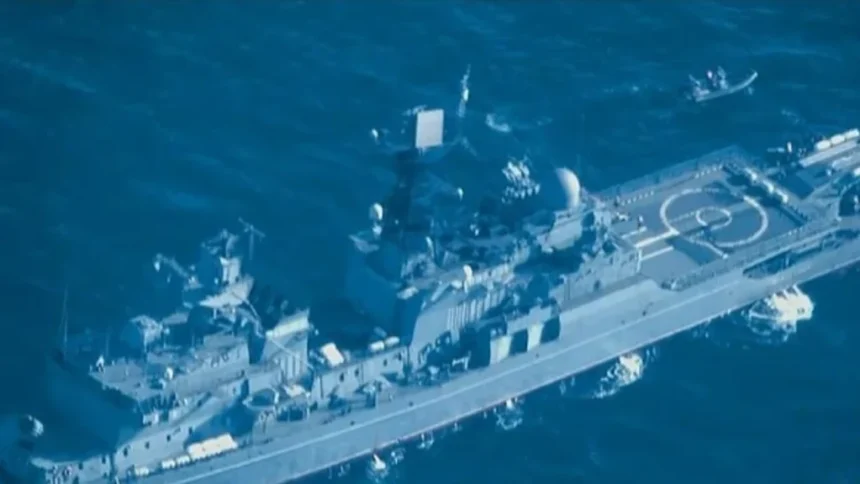
The British Royal Air Force (RAF) has used military drones for the first time to monitor Russian naval activity near the United Kingdom’s coastline, in a move reflecting growing concerns about potential threats to British security.
The development follows warnings from military experts that Russian vessels could potentially be used as platforms for launching remotely controlled drones in a large-scale attack against British targets.
According to the UK Ministry of Defence, an unarmed Protector RG1 drone flew over the English Channel during the past month, providing more than 10 hours of surveillance and intelligence gathering.
The drone operated alongside Royal Navy warships and helicopters as British forces monitored a Russian naval vessel.
The announcement comes amid criticism of the Labour government’s defense spending and concerns that insufficient investment could leave the UK vulnerable to potential Russian threats.
The Ministry of Defence has reported that Royal Navy activity monitoring Russian movements increased by 25 percent during the first seven months of 2026 compared with the same period in 2025.
Russian vessels have also been tracked while monitoring critical underwater cables around Britain. In response, the government has allocated an additional £330 million over four years to strengthen surveillance and monitoring of the seabed and develop more advanced anti-submarine capabilities.
Warnings over potential drone attacks
A senior military commander warned that a Russian drone attack could potentially be launched within minutes from a vessel operating near British waters, targeting infrastructure in different parts of the country.
“We need greater readiness, and that requires funding — more investment in defense now, not tomorrow,” the source said.
The commander argued that Britain needed more aircraft in the air and more vessels at sea, regardless of their size, to monitor maritime movements.
“Surveillance systems are essential to prevent any Russian incursion. We have new laser-guided missiles capable of destroying drones, but we need an early-warning system that gives the RAF enough time to get airborne,” the source added.
The commander also accused the Labour government of underestimating the scale of the potential threat.
According to the report, Russian drones have previously entered the airspace of Poland, Moldova, Lithuania, Norway and Denmark. Intelligence officials have warned that Britain could also face threats as Moscow continues to oppose London’s military support for Ukraine.
One of Britain’s capabilities for countering drones is the Wildcat helicopter, which can be equipped with machine guns and used to engage groups of unmanned aerial vehicles.
Tim Ripley, a senior analyst at Defence Eye, said the British military already had several capabilities for dealing with small drones but needed a more effective early-warning system to ensure defenses could be deployed in the right locations.
He argued that this would require more frequent air and naval patrols to monitor vessels operating near British waters, particularly ships that might switch off their Automatic Identification System (AIS) to avoid detection.
“Any vessel could launch a group of drones. We need an emergency plan to identify suspicious vessels so that air units and countermeasures on the ground can then be activated,” Ripley said.
UK Defense Ministry highlights new surveillance capabilities
British Defense Secretary Wes Streeting described the Protector drone’s deployment alongside Royal Navy warships and helicopters as a new development in monitoring activity near the country’s coastline.
“For the first time, Protector joined Royal Navy warships and helicopters in monitoring activity near our shores. This demonstrates that we are constantly developing new ways to monitor and prevent threats and irresponsible provocations,” Streeting said.
The deployment marks an expansion of Britain’s use of unmanned aircraft for maritime surveillance as concerns grow over Russian naval activity, the security of underwater infrastructure and the potential use of commercial or military vessels for hostile operations.