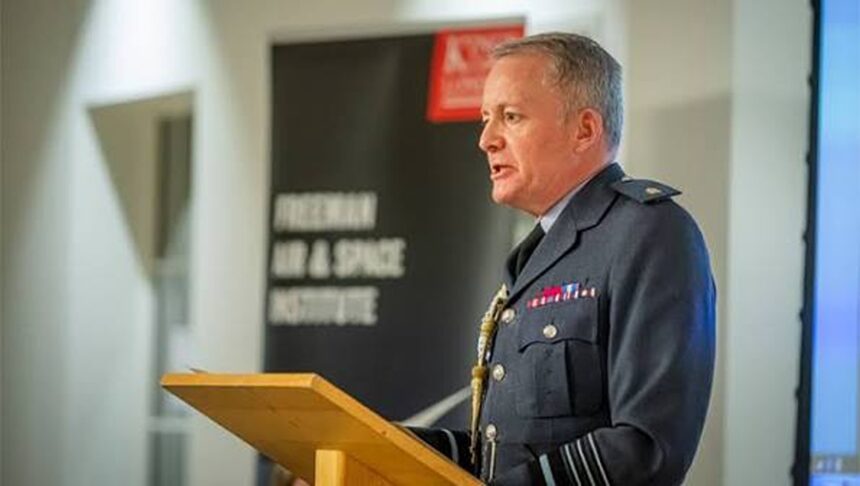
The United Kingdom is falling behind its European allies in confronting the increasingly serious threat posed by Russia. That is the warning from the head of the British Armed Forces, who has urged London to move faster in strengthening the country’s defence capabilities.
In an interview with the Financial Times, Chief of the Defence Staff Air Chief Marshal Sir Richard Knighton said Britain must catch up with its European allies, who, in his assessment, are more aware of the Kremlin’s growing willingness to take risks.
“This is the most dangerous period I have experienced in my adult lifetime,” the 57-year-old said, adding that the threat, primarily from Russia but also at the global level, is increasing.
Knighton said Moscow is demonstrating an increasingly high tolerance for risk, warning that the term “hybrid activities” no longer fully captures the scale of the actions Russia is suspected of carrying out.
“We are talking about targeted assassinations, sabotage and cyberattacks. These are very real actions by the Russian state, for which we have evidence in Europe and, to some extent, in the UK,” he said.
His warning comes as European security officials investigate whether a series of bomb threats targeting airlines and media organisations originated in Russia.
According to intelligence officials cited by the Financial Times, security and intelligence agencies from several countries have launched a joint investigation to establish the source of the threats. However, they stressed that more time is needed before responsibility can be officially attributed to any party.
Some members of the intelligence community nevertheless believe Russia is the most likely culprit. Moscow has previously denied involvement in hybrid attacks on European territory.
Knighton said the British government must explain the nature of the Russian threat to the public as it seeks to justify the need for increased defence spending.
He also addressed preparations for citizens in the event of potential emergencies. In an interview with the BBC on Sunday, he said he was responding to the government’s call for households to maintain emergency supplies of food and water amid concerns that hostile states could disrupt essential supplies.
Asked what he had included in his household emergency kit, Knighton said he had discussed the matter with his wife and had checked their cupboards over the weekend, discovering that the family already had a considerable supply of canned food.
“I also put up some extra shelves. But this is something we should all be thinking about,” he said.
According to Knighton, emergency services and the armed forces form the country’s first line of defence, but citizens can also contribute by preparing for extraordinary circumstances.
In an article published in The Independent last month, Knighton argued that Europe must take greater responsibility for its own defence at a time when war has returned to the continent and security can no longer be taken for granted.
“Russia’s war against Ukraine has demonstrated the importance of military readiness, industrial capacity and national resilience,” he wrote.
He added that European countries must strengthen their defence capabilities and assume greater responsibility for collective security.
“The question is not about preparing for war, but preventing it,” Knighton stressed, adding that history has repeatedly shown that weakness can encourage aggression, while strength helps preserve peace.
He said the purpose of deterrence is to convince potential adversaries that the cost of aggression would far outweigh any possible gains.