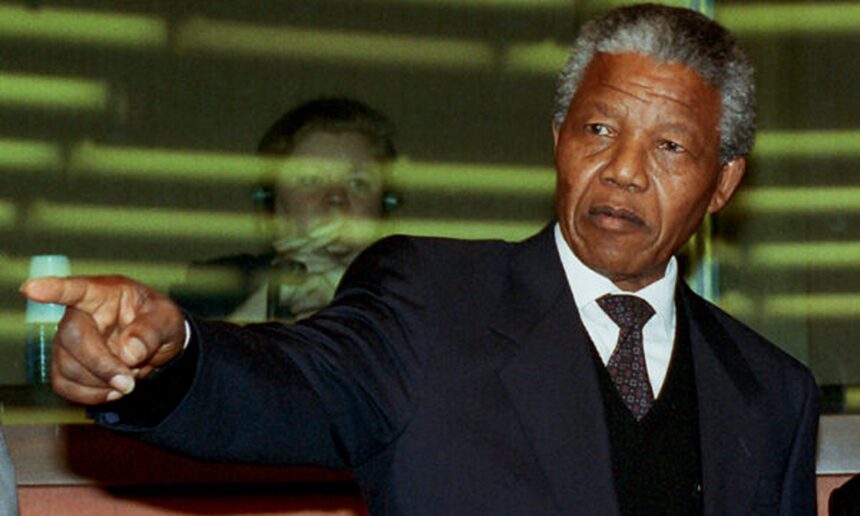
Nelson Mandela’s legacy is no longer enough to keep the party that ended apartheid in South Africa in power. After more than three decades of political dominance, the African National Congress (ANC) is losing support even in communities that were once its safest strongholds. For an increasing number of citizens, the historic struggle for freedom is being overshadowed by more immediate demands: jobs, water, electricity and corruption-free governance.
The local elections held on November 4 have highlighted the scale of this shift. The ANC secured just 30.8% of the vote nationally, a significant decline from the 45.6% it received in 2021.
A report by the British newspaper The Times reveals that dissatisfaction is particularly strong in Johannesburg’s poorer neighbourhoods, where residents accuse authorities of neglect, mismanagement and failing to deliver on their promises.
In Water Wax, an informal settlement on the outskirts of the city, families live in makeshift corrugated-iron homes, surrounded by damaged roads and rubbish. Water supplies remain unreliable, electricity is frequently unavailable, and some families are forced to share a single portable toilet.
For residents, these conditions are evidence of the enormous gap between the promises made after the end of apartheid and the reality of everyday life.
Robert Makeleni, 59, has lived in the area for seven years. For a long time, he supported the ANC, viewing it as the party that represented the struggle for equality and dignity. But his disappointment over the lack of progress eventually pushed him to change his vote.
“Look at how we live. The municipality has had more than enough time to do the right thing, but all we hear and read about is corruption,” he said.
Makeleni had taken part in protests and signed petitions demanding better living conditions. Nevertheless, he said, the problems remained unresolved.
In the latest elections, he voted for the Democratic Alliance (DA), a political force historically perceived as representing the white population and wealthier sections of society.
His decision was also influenced by a concrete intervention during the election campaign. As part of Helen Zille’s campaign for leadership in Johannesburg, the DA financed the completion of a water borehole that local authorities had failed to bring into operation.
In the electoral ward that includes Water Wax, the Democratic Alliance secured 53% of the vote, a result suggesting that traditional political and racial divisions are becoming less rigid.
“I want clean governance. I don’t care what colour the mayor is,” said Colin Zungu, another resident who decided to support the DA.
The shift in political preferences is not limited to Johannesburg’s outskirts. Soweto, one of the most important symbols of resistance against apartheid, is also gradually moving away from Mandela’s party.
The historic student protests of 1976 erupted in this area, becoming a defining moment in the struggle against racial discrimination. For decades, Soweto remained one of the ANC’s strongest electoral bases.
However, in the electoral ward covering Moletsane and Tladi, support for the party fell from 42.7% in 2021 to 33.9% in the latest elections.
Dintzi Mphahlele, a 54-year-old plumber, is among those who have lost faith in the historic party. He lives with 11 members of his family, spanning three generations, in a home surrounded by makeshift structures, while securing stable employment remains a daily struggle.
Mphahlele had voted for the ANC for most of his life. He later supported Julius Malema’s Economic Freedom Fighters before choosing ActionSA, the political party founded by former Johannesburg mayor Herman Mashaba, in the latest election.
He links his disillusionment to unemployment, corruption and what he sees as the awarding of public contracts to politically connected individuals.
“The disappointment is enormous,” the 54-year-old said.
Nevertheless, he is still unwilling to vote for the Democratic Alliance, which he continues to view as a party representing the interests of white and wealthy South Africans.
His 32-year-old daughter, Nosipho, sees things differently. She belongs to the generation born after the end of apartheid and does not feel the same historical attachment to the ANC.
“People my age don’t have those connections to the ANC. For us, it is easier to give the Democratic Alliance a chance,” she said.
The difference between father and daughter reflects a broader social transformation. Generations who experienced apartheid associate the ANC with liberation and the end of institutionalised discrimination. For younger people who never lived through that period, historical loyalty carries less weight than economic and social problems.
However, the ANC’s loss of support is not translating into a uniform shift towards a single party. Voters are spreading their support among the Democratic Alliance, ActionSA, the Economic Freedom Fighters and former president Jacob Zuma’s MK Party.
In KwaZulu-Natal province, the MK Party has recorded strong results. In the eThekwini metropolitan municipality, which includes Durban, the party received approximately 38.5% of the proportional vote, overtaking the ANC in an area where the latter had traditionally enjoyed considerable influence.
The fragmentation of the political landscape is expected to make the formation of stable local administrations more difficult. In Johannesburg, the Democratic Alliance may need an agreement with ActionSA, despite the clashes between the two parties during the election campaign.
The city has experienced years of political instability, with frequent changes in municipal leadership, while water supply, electricity, infrastructure and public safety remain among residents’ main concerns.
The election result represents another setback for the ANC, which lost its parliamentary majority in 2024 and is now facing a further contraction of its electoral base.
For many citizens, changing their vote does not mean rejecting Nelson Mandela’s historical role or the struggle against apartheid. Rather, it is a response to the problems that continue to affect their daily lives despite repeated political promises.
Makeleni summed up this shift with a clear message to the country’s leaders:
“Today, we have access to information. We can check what the people we elect are doing, and we have many more alternatives. The ANC is being shown that its proud history is not something people can feed their children with.”
In South Africa, the political battle is increasingly shifting away from the memory of liberation towards demands for tangible results. And it is precisely in the neighbourhoods where the ANC once built its strongest support that one of the greatest challenges to the party’s future is now emerging.