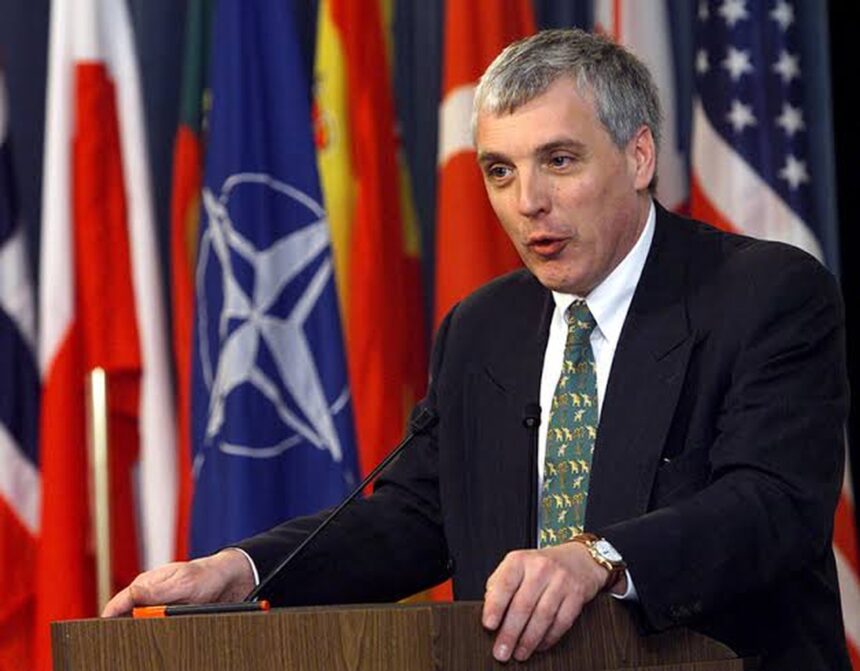
Kosovo should strengthen its security relations with European countries and the European Union rather than rely excessively on Washington, former senior NATO official Jamie Shea says, as the United States considers changes to its military commitments in Europe.
Speaking to Radio Free Europe, Shea said NATO’s presence in Kosovo is not expected to be directly affected by potential changes to the European security architecture. However, Kosovo’s aspirations to join the Alliance and its close security relationship with the United States could face new challenges.
Washington has proposed a broader framework for European security as part of its efforts to end Russia’s war against Ukraine. Presented on November 5 by Jared Kushner, U.S. President Donald Trump’s envoy, the initiative aims to strengthen security consultations, crisis communication and military transparency, while creating mechanisms to reduce the risk of escalation.
The proposal comes ahead of talks involving the United States, Ukraine and Russia, scheduled for November 10–11 in Abu Dhabi. Trump has suggested that diplomatic efforts could lead to an agreement extending beyond Ukraine and addressing wider European security concerns.
Kushner, meanwhile, has stressed that NATO should remain central to Europe’s collective defence and that no country should have the right to veto another state’s security choices or alliances.
It remains unclear what such an agreement would entail, and there is no public information indicating that Kosovo or KFOR are part of the discussions.
Why KFOR is not expected to be directly affected
Shea does not expect the potential changes to European security to have a direct impact on KFOR, given the mission’s mandate and peacekeeping role.
“I would not think so,” he said when asked whether the developments could have consequences for NATO’s mission in Kosovo.
KFOR operates under UN Security Council Resolution 1244, adopted in 1999 with Russia’s vote.
“Moscow appreciates the fact that KFOR is there primarily to protect Kosovo’s Serb community,” Shea told Radio Free Europe.
According to him, Russia is seeking to limit NATO’s heavy military presence in Central and Eastern Europe, while KFOR, as a peacekeeping mission, does not fall into that category.
Deployed in Kosovo after the end of the war, KFOR is tasked with contributing to a safe and secure environment and freedom of movement for all communities.
The mission currently has approximately 4,700 troops, following the reinforcement of its presence in 2023 amid rising tensions in northern Kosovo.
The improvement in the security situation has opened the way for a gradual adjustment of troop numbers, according to NATO assessments.
In June, the Alliance announced its intention to return to previous force levels, depending on conditions on the ground. NATO Secretary General Mark Rutte has identified a target of approximately 3,000 to 3,500 troops.
NATO has stressed that the process is reversible and will depend on its assessment of the security situation in Kosovo.
It remains unclear whether Kosovo or KFOR have been included in the latest discussions on European security.
Asked by Radio Free Europe, NATO did not provide a direct answer. Spokesperson Allison Hart confirmed that representatives of NATO, the United States, Ukraine, European countries and the European Union met in Brussels on November 5 as part of efforts to end the war in Ukraine.
Asked again whether Kosovo or KFOR had been part of the discussions, NATO said it had no further information to share.
Could Russia obstruct Kosovo’s NATO ambitions?
While KFOR is not expected to be directly affected, Shea sees potential consequences for Kosovo in the debate over NATO enlargement.
Russia has long opposed the Alliance’s expansion. In December 2021, before its full-scale invasion of Ukraine, Moscow demanded guarantees that NATO would not admit new members and would limit its military presence in Eastern Europe.
Russia’s demand to restrict NATO’s military presence to levels that existed before 1997 has resurfaced amid reports that Moscow could raise the issue again during negotiations on European security.
Shea believes Russia will seek to prevent further NATO enlargement, with Ukraine remaining its primary concern. Any such restrictions, he says, could also affect Kosovo’s aspirations.
“This would hinder Kosovo’s chances of joining NATO one day,” Shea said.
Kosovo’s path towards the Alliance is already complicated by the fact that four NATO members—Spain, Greece, Romania and Slovakia—do not recognise its independence. The admission of new members requires consensus among all Allies.
NATO continues to uphold its open-door policy. The U.S. proposal has also stressed that no country should have the right to veto another state’s security choices or alliances.
Beyond enlargement, Shea believes Russia could also attempt to prevent the deployment of additional NATO forces in the Western Balkans.
Moscow could be particularly concerned if political changes in Serbia bring Belgrade closer to the Alliance, he said.
However, Shea noted that the Western Balkans are not among Russia’s main military priorities. Moscow is more focused on the Black Sea region, Poland, the Baltic states and Northern Europe—areas closer to Russia’s borders.
What could change in the U.S. military commitment to Europe?
Another issue of particular importance to Kosovo is the future of the American military presence in Europe.
Shea recalled that Russia has previously called for the withdrawal of U.S. forces from the continent.
“Such a measure could affect Kosovo, which has always maintained close security relations with the United States,” he said.
Washington is already reviewing its military commitments in Europe and wants European allies to assume greater responsibility for the continent’s defence.
In June, the United States European Command (EUCOM) confirmed to Radio Free Europe that it would adjust the American contribution to KFOR in phases, in line with NATO plans and security assessments.
EUCOM stressed that the United States continues to consider KFOR a key component of regional stability, without providing further details about the scale of the changes.
Another development took place on October 12, when the Florida National Guard handed over command of KFOR’s Regional Command East to active-duty U.S. Army units at Camp Bondsteel.
The change, the first of its kind in more than a decade, was a reorganisation of units and was not accompanied by any announcement of a U.S. withdrawal from Kosovo.
It remains unclear whether the broader review of American military commitments in Europe will affect the future of the U.S. presence in Kosovo.
Radio Free Europe asked the Pentagon whether the proposed European security framework could have consequences for KFOR, American troops in Kosovo or Washington’s commitments in the Western Balkans.
The Pentagon referred the questions to the White House, which had not responded by the time the article was prepared.
Shea said the reduction of the U.S. military presence in Europe has already begun, independently of the negotiations with Russia. He believes the new composition of the U.S. Congress could make further reductions more difficult for the Trump administration.
Kosovo and Europe’s growing security role
As Washington considers a broader security framework, European countries are seeking a role in decisions affecting the continent’s future.
EU foreign policy chief Kaja Kallas has stressed that Europe already has a security architecture, but Russia continues to violate the agreements underpinning it.
Kallas has said that Russian President Vladimir Putin has no veto over European security and that the EU must be involved in negotiations on any peace agreement for Ukraine.
That demand was reinforced on November 8, when French Foreign Minister Jean-Noël Barrot confirmed that European representatives would take part in the planned discussions in Abu Dhabi.
The U.S. proposal, meanwhile, remains at the discussion stage, with no agreement yet reached on changing Europe’s security architecture.
Shea says Kosovo should prepare for a greater role by European countries in the security of the Western Balkans, regardless of the outcome of the current negotiations.
According to him, European countries have already assumed most of the responsibility for regional security. Kosovo should therefore strengthen its relations with European states and the European Union rather than rely excessively on Washington.
For Shea, this need goes beyond the negotiations with Russia and is linked to long-term changes in the United States’ military role in Europe.
How many NATO troops are deployed in Kosovo?
A total of 4,686 troops from 29 countries are currently serving in Kosovo as part of NATO’s peacekeeping mission, KFOR. More than half of the forces come from Italy, the United States, Hungary and Türkiye. NATO increased its presence in Kosovo in 2023 following heightened tensions in the Serb-majority north.