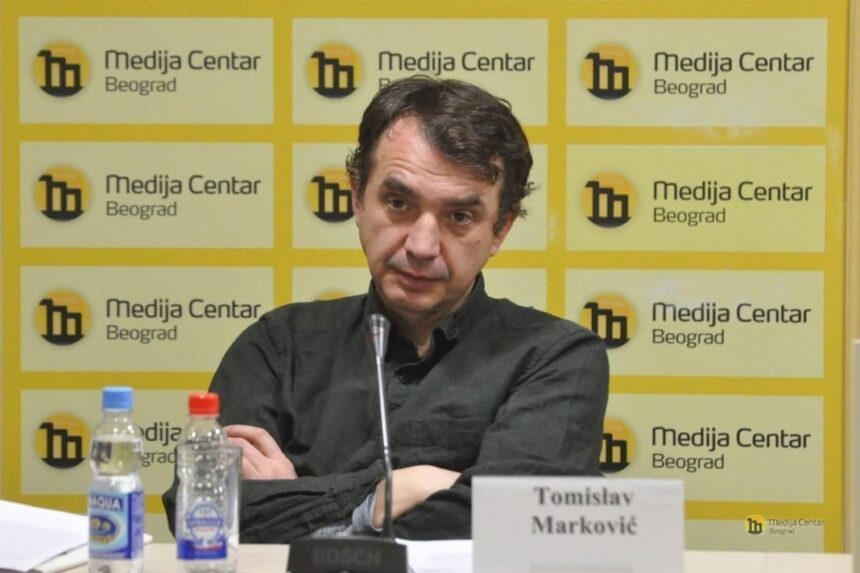
Serbia’s authoritarian regime has fallen following years of resistance by students and citizens, but the country’s deeper political and ideological problems remain unresolved, Serbian author and columnist Tomislav Marković argues in an opinion piece published by Nomad.ba.
Marković argues that the regime of Aleksandar Vučić did not emerge in isolation, but was a continuation of the political legacy of Slobodan Milošević, as well as the governments of Boris Tadić and Vojislav Koštunica, which he describes as guardians of the nationalist ideology and the legacy of war and genocide in the region.
He maintains that Serbia’s political and social crisis has lasted not 14 years, but at least four decades, raising questions about whether the recent political changes represent the beginning of a genuine break with the ideology that has shaped Serbian society since the late 1980s.
The collapse of the Vučić system
Marković describes the electoral victory of the student-backed list, which secured more than 620,000 votes above the Serbian Progressive Party (SNS), as a decisive moment in the struggle against authoritarian rule.
He credits the student movement with mobilising citizens and breaking years of political apathy, despite what he describes as electoral irregularities and unfair conditions.
According to the author, institutions that had spent years serving the interests of the ruling establishment have suddenly begun carrying out arrests, investigations and prosecutions at an unprecedented pace.
However, he questions whether the apparent transformation of the police, judiciary and prosecution service reflects a genuine commitment to the rule of law or simply an attempt by officials to adapt to the changing political circumstances.
Marković also argues that the Socialist Party of Serbia (SPS), which failed to cross the electoral threshold, should have disappeared from Serbian politics decades ago, given its responsibility for wars, war crimes and the destruction of the former Yugoslavia.
He describes the SNS not as a conventional political organisation but as an organised criminal network that had effectively taken control of state institutions.
Dismantling the criminal network
The author warns that dismantling the structures associated with Vučić’s government will be a major challenge for the incoming authorities.
He argues that corruption may have spread throughout public institutions, state-owned enterprises, municipal administrations and businesses connected to the ruling establishment.
As an example, he cites the construction of a small bus stop in Bigrenica, near Ćuprija, which reportedly cost €380,000 despite consisting of a small concrete platform and a metal shelter.
For Marković, the example illustrates the scale of alleged misuse of public funds during the SNS government’s years in power.
He warns that investigating the full extent of corruption will take years and could expose a level of institutional and financial abuse that will place enormous pressure on Serbia’s judicial system and prison capacity.
Nevertheless, he argues that addressing corruption alone will not be sufficient, because the roots of the country’s political crisis extend much further into its recent history.
Four decades of nationalism and an unfinished reckoning
Marković insists that Serbia must confront the political and ideological legacy of the 1990s rather than postpone the issue indefinitely.
He criticises those who argue that the immediate priority should be investigating the crimes and corruption of the Vučić era, while questions surrounding the wars, ethnic cleansing, mass graves and genocide of the 1990s can be addressed at some later point.
He warns that repeatedly postponing accountability for the past risks preserving the same nationalist foundations that enabled successive authoritarian governments to emerge.
The author argues that the political culture established during Milošević’s rule was never fully dismantled and that its influence continued through subsequent governments and political generations.
He also questions why Serbian society, particularly its intellectual circles, remains reluctant to examine how mass nationalist mobilisation became possible in the late 1980s and why authoritarian leaders and nationalist narratives continue to find support.
According to Marković, genuine democratic transformation requires collective self-reflection and an honest examination of the country’s responsibility for the suffering inflicted on other communities.
The human cost of nationalism
Reflecting on the recent electoral victory, Marković writes that his initial reaction was not euphoria or relief, but sadness.
He recalls people whose lives were destroyed or permanently damaged by nationalism, political violence, discrimination and the social consequences of the wars.
He refers to broken families, poverty, humiliation, depression, addiction and psychological suffering, arguing that an entire generation has been deeply affected by the political and ideological violence of the past four decades.
He also recalls an interview with Ibrahim Hadžić, who described the physical and psychological consequences of discrimination and pressure during the 1990s, including severe hearing loss that he attributed to prolonged stress and helplessness.
Marković uses these experiences to emphasise that political change cannot erase the suffering endured by individuals and communities.
The irreversible consequences of the past
In the final section of his commentary, Marković reflects on the distinction between what can be repaired and what is permanently lost.
Even if Serbia has entered the final stage of an authoritarian era, he argues, political change cannot bring back those killed in wars, erase mass graves or heal all the wounds left behind.
Drawing on Charles Baudelaire’s poem The Irremediable, Marković explores the ideas of the irreversible, the irreparable and the unforgivable.
He argues that Serbian society has too often behaved as though the consequences of dictatorship, war and crimes could simply be undone once political circumstances changed.
For him, the challenge facing Serbia goes beyond replacing one government with another. It requires confronting the ideological foundations of nationalism, acknowledging historical responsibility and recognising the permanent consequences of violence.
He concludes that without such reflection, the country risks repeating the mistakes that have shaped its modern history.