In his May 12, 2026, analysis, Ngadhnjim Brovina argues that the Serbian government has successfully executed a three-year strategic maneuver, transforming its initial reservations about the Brussels/Ohrid Path to Normalisation Agreement (2023) into an entrenched diplomatic doctrine.
Brovina posits that this was achieved not through a formal renegotiation of the text, but through a “sequential non-objection” from European Union institutions, effectively hollowing out the agreement’s original “recognition-by-conduct” intent.
The Structural Inversion: Text vs. Doctrine
The core of the dispute lies in the tension between the legal text of the 2023 Agreement and Belgrade’s operational application of it.
- The Original Architecture (The Text):
- Article-Independence: The Implementation Annex explicitly states that all 11 articles are independent. Non-implementation of one (e.g., Article 7) cannot legally be used as a veto against others (e.g., Article 4 on international membership).
- Recognition-by-Conduct: The text outlines mutual recognition of symbols, permanent missions, and non-objection to international integration.
- The Belgrade Doctrine (The Reading):
- Article 7 as the “Gatekeeper”: Belgrade treats the establishment of the Association of Serb-Majority Municipalities (ASM) as a mandatory precursor to all other obligations.
- The Veto Power: By prioritizing Article 7—knowing it is “constitutionally indigestible” for Pristina—Belgrade creates a permanent diplomatic deadlock that protects its refusal to recognize Kosovo’s sovereignty.
The Institutional Trajectory (2023–2026)
The transformation from a private “disclaimer” to public “doctrine” followed a specific documentary sequence:
| Phase | Event | Institutional Impact |
| I: The Disclaimer (2023) | Brnabić Letter: Private correspondence to the EEAS stating acceptance is only valid outside the context of recognition. | Operates as a “private disclaimer” attached to a public undertaking. |
| II: The Acknowledgement (2024) | Borrell’s Statement: High Rep acknowledges “constitutional limitations” regarding Serbia’s position. | The EU ceases to contest the Brnabić letter, treating it as a “fact to be worked around.” |
| III: The Parallel Registers (2025) | Commission Reports: Recommitments are recorded as binding, yet Belgrade’s refusal to retract the letter is ignored. | Formal legal acceptance of the 11 articles coexists with an operational acceptance of the narrower reading. |
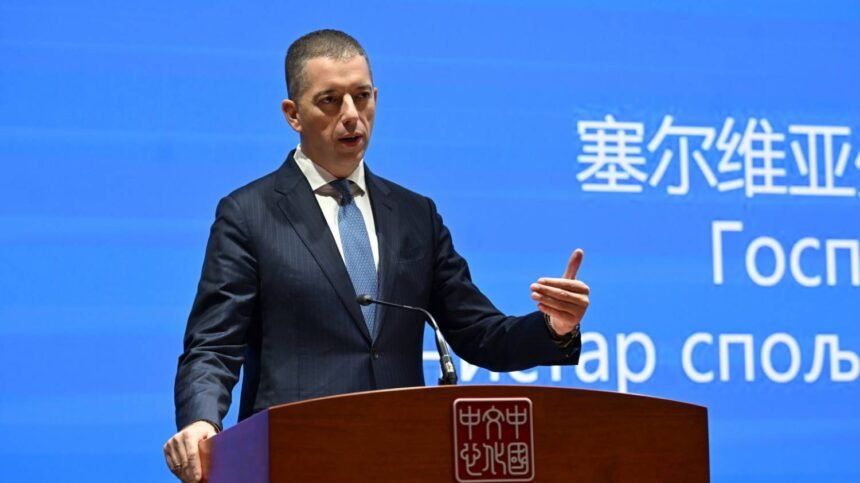
| IV: The Doctrine (May 11, 2026) | Đurić Statement: FM Đurić explicitly inverts the independence principle, naming ASM the absolute condition for progress. | Closure: Made in Brussels with EUSR Peter Sørensen; met with institutional silence, cementing it as the “operative reading.” |
The “Sørensen Effect” and Institutional Silence
Brovina highlights a critical shift in the mediation leadership. While previous mediators (Lajčák, Borrell) managed the “middle stage” of this sequence, the final consolidation occurred under the mandate of Peter Sørensen, the EU Special Representative who took office in early 2025.
The analysis suggests that the EU’s “dialogue-preservation reflex”—the desire to keep the process alive at any cost—has incentivized a policy of non-confrontation. This silence has allowed Belgrade to dictate what is “on the table” in negotiations, effectively resolving the dispute in Serbia’s favor by default.
Conclusion: A Hollowed Instrument
The diagnostic observation provided is that the Path to Normalisation Agreement is now two different things:
- On Paper: A binding 11-article document used by the European Commission for administrative reporting.
- In Practice: A tool for Belgrade to demand Article 7 (ASM) while vetoing any progress on Kosovo’s international status.
By repeating its reading without facing institutional contradiction, Belgrade has successfully “hollowed out” the 2023 agreement, turning a path to normalization into a doctrine of conditional engagement.