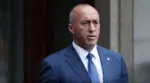
Writing for Serbian news outlet “Vreme” Journalist Andrej Ivanji sees Serbian President Aleksandar Vučić as someone who may believe that on Tuesday he is traveling to Brussels as the President of the Republic of Serbia, but in reality, he is going as the President of “Ćaciland” – a political construct of his own making, though he may not yet realize it.
In Belgrade, citizens seem to have become accustomed to the permanent occupation of Pionirski Park, the closure of Nikola Pašić Square, and the blockade of part of King Alexander Boulevard. They grumble but endure with their heads bowed.
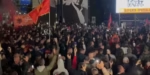
Yet, from outside Serbia, the scene in front of the National Assembly appears surreal. The government, which claims to enjoy overwhelming popular support, has created an informal tent camp in central Belgrade, patrolled day and night by police, where party loyalists and individuals with long criminal records freely circulate.
European Union officials whom Vučić regularly meets are well aware that this camp serves as a base for the Serbian Progressive Party’s paramilitary units — political strike groups used to intimidate opponents. EU Commission President Ursula von der Leyen knows exactly what this resembles: Germany’s SA (Sturmabteilung), the paramilitary wing of Hitler’s Nazi Party used to crush dissent.
A “Symbol of Serbia’s Existence”
For Vučić, “Ćaciland” represents the “symbol of Serbia’s existence” and an “oasis of freedom.” Following his twisted logic, he compares it to Asterix and Obelix’s small Gallic village resisting Caesar’s legions. But what is he really implying — that he’s Tandarabix, the irrelevant chief of the rebels?
According to the Office of the President of Ćaciland, Vučić is set to attend the EU Enlargement Summit in Brussels, organized by Euronews, and will meet European Council President António Costa and EU Commissioner for Enlargement Marta Kos. The president is also scheduled for several side meetings with EU officials — representing not Serbia, but his imagined “republic” of Ćaciland.
It would be fascinating to hear how he might justify the existence of this “oasis of freedom” — a self-proclaimed territory ruled by fear and impunity — while simultaneously seeking EU integration.
The Rule of Law: A Forgotten Prerequisite
The rule of law is the foundation of any country aspiring to EU membership. It includes something as simple as responding when hundreds of citizens file noise complaints over the deafening loudspeakers installed in “Ćaciland” — used as acoustic weapons by the regime’s loyalists — and yet, no institution reacts.
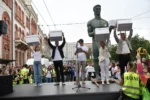
Beyond this, the use of party militias and the harassment of protesters, such as Dijana Hrka, who is currently on a hunger strike, illustrate the extent to which Vučić’s “oasis” has turned into a symbol of authoritarian control, not freedom.
Media as Vučić’s Greatest Enemy
Over the years, Vučić has turned the independent media into his greatest enemy, waging a relentless campaign of intimidation, censorship, and discreditation against journalists who challenge his authority.
However, this oppression of free speech is now backfiring.
Each day, the suppression of dissent only strengthens public resistance and exposes the fragility of Vučić’s grip on power.
His war on truth has become a war against himself, eroding what remains of democratic legitimacy in Serbia.