Serbia’s announcement that former Bosnian Serb military commander Ratko Mladić could be buried with the country’s highest state honors has triggered strong criticism from Bosniak representatives and civil society groups, who say such a move would send a “dangerous message” to the country’s Bosniak community.
Serbian Tourism and Youth Minister Husein Memić, a member of the government from the Sandžak Democratic Party, told Radio Free Europe that he would not attend or be part of Mladić’s funeral.
“Ratko Mladić is a man who was convicted by the Hague Tribunal, and there should be nothing more to say about that,” Memić said.
His comments came after Serbian Justice Minister Nenad Vujić announced on August 28 that Mladić would be buried with the “highest state honors.”
However, the Serbian government, Justice Ministry and Presidency have not confirmed to RFE/RL what role the state would play in the funeral.
President Aleksandar Vučić also sought to distance himself from the announcement, saying Mladić would be buried wherever his family wanted and that Serbian authorities currently had no information about the funeral arrangements.
Bosniak community condemns the announcement
The Bosniak National Council condemned the prospect of state honors for Mladić, arguing that it sends a “dangerous message” to Bosniaks in Serbia and called on officials not to glorify a convicted war criminal.
The Citizens’ Assembly of Novi Pazar, an informal civic organization that emerged during student protests, described the prospect of state honors for Mladić as “horrifying.”
“You cannot ask Bosniaks to trust institutions while simultaneously giving state recognition to a man convicted of genocide against their people,” the organization told RFE/RL.
Ahmed Delimeđac, a lawyer from Novi Pazar, said he was concerned that Mladić’s grave could become a site of glorification.
“This is a continuation of the path Serbia has been on for some time — strengthening, glorifying and recognizing war crimes,” he said.
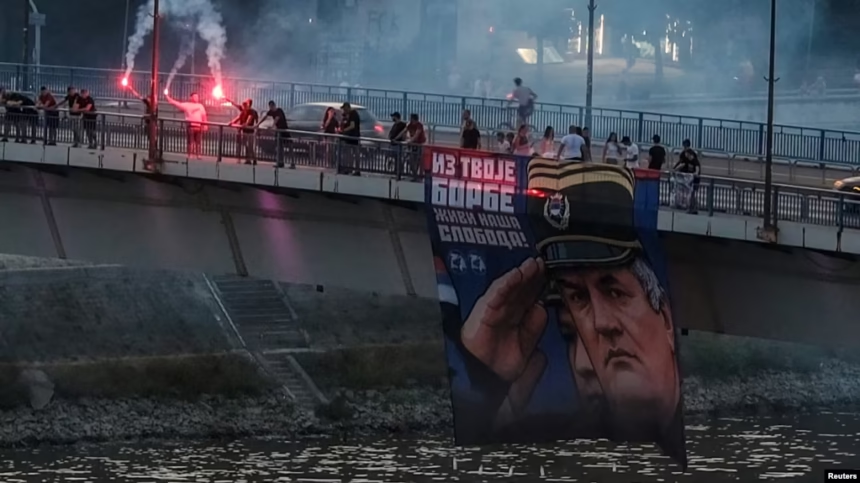
Messages praising Mladić have spread across Serbian and Republika Srpska media and public spaces following his death, including statements by politicians such as former Republika Srpska President Milorad Dodik, who described his death as a “killing.”
Mladić was convicted of genocide and war crimes
Mladić, the former commander of the Army of Republika Srpska, was convicted by the International Criminal Tribunal for the former Yugoslavia and sentenced to life imprisonment in 2021.
The Hague court found him guilty of genocide in Srebrenica, where around 8,000 Bosniak men and boys were killed in July 1995, as well as persecution, extermination, murder, forcible transfer, deportation, terrorizing civilians during the siege of Sarajevo and the taking of UN peacekeepers hostage.
He was convicted on 10 of 11 counts. He was acquitted of genocide charges relating to six municipalities in Bosnia and Herzegovina in 1992.
Mladić died in The Hague on August 27 after suffering from serious health problems.
The European Commission said on August 28 that it was up to Serbian authorities to determine what role they would play in his funeral, while emphasizing that glorification of war criminals is incompatible with fundamental European values.
Serbia’s record of honoring convicted war criminals
Critics say the controversy fits into a broader pattern of how Serbia has treated individuals convicted of war crimes committed during the wars of the 1990s.
Aleksandar Popov of the Center for Regionalism argued that Serbian authorities have long tolerated or promoted narratives that relativize war crimes rather than encouraging a process of confronting the past.
Vladimir Lazarević, a former Yugoslav Army general convicted of war crimes against Albanians in Kosovo, returned to Serbia in 2015 after serving 14 years of a 15-year sentence. He was welcomed by senior Serbian political and military officials and later became a lecturer at a military academy.
Former Yugoslav Army officer Veselin Šljivančanin, who was convicted over the killings at Ovčara in Croatia, appeared at events organized by Serbia’s ruling SNS after returning to Serbia in 2011 following his prison sentence. He was also seen alongside Vučić at a factory opening in 2017.
Nebojša Pavković, former commander of the Yugoslav Army’s Third Army and a convicted war criminal over crimes against Kosovo Albanians in 1999, was buried in Belgrade’s Alley of Distinguished Citizens in 2025 with full military honors.
Mladić’s legacy reaches beyond the funeral
The controversy has also spilled into sports stadiums.
Fans of Red Star Belgrade displayed banners honoring Mladić and chanted his name during a match against Viktoria Plzeň in the Czech Republic on the day of his death. Partizan fans also displayed his image during a match in Belgrade on August 31.
The Srebrenica Memorial Center has called on UEFA to permanently disqualify Red Star from European competitions following the display honoring Mladić.
In Novi Pazar, meanwhile, fans staged an anti-Mladić protest during a football match, throwing diapers onto the pitch while directing insults at the former commander.
The competing reactions illustrate how Mladić’s death has reopened unresolved questions over Serbia’s relationship with its wartime past.
For Bosniaks in Sandžak, the issue is particularly sensitive. Representatives of the community argue that granting state recognition to a man convicted of genocide would undermine trust in Serbian institutions and further normalize the glorification of wartime crimes.
The dispute over Mladić’s funeral is therefore about more than burial arrangements. It has become another test of whether Serbia will distance itself from the glorification of convicted war criminals or allow their legacy to remain part of the country’s public and political life.