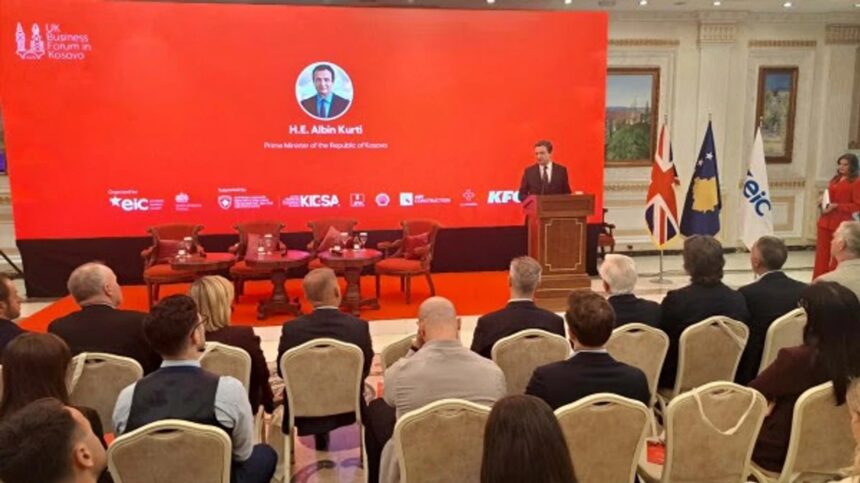
The British Business Forum in Pristina opened with messages focused on strengthening economic ties and friendship between Kosovo and the United Kingdom.
Kosovo Prime Minister Albin Kurti said Kosovo aims to expand its partnership with the United Kingdom beyond political and diplomatic relations, with a particular focus on strengthening economic ties.
Speaking at the British Business Forum in Kosovo 2026, Kurti said economic ties can create lasting relations between the two peoples, while businesses can create concrete opportunities through jobs, access to markets and the exchange of ideas.
“This is an event aimed at expanding our partnership with the United Kingdom beyond the excellent political and diplomatic relations we have. While our longstanding friendship and diplomatic relations have brought our two countries closer, it is economic ties that will create lasting connections between our peoples. Businesses do something that governments alone cannot do. They create concrete opportunities for people by creating jobs, opening markets and enabling ideas to cross borders.
“Since 1999, Kosovo and the United Kingdom have built a strong and lasting alliance. The United Kingdom’s commitment to Kosovo is also demonstrated through its contribution to KFOR and its support for our security and peace. It is therefore natural that cooperation between our two countries has been particularly strong in the field of defense,” Kurti said.
Kurti also highlighted cooperation between the two countries in the security sector, stressing that Kosovo and the United Kingdom have built a strong and enduring alliance since 1999.
He also recalled the arrival of the first NATO troops in Kosovo, led by then-KFOR commander, British General Michael Jackson.
“And we can never forget June 1999, when the first NATO troops to enter our country were British troops, led by the then-KFOR commander, General Michael Jackson. So, for a period of time in Kosovo, Michael Jackson was more famous as a British Army general than as the King of Pop. And perhaps, on our part, we responded with our own shared Queen of Pop, Dua Lipa.
“Today, we are proud that Kosovo has not simply been a beneficiary of such support, but has also taken an active role in contributing to international security,” Kurti said.
Meanwhile, British Ambassador to Kosovo Jonathan Hargreaves congratulated Kosovo on the election of its new president and said relations between the two countries cannot rely solely on their shared history but must continue to develop through economic cooperation.
Hargreaves said the next chapter in Kosovo-UK relations should increasingly focus on business, investment, innovation and shared prosperity.
“Let me begin, Prime Minister, by congratulating Kosovo on the election of its new president. Not only because, as far as I know, this is the third or, according to some calculations, the fourth woman to have served as president of Kosovo. As far as I know, that is a record. And it is also a fantastic example for the rest of the world.
“But it is also an extraordinary opportunity for a fresh start, a new era in Kosovo’s development, even more firmly connected economically, politically and in terms of security with your European neighbors and with Euro-Atlantic institutions,” he said.
He expressed optimism that the next chapter of relations between the United Kingdom and Kosovo should and would increasingly be about business.
“When people think about relations between the United Kingdom and Kosovo, I dare say they often think first about security, politics or diplomacy. And that is understandable, because in the United Kingdom we are proud to have stood alongside Kosovo at the most important moments in its history.
“And many Kosovars, including undoubtedly many of you here today, have family memories of that support and partnership over the years. Many British diplomats, soldiers and aid workers have devoted years of their lives to helping Kosovo build its future.
“But, as we all know, good relations cannot rely on history alone. They continue to develop and are sustained by the future. And I think we are here today because we believe that the next chapter in relations between the United Kingdom and Kosovo should and will increasingly be about business, investment, innovation and the shared prosperity of our peoples,” he said.
He stressed that optimism about Kosovo’s future must be accompanied by honesty and improvements in the business environment for investors.
“It is good to be optimistic, and I think we all feel particularly optimistic about Kosovo’s future today. But, of course, the real test of optimism is whether those roots — the ‘radical’ part — are deep and firmly planted.
“So optimism must be accompanied by honesty. I know investors see opportunities in Kosovo, and attracting investors is, of course, important. But keeping them satisfied is even more important. They need quick answers, clear guidance and institutions with which it is easy and fast to do business.
“Our political relationship remains stronger than our economic relationship, while the people-to-people ties between us remain stronger than our economic ties,” he said.
Meanwhile, Emrush Ujkani, Executive Director of the European Council of Investors, said the commitment to economic cooperation must be translated into concrete steps.
According to him, investment requires confidence in the stability of the rules, the institutions that enforce them and the ability of partners to fulfill their commitments.
“Our task today is to turn this commitment into concrete steps through this forum. Economic partnerships develop when businesses can identify a credible opportunity and understand the conditions under which they can pursue it.
“Investments require confidence in the stability of the rules, in the institutions that enforce them and in the ability of partners to fulfill their commitments. For a country seeking sustainable development, these considerations are essential. Capital can finance projects, but the quality of governance and implementation determines whether a project can create long-term value,” Ujkani said.