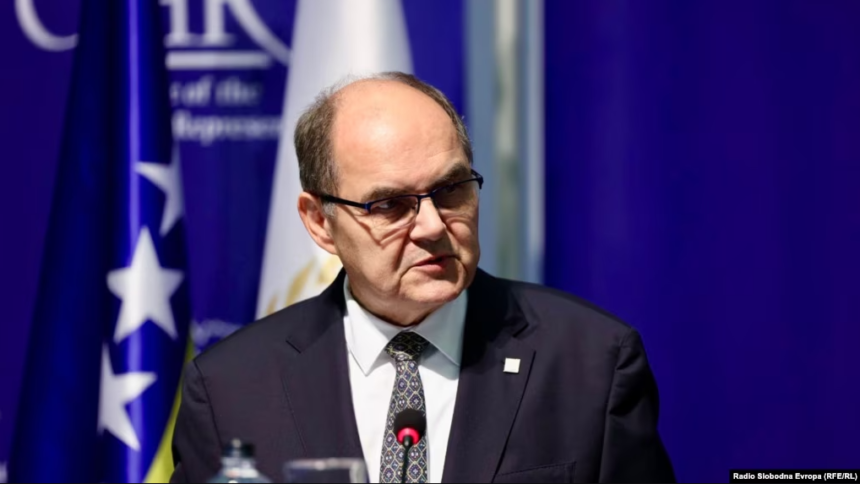
In a major development for the stability of the Western Balkans, Christian Schmidt has officially announced his personal decision to resign from his post as the High Representative for Bosnia and Herzegovina. The Office of the High Representative (OHR) issued the announcement on Monday, May 11, 2026.
Schmidt has formally notified the Steering Board of the Peace Implementation Council (PIC) of his departure and has requested the immediate initiation of the process to appoint his successor.
A “Personal Decision” Amid Regional Tension
While the OHR described the move as a “personal decision,” it comes at a time of heightened political friction within Bosnia and Herzegovina. Schmidt emphasized that he will remain in his role during the transition period to ensure continuity.
“The united international community remains indispensable for the stability of Bosnia and Herzegovina and for its progress toward Euro-Atlantic aspirations,” Schmidt stated in the official release.
He called upon citizens and political leaders from both entities—the Federation of BiH and Republika Srpska—to intensify their reform efforts and collaborate with his eventual successor to achieve key integration milestones.
The Role of the High Representative
Established by the Dayton Peace Agreement in 1995, the OHR is tasked with overseeing the civilian implementation of peace. The High Representative holds significant authority, known as the “Bonn Powers,” which include:
- The ability to impose or amend laws.
- The power to change the Constitution of BiH.
- The authority to dismiss elected officials who obstruct the peace process.
Schmidt, a politician from Germany’s Christian Social Union (CSU) and former Minister of Agriculture, took over the position in 2021 from Austrian diplomat Valentin Inzko. His tenure was marked by frequent clashes with leadership in the Republika Srpska over the use of his executive powers.
The Road Ahead: Appointing a Successor
The process to replace Schmidt involves a multi-step international consensus:
- PIC Nomination: The Steering Board of the Peace Implementation Council—comprising the U.S., UK, Germany, France, Italy, Canada, Japan, the EU, Turkey, and Russia—must agree on a candidate.
- UN Confirmation: The nominee must then be confirmed by the United Nations Security Council.
Given the current geopolitical climate, particularly the stance of Russia within the PIC and the UN Security Council, the appointment of a new High Representative is expected to be a contentious and difficult diplomatic process.
Legacy of the OHR
Since 1995, the OHR has been led by various European diplomats, including Carl Bildt, Paddy Ashdown, and Miroslav Lajčák. Schmidt’s resignation marks the end of a high-pressure chapter in the OHR’s history, leaving the “Bonn Powers” in a state of transition during one of the region’s most sensitive political periods.