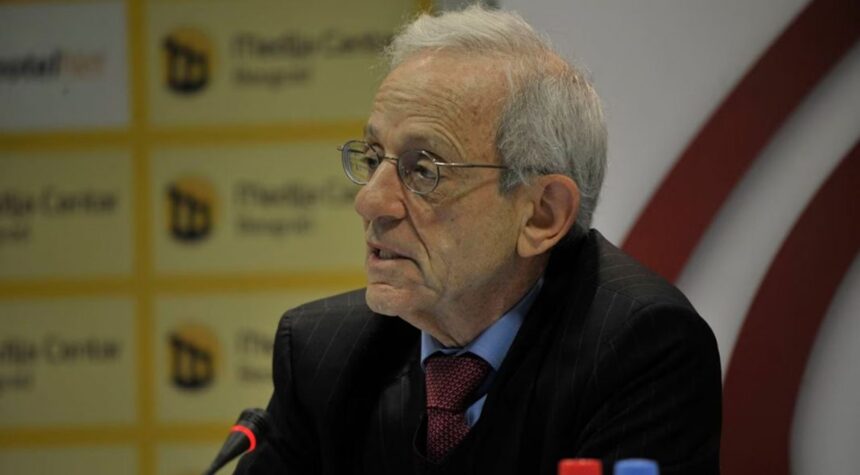
Renowned American foreign policy analyst Daniel Serwer stated that true reconciliation cannot be forced upon survivors of wartime violence. Instead, societies must focus on constructing cultural and functional milestones aimed at a better future rather than dwelling on historical grievances.
Serwer delivered his analysis via a live video link to participants at the International Conference titled “Bridges of Memory: Reconciliation and Transitional Justice in Post-Conflict Societies, Diplomacy, Memory, and Historical Interpretation,” held in Prishtina today, June 10, 2026.
Revisiting Transitional Justice and Memory
During his address, the veteran Balkan expert questioned the current effectiveness of judicial and memory frameworks in the region, arguing that standard mechanisms have failed to yield genuine reconciliation.
“The courts that demand a reaction from Albanians must return to their proper place. Memories have not become a bridge, and justice has not truly been transitional. We cannot demand that those who have experienced violence simply reconcile. I believe we must build bridges for a better future, not for the past,” Serwer remarked.
A Bold Proposal: Internationalized Education to Heal Division
To counter the persistent ethnic and physical partition within the country, Serwer introduced a progressive educational blueprint designed to naturally integrate future generations.
- Overcoming Separation: He noted that a rigid physical division still exists in Kosovo, which limits cross-community interaction.
- The Blueprint: Serwer proposed that Kosovo implement a comprehensive international education system, spanning from kindergarten all the way through university.
- The Outcome: Under this model, students would study in a shared international language, which would simultaneously elevate their future global employment prospects.
- Mutual Understanding: While acknowledging that the transition would face obstacles, he emphasized that it would naturally encourage children to learn each other’s native languages in a shared environment.
Concluding his remarks, the analyst reminded the audience that while individuals have every right to pursue their personal demands for justice, the reality remains that communities must actively share their future together.