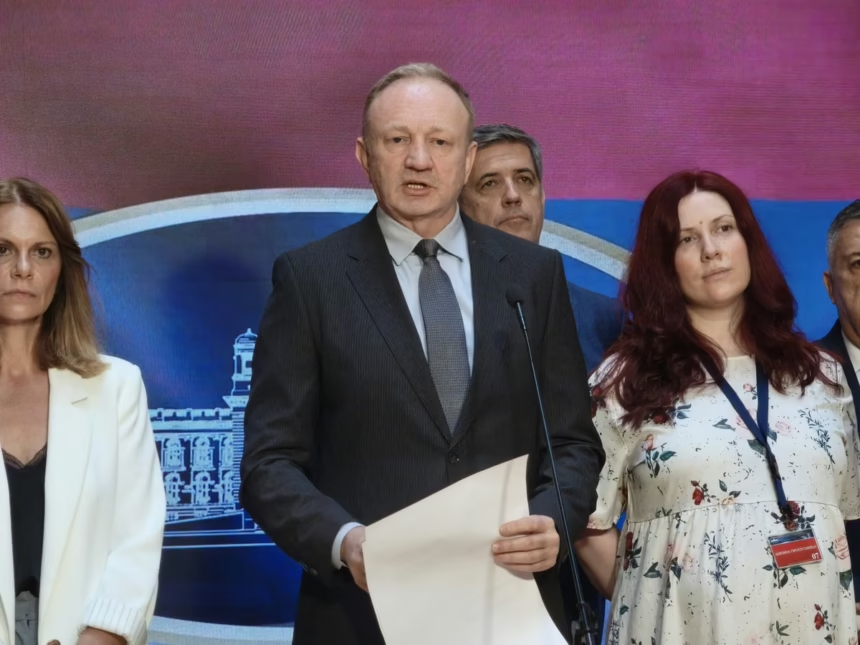
Serbian opposition leader Dragan Đilas has accused the government of President Aleksandar Vučić of deeply dividing society, weakening state institutions and creating what he described as a “false reality” while the country itself deteriorated.
Speaking in the Serbian Parliament, Đilas, leader of the Freedom and Justice Party (SSP), recalled a speech he delivered two years ago in which he accused the government of being controlled by what he called an organized criminal group with political, militant, institutional and media components.
He alleged that the political component was represented by the Serbian Progressive Party (SNS), while the militant wing consisted of “criminals, thugs and hooligans” allegedly cooperating with the ruling party.
Đilas also accused parts of the prosecution, police, Security Intelligence Agency (BIA), judiciary, tax administration and other institutions of protecting regime loyalists and targeting political opponents.
He described Serbia’s pro-government media landscape as another pillar of the system, accusing tabloids, online portals and national television broadcasters of misleading the public, glorifying Vučić and attacking critics of the government.
“You created a false reality”
Đilas said the government had pushed social divisions to unprecedented levels, creating an environment in which people increasingly viewed one another as either “traitors” or “patriots.”
“You created a false reality. And while you kept that false image alive, the real Serbia was sinking,” Đilas said.
He argued that the country had suffered from the deterioration of institutions, public trust and social cohesion, warning that generations had grown up witnessing divisions among neighbors, colleagues and even family members.
Đilas also accused the government of repeatedly making promises without delivering on them and of responding to unfulfilled commitments with new promises rather than accountability.
Opposition proposals rejected
The SSP leader cited several legislative proposals that he said would have benefited Serbia but were rejected by the government.
Among them were measures aimed at reducing the number of betting shops and gambling facilities, judicial reforms and legislation intended to implement recommendations from the Organization for Security and Co-operation in Europe’s Office for Democratic Institutions and Human Rights (ODIHR) and improve electoral conditions.
He also cited proposals concerning an alimony fund and support for parents caring for children, arguing that the government later adopted its own versions without adequately addressing the problems.
Đilas further challenged official economic claims, arguing that statements about Serbia’s gross domestic product reaching nearly €90 billion in 2025 referred to nominal GDP affected by inflation rather than reflecting the underlying economic performance.
“Vučić and SNS are not Serbia”
Đilas said Vučić would eventually be judged harshly by history and accused his government of creating a system in which political loyalty had become more important than competence.
“To save Serbia, Vučić and his regime must go,” he said, calling for a united opposition front capable of defending every vote and preparing for the period after the elections.
He stressed that “Vučić and the Serbian Progressive Party are not Serbia,” arguing that the country belongs to its citizens rather than to one political party or leader.
Đilas said the SSP had prepared a plan for what should follow a change of government, promising not a problem-free country but a functioning state in which employment would depend on qualifications rather than party membership.
“Our job is not only to remove Aleksandar Vučić. Our job is to build a country in which there can never be another Vučić after him,” Đilas said.