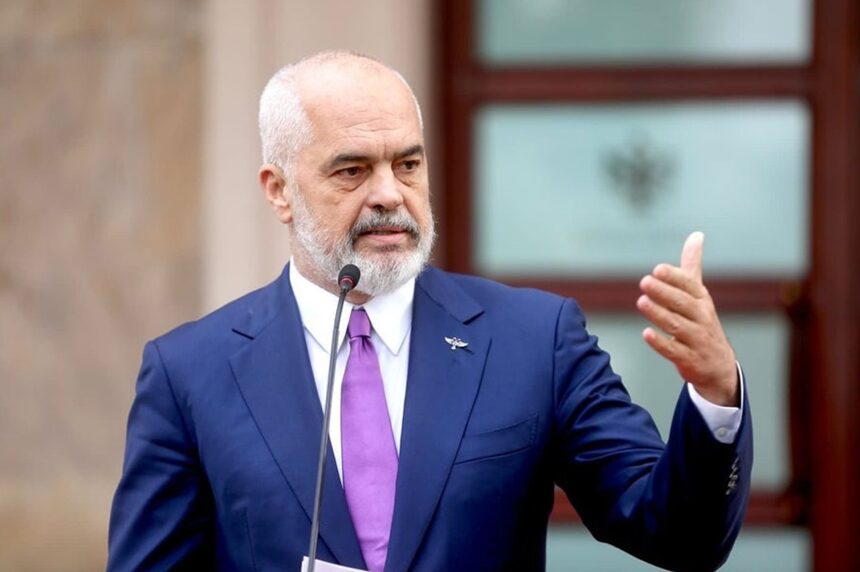
In a candid interview with Euronews Serbia, Albanian Prime Minister Edi Rama shed light on the complex nature of regional diplomacy, describing Serbian President Aleksandar Vučić as a “difficult partner” while explaining the deep-seated skepticism that surrounded the “Open Balkan” initiative.
Rama argued that the regional integration project was largely condemned not because of its economic or political merits, but due to the controversial reputations of the leaders championing it.
The Personification of Politics in the Balkans
When asked why the “Open Balkan” initiative faced intense criticism and suspicion across several regional capitals and international circles, Rama delivered a blunt assessment of Balkan political psychology:
“It was considered a terrible idea for only one reason—because Vučić and I were behind it. If you removed our names and replaced them with, say, five others, it would have been considered a brilliant idea. That is simply how everything works in the Balkans.”
According to the Albanian Prime Minister, deep-seated political mistrust and personal animosities often overshadow the practical benefits of cross-border cooperation, leaving strategic initiatives hostage to the names of their authors.
A Complex Partnership
In the interview, Rama did not shy away from characterizing his relationship with the Serbian President. He openly acknowledged that cooperating with Aleksandar Vučić is a continuous diplomatic challenge, labeling him “always a difficult partner.”
Despite their contrasting political stances—most notably regarding the status of Kosovo—both leaders have consistently engaged in direct dialogue, arguing that economic pragmatism must precede political resolution.
Montenegro’s ‘Yellow Submarine’ Transformation
Beyond Belgrade-Tirana dynamics, Rama highly praised the political and economic evolution of Montenegro, using a colorful maritime analogy to describe its path toward European integration:
- From Smuggling to Consensus: Rama commended Montenegro’s transition from what he termed “a ship linked to smuggling” into “a yellow submarine that everyone likes.”
- The Integration Journey: While tipping his hat to Podgorica’s extraordinary reforms, the Albanian Premier cautioned that individual progress “alone is not enough” to secure the collective future of the region.
A Mutual Need: The Western Balkans and Europe
Concluding his remarks, Rama emphasized that geopolitical realities have shifted the balance of necessity between the region and Brussels. He maintained that Europe today needs the Western Balkans just as much as the Western Balkans needs Europe to ensure long-term continental security and economic stability.