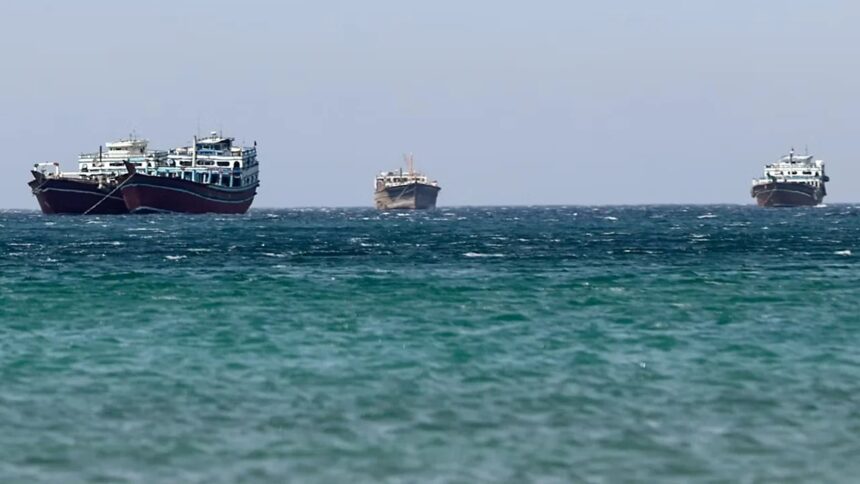
In a major and dangerous escalation along the world’s most vital energy corridor, two United Arab Emirates oil tankers were struck by Iranian cruise missiles in the Strait of Hormuz on Tuesday, leaving one crew member dead and eight others injured.
The UAE Ministry of Defense strongly condemned the strike, which targeted the vessels Mombasa and Al Bahiyah while they were transiting the southern shipping lane of the strait within the territorial waters of Oman.
Casualties and Vessel Damage
According to official military statements, the missile strikes caused immediate fires on both vessels, which have since been brought under control by emergency crews.
- Fatalities: One Indian crew member aboard the Mombasa was killed in the attack.
- Injuries: Eight crew members were wounded, four of them critically. The injured list includes six Indian nationals and two Ukrainians.
- Property Damage: Both national tankers sustained significant material damage to their hulls and structures.
Conflicting Narratives: Piracy vs. “Offending” Vessels
The incident has triggered a fierce war of words between Abu Dhabi, its international allies, and Tehran.
“Targeting commercial shipping and using the Strait of Hormuz as a tool of economic coercion or blackmail constitutes an act of piracy and poses a direct threat to the stability of the region and global energy security.”
— UAE Ministry of Foreign Affairs (MoFA)
The UAE affirmed its “full right to respond to this hostile escalation” and declared it has placed its national security forces on a heightened state of readiness.
Conversely, Iran’s Islamic Revolutionary Guard Corps (IRGC) issued a statement claiming they targeted and disabled two “offending” supertankers. The IRGC asserted the vessels were hit after ignoring repeated warnings, turning off their tracking systems, and attempting to sail through a mined route.
The IRGC did not explicitly name the Mombasa or Al Bahiyah, but accused the United States of inciting foreign commercial vessels to use “illegal routes,” warning that cooperation with Washington would only destabilize global energy markets further.
A Widening Geopolitical Conflict
The missile strikes occurred amidst a rapidly deteriorating security environment in the Middle East, following weeks of high-intensity conflict that began on February 28, when the US and Israel launched joint military operations against Iran.
The strikes on the UAE tankers followed a third consecutive night of US military airstrikes targeting Iranian positions. In response to the growing threat, US President Donald Trump announced the reinstatement of a naval blockade on Iranian ports while proposing a 20 percent tariff to fund security patrols in the Strait of Hormuz—a measure the UN shipping agency has already publicly opposed.
| Actor | Action / Position | Strategic Objective |
| Iran (IRGC) | Fired cruise missiles, declared the Strait closed | To push back against US/Israeli military pressure and enforce its blockade. |
| United States | Executed 3 nights of airstrikes, proposed tariffs | To degrade Iranian military capabilities and keep the strategic shipping lane open. |
| UAE & Oman | Condemned attacks, declared readiness to respond | To protect sovereign territorial waters and secure critical commercial shipping routes. |
With regional skies filled with interceptors and maritime traffic through the Strait already down by over 52 percent, this latest attack on civilian shipping raises the immediate threat of a broader, unrestricted maritime war in the Gulf.