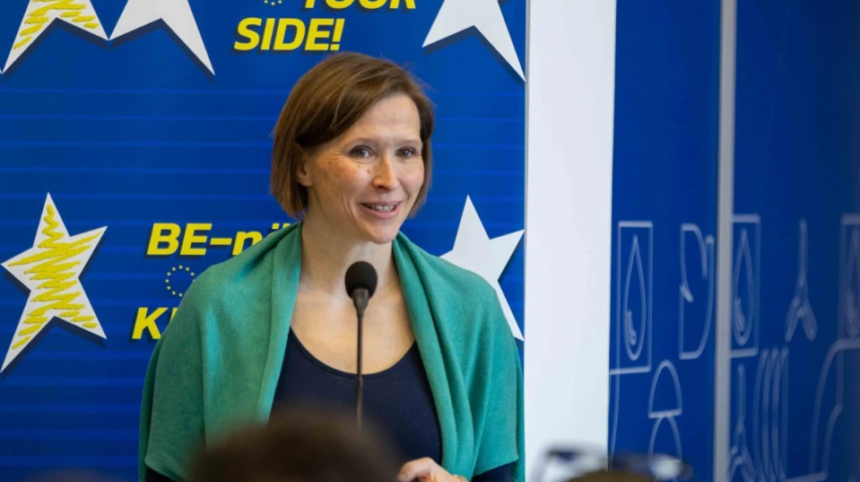
Eva Palatova, the Acting Head of the European Union Office in Kosovo, issued a public statement on Monday congratulating Prime Minister Albin Kurti on his party’s electoral victory in Sunday’s snap parliamentary elections. The EU diplomat also extended her congratulations to all political parties that secured representation and issued an urgent appeal for the swift constitution of the country’s new governing institutions.
Palatova underscored that with the election day successfully concluded, the focus must immediately shift toward inter-party dialogue, political compromise, and institutional continuity.
A Call for Political Compromise and EU Integration
The EU envoy’s remarks come at a delicate time for Prishtina, as preliminary data shows Kurti’s Lëvizja Vetëvendosje (LVV) short of a standalone legislative majority, meaning cross-party coalitions or ad-hoc voting alliances will be mandatory to form a government and elect a head of state.
Palatova emphasized that the incoming administration must prioritize long-term stability over narrow partisan interests to ensure that Kosovo’s European perspective remains on track.
“Now is the time for political compromise and the creation of stable institutions,” Palatova noted in her official reaction. “Putting the primary interest of the citizens and Kosovo’s European integration process at the forefront must be the absolute priority of all political actors.”
Institutional Stability as a Catalyst for Reforms
The European Union’s message underscores Brussels’ desire to avoid a prolonged political vacuum in the Western Balkans, especially given the frozen status of regional integration talks and heightened geopolitical friction.
Palatova concluded by reiterating that a functional parliament and a fully empowered executive branch are essential requirements for implementing key structural reforms:
- Inter-Party Cooperation: Fostering a constructive relationship between the ruling majority and the newly elected opposition spectrum to pass critical laws.
- Concrete Results for Citizens: Addressing domestic economic challenges, rule-of-law benchmarks, and judicial independence.
- Advancing the European Path: Aligning domestic legislation with EU standards to unlock deeper financial assistance and political integration.
As the Central Election Commission (CEC) continues the process of verifying and counting conditional and diaspora ballots, Brussels’ early diplomatic intervention serves as an implicit reminder that the international community expects a mature, rapid transition of power free from prolonged constitutional gridlock.