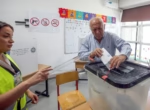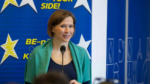
Following the preliminary results of Kosovo’s snap parliamentary elections, the main opposition parties have signaled their readiness to enter coalition negotiations to ensure the swift formation of state institutions. In a notable shift away from past political polarization, both the Democratic League of Kosovo (LDK) and the Democratic Party of Kosovo (PDK) announced they hold no “red lines” against any ethnic Albanian parties—including Prime Minister Albin Kurti’s winning Lëvizja Vetëvendosje (LVV)—saving their absolute refusal to cooperate exclusively for the Belgrade-backed Srpska Lista.
However, despite the general openness to dialogue, a complex institutional battle is brewing over the presidency. The position of LDK’s candidate, Vjosa Osmani, has quickly emerged as the pivotal bargaining chip—and a potential obstacle—in the upcoming matrix of coalition building.
LDK Opens the Door to Talks but Anchors on the Presidency
On Sunday evening, immediately following the release of initial ballot counts, LDK Chairman Lumir Abdixhiku set the tone for his party’s post-election strategy. He underscored that preventing an institutional vacuum is the party’s top priority, while firmly excluding Belgrade’s proxies from any governance calculations.
“We have no red lines for any Albanian party, except for Srpska Lista. For us, it is paramount to establish our institutions,” Abdixhiku stated.
[The Post-Election Coalition Landscape]
• Absolute Red Line: Both LDK and PDK completely refuse to negotiate with Srpska Lista.
• Open Channels: Opposition is willing to sit down with Kurti's Lëvizja Vetëvendosje (LVV).
• The Presidency Leverage: LDK centers its talks on installing Vjosa Osmani as Head of State.
Despite the flexible rhetoric regarding a government cabinet, LDK’s specific terms for the Head of State remain unyielding. Vjosa Osmani, who serves as LDK’s list bearer and formal presidential nominee, adopted a firm stance on Sunday, declaring:
“Lëvizja Vetëvendosje has absolutely no reason to reject me as the seventh President of the Republic of Kosovo.”
By Monday, however, as cross-party mathematics began to settle, Osmani softened her public tone in a Facebook address to voters. While thanking citizens for their support, she noted that “my name has never been, is not, and will never become an obstacle to the creation of Kosovo’s institutions,” signaling room for tactical maneuvering.
PDK Urges Rapid State Formation Without Preconditions
The Democratic Party of Kosovo (PDK), which successfully maintained its status as the largest opposition force and the second-largest party in the country, mirrored the call for political maturity.
During a press conference on Monday, PDK Chairman Bedri Hamza acknowledged that while his party had hoped for a stronger electoral turnout, the focus must immediately pivot toward constitutional stability.
“I have never had red lines for any party, not now and not in past elections,” Hamza emphasized. “I believe that the work to form institutions must begin immediately. What is vital is to constitute the Assembly as quickly as possible, form the government, and elect the President so that we do not face an institutional vacuum.”
Analysts Warn of “Contradictory Postures” and Turnout Punishment
Political analysts view the sudden drop in voter turnout on June 7 as a collective reprimand from the electorate toward the entire political establishment. Furthermore, experts warn that LDK’s dual messaging could inadvertently stall the very negotiations they claim to welcome.
Albinot Maloku, a prominent political analyst, pointed out the logical friction between LDK’s lack of “red lines” and their rigid insistence on the presidency:
“Even in yesterday’s declarations, we saw a powerful dualism,” Maloku observed. “If a party claims that the absolute starting point for any governance agreement is their specific candidate for president, but in the same breath says they have no red lines, these two stances simply do not align. When you truly have no red lines, alternatives must remain open, and you do not rigidly dictate the starting point.”
As the Central Election Commission (CEC) prepares to count conditional, postal, and diaspora ballots to finalize the exact seat allocations in the 120-seat Assembly, the opposition’s willingness to talk has averted an immediate political dead-end. Nevertheless, the price of a stable government under Albin Kurti will heavily depend on whether Vetëvendosje is willing to concede the presidency to the opposition, or if the parties can find a compromise candidate to prevent yet another prolonged legislative paralysis.