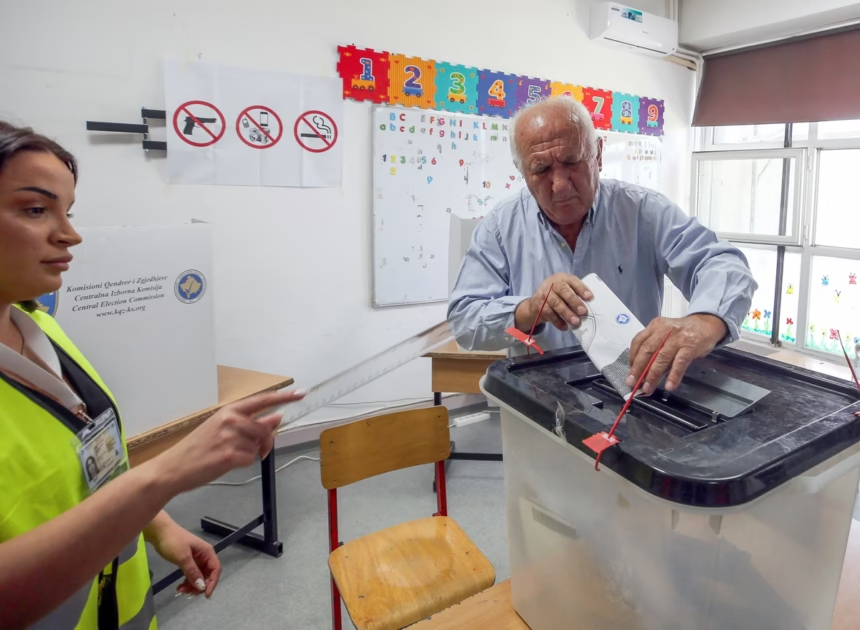
The Parliamentary Assembly of the Council of Europe (PACE) released its preliminary findings on Monday following Sunday’s snap parliamentary elections in Kosovo. Julian Bulai, the head of the PACE observation delegation, stated that while the electoral process was conducted in an orderly and professional manner without major security incidents, monitors detected clear external interference emanating from Serbia, alongside a coordinated wave of online disinformation.
The seven-member PACE delegation was the sole international mission monitoring the ground on election day. Despite praising the peaceful atmosphere at polling stations, the delegation warned that a noticeable drop in voter turnout signals deeper systemic issues that Kosovo’s political leadership must address.
External Influences and Campaign Irregularities
The observation mission raised significant flags regarding the integrity of the broader campaign environment leading up to the June 7, 2026 vote. Beyond digital disinformation campaigns designed to sway public opinion, PACE expressed formal concern over the misuse of state resources by domestic parties and the logistical vulnerabilities of the diaspora voting system.
Most critically, Julian Bulai explicitly pointed to external state-driven manipulation:
“The observation mission noticed external influences, particularly coming from Serbia,” Bulai confirmed during the presentation of the preliminary report, referencing the geopolitical pressure surrounding representation for the Kosovo Serb minority.
Despite these pressures, Bulai congratulated the citizens of Kosovo on their visible commitment to democracy, while simultaneously urging newly elected officials to put an end to chronic institutional paralysis.
Preliminary Election Results and the Looming Institutional Crisis
According to the preliminary data released by the Central Election Commission (CEC) of Kosovo—which excludes conditional ballots, mail-in votes, and diplomatic mission registries—the ruling party has clinched another victory, though it faces a complex path to forming a stable government.
[Kosovo Assembly Seat Projections (Preliminary Data)]
• Lëvizja Vetëvendosje (LVV):  42.91% ──> 48 Seats
• Democratic Party of Kosovo (PDK): 21.12% ──> 24 Seats
• Democratic League of Kosovo (LDK): 17.58% ──> 20 Seats
• Alliance for the Future of Kosovo (AAK): 7.16% ──> 8 Seats
* Note: 20 seats remain constitutionally reserved for minorities (10 for the Serb community).
Prime Minister Albin Kurti’s Lëvizja Vetëvendosje (LVV) secured the top spot with 42.91% of the vote, yielding 48 seats in the 120-seat Assembly. This leaves them short of an absolute majority.
The opposition spectrum is led by the Democratic Party of Kosovo (PDK) with 21.12% (24 seats), followed by the Democratic League of Kosovo (LDK) with 17.58% (20 seats), and the AAK Alliance with 7.16% (8 seats). Meanwhile, the Belgrade-backed Srpska Lista absorbed 6.18% of the total vote, dominating the 10 seats strictly reserved for the ethnic Serb community.
Political analysts warn that while Kurti secured a mathematical victory, he remains in a precarious position, facing a potential institutional crisis and grueling coalition talks to avoid total legislative gridlock.