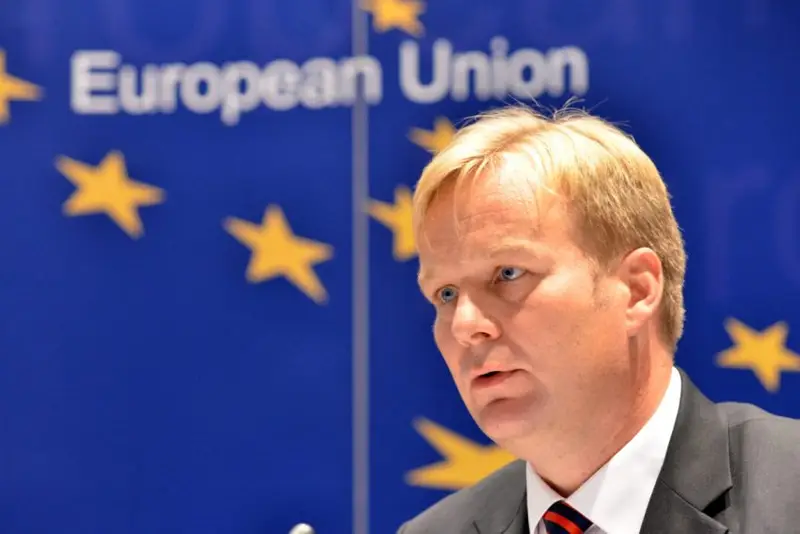
European Union Special Representative for the Kosovo-Serbia Dialogue Peter Sorensen has warned that implementation of the commitments arising from the 2023 Agreement on the Path to Normalisation and its Implementation Annex remains significantly behind schedule, stressing that both Prishtina and Belgrade must act without waiting for the other side.
In an interview with Gazeta Express, Sorensen said the agreements are legally binding and that their implementation is not optional.
“Implementation is not at the level it should be. And implementation is not ‘optional’. Both sides know this; the EU and its member states have said this many times,” Sorensen said.
He rejected the idea that progress depends on determining which side should make the first move, arguing that both parties have parallel obligations that must be fulfilled.
“It is not about who makes the first move. Neither side needs to wait for the other,” he said.
According to Sorensen, Kosovo’s obligations under the Implementation Annex are clear, including those stemming from Article 7. At the same time, Serbia has its own outstanding commitments, including obligations related to not opposing Kosovo’s membership in international organizations and accepting Kosovo’s documents and symbols.
“Serbia’s obligations stand in parallel. Both are equally delayed,” Sorensen said.
The EU envoy also emphasized that the passage of time does not alter the commitments undertaken by either party.
“The 2023 Agreement and its Annex remain in force. They are legally binding on both sides. The passage of time changes nothing,” he said.
Asked about the possibility of another high-level meeting between Kosovo and Serbia, Sorensen said such a meeting would only be convened when there is a realistic prospect of achieving concrete results.
“A high-level meeting is neither a reward nor an opportunity for photographs. It is convened when it can help achieve a result,” he said.
Sorensen also stressed that increased involvement by senior EU officials, including EU foreign policy chief Kaja Kallas, cannot substitute for decisions that must ultimately be made by Prishtina and Belgrade themselves.
“No external actor can implement these agreements on their behalf. Only Belgrade and Prishtina can do that,” Sorensen concluded.
His comments come amid continued delays in implementing key elements of the normalization framework, with the EU maintaining pressure on both sides to fulfill their respective obligations rather than conditioning progress on reciprocal steps.