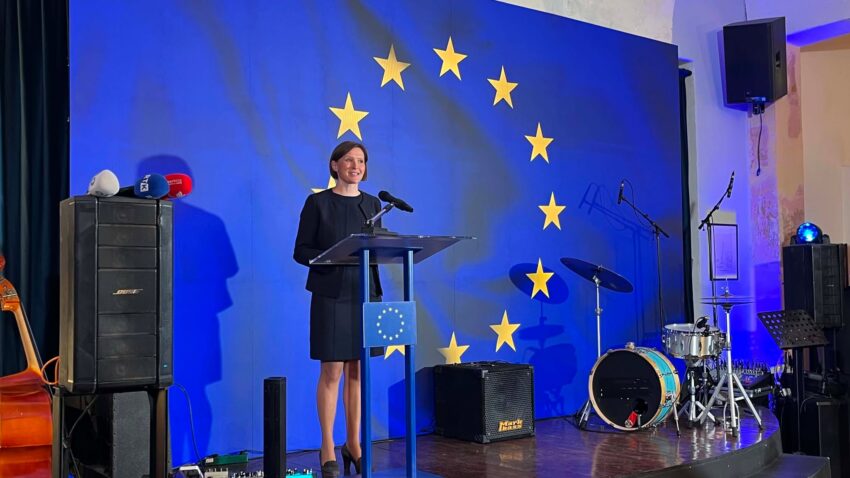
During an event marking Europe Day (May 9), Eva Palatova, the Acting Head of the EU Office in Kosovo, delivered a candid assessment of Kosovo’s path toward European integration. She emphasized that EU candidate status is not granted automatically and requires the unanimous backing of all 27 member states.
Addressing Prime Minister Albin Kurti directly, Palatova outlined the specific expectations Brussels has for Kosovo as it approaches a critical electoral period.
The Road to Candidate Status
Palatova acknowledged Kosovo’s ambition to advance its membership application, originally submitted during the Czech Presidency in Prague. However, she stressed that the responsibility for progress lies primarily with Pristina’s ability to build consensus among European capitals.
“Brussels cannot simply give candidate status. You must convince the 27 member states,” Palatova stated, highlighting that diplomatic persuasion must be backed by concrete domestic results.
Three Key Pillars for Progress
The EU official identified three essential elements that Kosovo must fulfill to strengthen its bid:
- Free and Fair Elections: With parliamentary elections scheduled exactly one month from today, Palatova emphasized that they must be “free, fair, and inclusive” to uphold Kosovo’s standing as a vibrant democracy.
- Rapid Institutional Formation: Brussels expects the swift creation of a new government following the elections. This government should be backed by a strong parliamentary majority capable of achieving cross-party compromises and electing a president.
- Multi-ethnic Character and Minority Rights: The treatment of non-majority communities is a primary concern for EU capitals. Palatova noted that all Kosovars, regardless of ethnicity, must feel they have a home and a future in the country.
The Dialogue and the “Yerevan Agreement”
A significant portion of the EU’s evaluation relies on Kosovo’s engagement in the Belgrade-Pristina Dialogue. Palatova underscored the importance of the March 14 agreement (likely referring to a 2026 implementation milestone) and the commitments reaffirmed by Prime Minister Kurti this week at the European Political Community Summit in Yerevan.
- Good Faith Implementation: The EU expects all agreements to be implemented in good faith to maintain diplomatic momentum.
- The Thessaloniki Promise: Palatova noted that while the 2003 Thessaloniki Summit promised a European perspective for the Western Balkans, the EU of 2026 has different standards and complexities than it did two decades ago.
Conclusion
Palatova concluded by stating that while the EU is present to assist, the “tangibility” of candidate status depends on the unified cooperation of Kosovo’s political leadership across the spectrum. The upcoming month is seen as a litmus test for Kosovo’s institutional stability and democratic maturity.