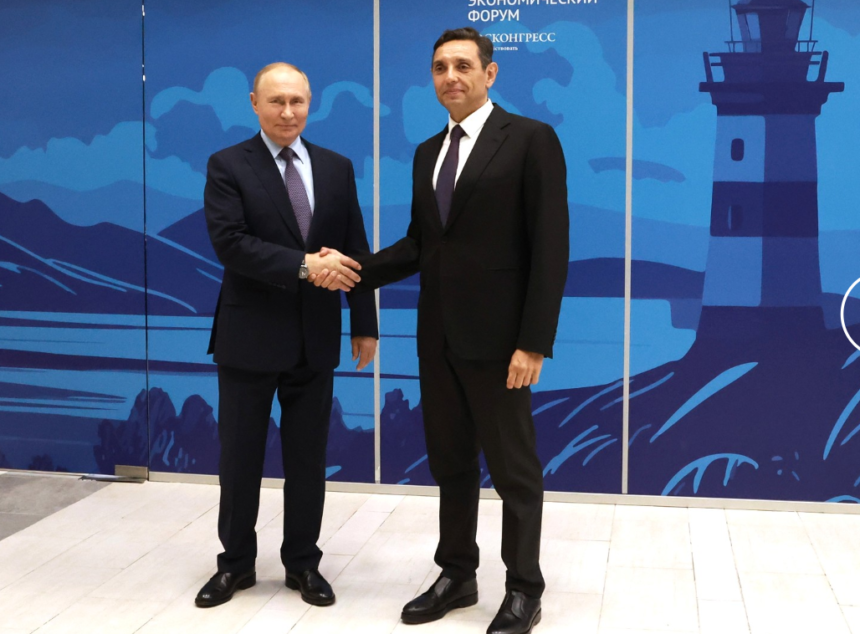
As Moscow prepares for its annual Victory Day parade on May 9, a deepening rift in Serbian political life has exposed what analysts call a “dual-layer” foreign policy, where the government’s formal alignment with Europe is increasingly undermined by a louder, pro-Russian parallel layer.
The controversy was ignited this week by a high-profile interview on Sputnik Srbija featuring Aleksandar Vulin, the former Director of Serbia’s Security and Intelligence Agency (BIA) and a recently departed Deputy Prime Minister. In the interview, Vulin characterized the European Union as the ideological “heir of Nazism,” claiming the institution is defined by its refusal to honor the Soviet liberation of Europe.
The comments, delivered just three days before the Moscow parade, have raised urgent questions in Brussels about the sincerity of Serbia’s EU accession process.
The “Vulin Pipeline”: Relocation, Not Removal
International observers initially read Vulin’s removal from the cabinet of Prime Minister Đuro Macut in April 2025 as a concession to Western pressure. Macut, an endocrinologist brought in as an independent to defuse the massive student protests triggered by the 2024 Novi Sad railway station tragedy, was seen as a move toward technocratic reform.
However, critics now argue that Vulin’s exclusion was merely a strategic relocation.
- Operational Influence: Despite lacking a formal cabinet seat, Vulin remains the primary operational link between Serbian and Russian intelligence services.
- Russian Recognition: In January 2024, Vulin was decorated with the Russian Order of Friendship at the SVR headquarters in Moscow for his efforts in developing bilateral security cooperation.
- The Unfiltered Voice: Freed from the constraints of a government portfolio, Vulin is now positioned to circulate radical Kremlin-aligned narratives that delegitimize the very Union Serbia is officially negotiating to join.
The “Gradient of Retreat”: Belgrade’s Balancing Act
The 2026 Victory Day celebrations highlight a shift in how regional leaders are handling their relationship with Vladimir Putin.
- Slovakia’s Robert Fico: Has downgraded his involvement, choosing to lay flowers and meet Putin privately while boycotting the military parade itself.
- Serbia’s Aleksandar Vučić: Has opted for a more distant gesture, sending a congratulatory letter via the Russian Ambassador in Belgrade rather than attending in person.
- The Proxies: Filling the physical void in Moscow are figures like Milorad Dodik, who continues to be treated as a head of state by the Kremlin despite being removed from his entity’s presidency by Bosnia’s Central Election Commission.
Analysts suggest this is a deliberate “good cop, bad cop” strategy: while President Vučić maintains a diplomatic distance to appease Brussels, the parallel layer—represented by Vulin and Dodik—loudly reaffirms Belgrade’s strategic pivot toward Moscow.
The Methodology Gap in Brussels
The European Union’s methodology for measuring candidate state alignment—tracking votes on foreign policy positions and legislative implementation—is increasingly seen as insufficient for the complexities of the 2026 Western Balkans.
“The methodology assumes candidate states are acting in good faith,” says one regional expert. “It cannot account for a parallel messaging architecture that actively sabotages the destination of the accession process.”
Political Outlook
As the Macut government continues to present a layer of visible compliance to the EU, the “Vulin pipeline” continues to export the Kremlin’s “denazification” framework into Serbian domestic discourse. For now, the dual-track system remains in place: Belgrade pays no price for its parallel rhetoric, and the accession process continues, despite the shadow of a partnership that remains firmly rooted in Moscow.