The European Union plans to invest an additional €200 million in Greenland over the next two years, targeting digital infrastructure, clean energy and the sustainable development of critical mineral resources.
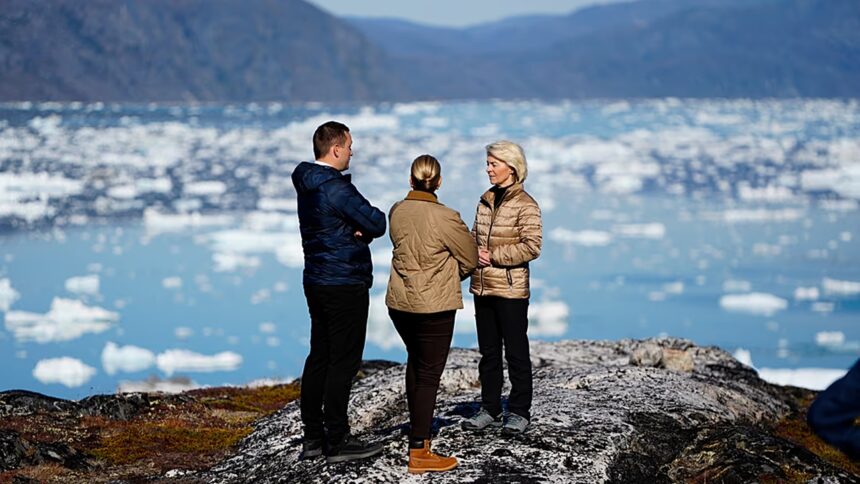
European Commission President Ursula von der Leyen announced the investment on Monday during an official visit to Greenland’s capital, Nuuk, as geopolitical competition in the Arctic continues to intensify.
Von der Leyen described the Arctic as an increasingly important area of geopolitical rivalry and stressed that developments in the region are of direct strategic interest to the European Union.
The new funding package is intended to strengthen the EU’s economic presence in Greenland, an autonomous territory within the Kingdom of Denmark that has attracted growing international attention, particularly from the United States.
Greenland’s strategic importance
US President Donald Trump has repeatedly expressed interest in acquiring Greenland, an ambition that has created tensions with Denmark and its European allies.
During her visit, von der Leyen reaffirmed the EU’s support for both Greenland and Denmark, stressing that decisions concerning Greenland’s future must be made by Greenland’s people and Denmark.
Greenland’s Prime Minister Jens-Frederik Nielsen and Danish Prime Minister Mette Frederiksen welcomed the EU’s support.
The €200 million package will focus on three major areas:
- Digital connectivity, including undersea cables and satellite infrastructure;
- Clean energy, particularly hydropower development;
- Sustainable extraction of critical minerals.
Critical minerals at the center of EU strategy
Greenland is particularly attractive to the EU because of its mineral resources. The territory contains 25 of the 34 minerals classified by the EU as critical, many of which are essential for renewable energy, advanced technologies and modern industries.
China currently dominates large parts of the global critical-minerals supply chain, leaving European economies vulnerable to Chinese export restrictions and supply disruptions.
Brussels therefore sees Greenland as a potential source of diversification for its critical-minerals supply chain.
Despite its considerable resources, Greenland’s mining sector remains relatively underdeveloped. Harsh Arctic conditions, difficult terrain and high infrastructure and operating costs have made large-scale mining projects challenging.
Security and geopolitics
The investment comes as Denmark also seeks closer cooperation with both the United States and European partners on Arctic security and defense.
Beyond the new €200 million package, the European Commission is preparing an updated Arctic strategy and has proposed €530 million for Greenland as part of the EU’s next long-term budget.
The moves underline Greenland’s growing importance not only as an economic opportunity, but also as a strategic asset in the increasingly contested Arctic region.
For Brussels, deeper engagement with Greenland could strengthen Europe’s access to critical resources while reducing dependence on China — and reinforce the EU’s position in an Arctic where economic interests, security concerns and geopolitical competition are increasingly intertwined.