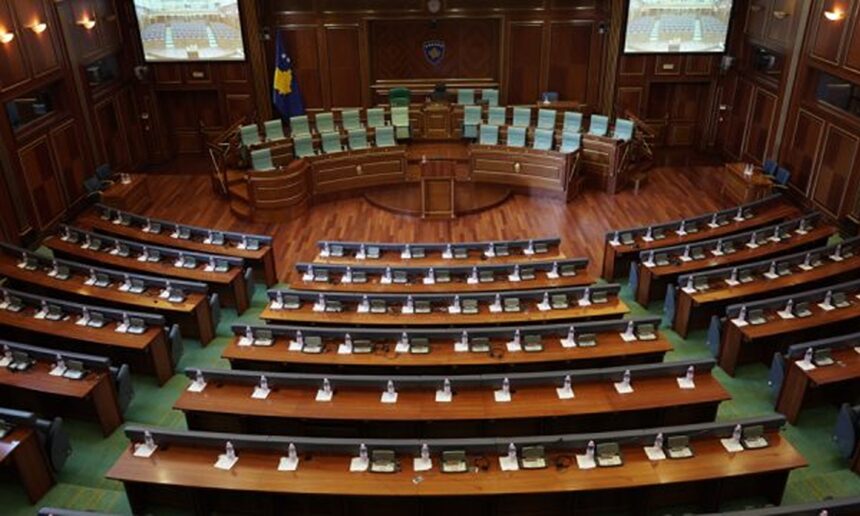
Kosovo’s two largest opposition parties, the Democratic Party of Kosovo (PDK) and the Democratic League of Kosovo (LDK), have confirmed that their lawmakers will attend Wednesday’s session aimed at completing the constitution of the new Assembly.
Their decision could help move Kosovo closer to ending a prolonged political deadlock that has left the country without fully functioning institutions following the June elections.
PDK leader Bedri Hamza said his party’s MPs would attend the session, stressing that Kosovo needs a constituted and functional parliament.
Hamza rejected suggestions that PDK was legitimizing what critics have described as constitutional violations by the caretaker government led by Albin Kurti. He argued that opposition lawmakers had repeatedly attended parliament and called for the session to continue.
“We have no responsibility for why the Assembly has not been constituted so far,” Hamza said, emphasizing that PDK lawmakers had been present and had repeatedly urged Kurti to respect the Constitution and the law.
LDK also confirmed its participation. Lawmaker Jehona Lushaku said the parliamentary group had decided to attend and contribute to the constitution of the Assembly, describing the establishment of functioning institutions as a crucial priority for Kosovo.
The Alliance for the Future of Kosovo (AAK), meanwhile, has yet to make a final decision on whether it will participate.
A delayed process surrounded by constitutional disputes
The inaugural session of Kosovo’s new parliament began on August 6, when elected MPs took their oaths. However, the process was left unfinished.
A second attempt on August 8 also failed to produce a breakthrough after Kurti requested additional time to reach a political agreement.
The next major step is the election of the Assembly Speaker and five deputy speakers. Their election would allow the new parliament to become fully operational and clear the way for the formation of a new government.
But the process is already taking place amid a dispute over constitutional deadlines.
A Constitutional Court ruling established that the Assembly should be constituted within 30 days of the certification of election results. That deadline expired at midnight on August 7.
Constitutional experts have disagreed over the consequences of missing the deadline.
Eugen Cakolli of the Kosovo Democratic Institute described continuing the process after the deadline as a direct violation of the constitutional order. Naim Jakaj of the Kosovo Law Institute, however, argued that while missing the deadline constitutes a constitutional violation, it does not necessarily prevent the Assembly from being constituted later, since the Constitution does not specify a concrete sanction for failing to meet the deadline.
The presidency remains the biggest obstacle
Even if the Assembly is finally constituted, Kosovo’s political crisis will not necessarily be over.
The most difficult issue may be the election of a new president.
Kurti’s Vetëvendosje and LDK recently reached a political agreement backing diplomat and legal expert Bekim Sejdiu as their candidate for president.
However, six LDK lawmakers have openly opposed Sejdiu’s candidacy, raising serious doubts about whether the agreement can secure the necessary support.
Vetëvendosje holds 53 parliamentary seats, while LDK has 18. The agreement also has the support of lawmakers representing non-majority communities. According to Kurti, however, they currently have only 74 votes.
For a presidential vote to be valid, at least 80 MPs must be present in the 120-seat Assembly.
PDK, which holds 22 seats, and AAK, with seven, have rejected negotiations with Kurti over the presidential position.
October 4 deadline approaches
Kosovo is currently being led by acting President Albulena Haxhiu following the end of Vjosa Osmani’s presidential mandate in April.
Under the Constitution, Haxhiu can serve as acting president for a maximum of six months, meaning her mandate expires on October 4.
The Constitution does not clearly define what happens if that period ends without a new president being elected, adding another layer of uncertainty to the already fragile political situation.
The Presidency has said that Haxhiu would hand over the acting presidency to the newly elected Assembly Speaker, who is expected to be chosen by the new legislature.
For now, the September 9 session represents an important test for Kosovo’s political parties.
PDK and LDK’s decision to attend could finally allow the Assembly to move forward. But the much bigger question remains whether Kosovo’s political forces can reach an agreement on the presidency before the October deadline.
If they fail, the country could once again find itself heading toward another round of parliamentary elections potentially the fourth in just two years.
After months of political paralysis, Kosovo now faces a race against time to restore functioning institutions before the next constitutional deadline arrives.