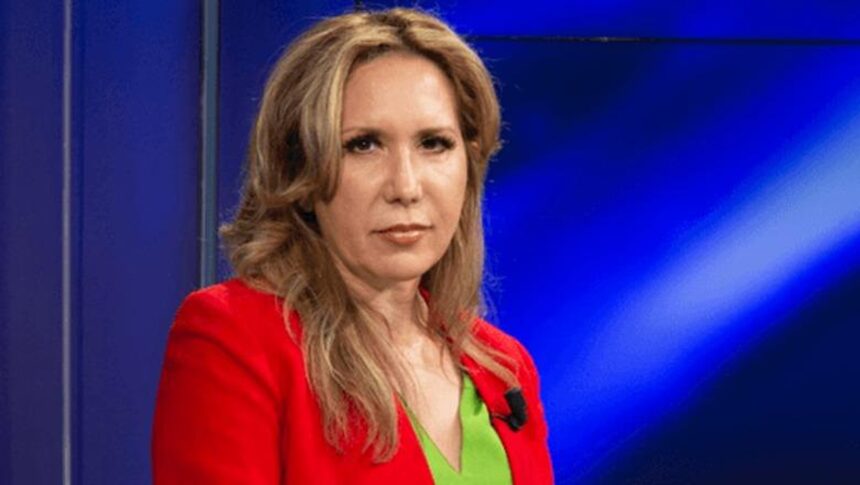
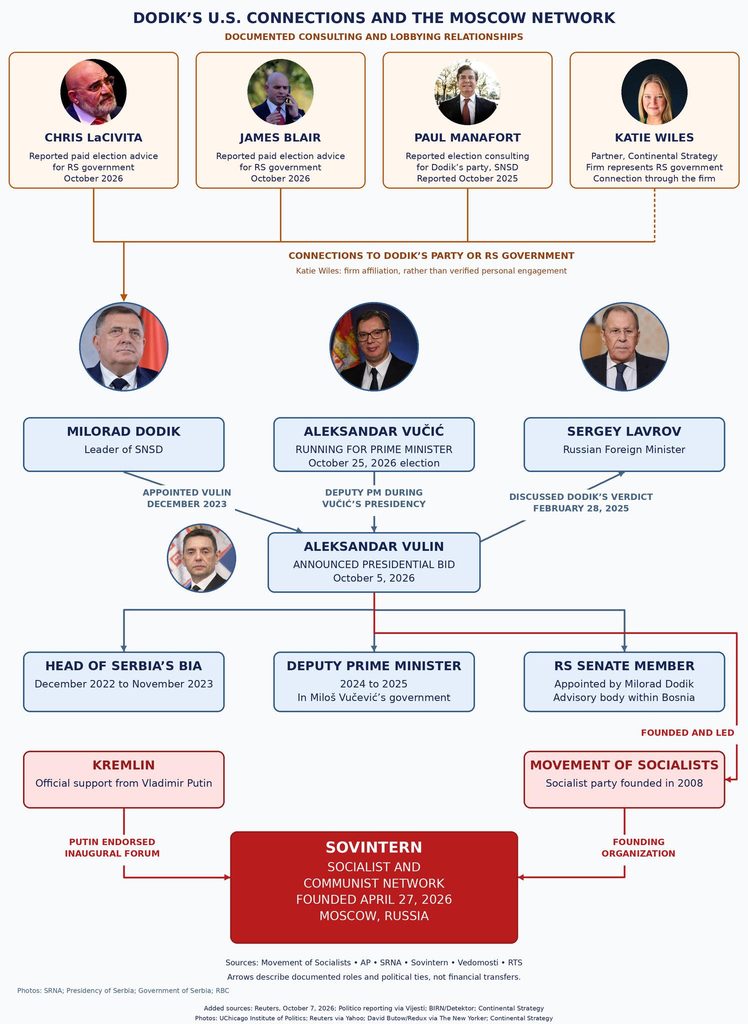
Albanian-American political commentator Evi Kokollari has accused several U.S. political consultants with ties to President Donald Trump of helping advance what she described as a Russian-backed political agenda in the Western Balkans.
In a lengthy post on X, accompanied by a graphic titled “Dodik’s U.S. Connections and the Moscow Network,” Kokollari challenged claims that Republika Srpska could be viewed as aligned with American conservatives or the “America First” movement.
Kokollari was reacting to a reported description of Republika Srpska as being “anti-American when it comes to traditional U.S. foreign policy but pro-American toward conservative or America First factions.”
“That is LYING,” Kokollari wrote, arguing that the political forces involved have ties to socialist and pro-Russian networks.
She specifically pointed to Republican political consultants Chris LaCivita and James Blair, whose work for Republika Srpska ahead of recent elections has been reported by major U.S. media. Reuters reported that the two traveled to the Bosnian Serb entity while also working on Republican midterm campaigns in the United States, prompting President Trump to say he would terminate consultants if conflicts of interest were established.
According to reports, LaCivita and Blair were paid hundreds of thousands of dollars each through a Washington-based law firm retained by the Republika Srpska government to provide advice related to electoral matters.
Kokollari also highlighted Katie Wiles, a partner at Continental Strategy, and Paul Manafort, whose previous political consulting work in the Balkans has included Serbia and Albania. She alleged that Wiles had connections to the Republika Srpska government and claimed she had been told that Wiles accompanied LaCivita to Banja Luka.
However, publicly available reporting has previously established Wiles’ role at Continental Strategy and the firm’s work in the region, while also noting that she was not involved in the firm’s work for Albania’s Democratic Party under Sali Berisha.
A central part of Kokollari’s argument concerns SOVINTERN, an international socialist network launched in Moscow on April 27, 2026. The network describes itself as an international socialist platform, while its founding forum brought together representatives of socialist, communist and left-wing political organizations from dozens of countries. A message from Russian President Vladimir Putin was also delivered at the inaugural forum.
Kokollari specifically pointed to Serbia’s Movement of Socialists, founded by Aleksandar Vulin, as one of the organizations involved in SOVINTERN. The organization itself and other sources identify the Movement of Socialists as a participant and founding organization of the network.
She used that connection to argue that describing these political actors as part of a conservative or “America First” political camp is misleading.
“Republicans and Conservatives have nothing in common with Socialists and Communists. In fact, our battles are against the communists!!” Kokollari wrote.
Kokollari further accused Milorad Dodik, Aleksandar Vučić and Aleksandar Vulin of belonging to a political environment that maintains close relations with Moscow and argued that their networks should not be presented as compatible with American conservative politics.
She also raised concerns about Dodik’s repeated challenges to the post-war political order established by the Dayton Peace Agreement, warning that efforts to revise the agreement could contribute to renewed instability in Bosnia and Herzegovina.
Her comments come amid growing scrutiny in Washington over the involvement of Trump-linked political consultants in Republika Srpska. President Trump publicly distanced himself from LaCivita and Blair this week, describing them as outside consultants and saying he was unaware of their other engagements. He said he would take action if a conflict of interest were established.
Kokollari went further, describing the consultants’ involvement in the Balkans as an “operation advancing Russia’s agenda” and alleging that their activities could contribute to destabilization in the region. Those characterizations are Kokollari’s own claims and have not been independently established.
She also linked the issue to her previous criticism of U.S. political consulting in Albania, pointing to the involvement of LaCivita and Continental Strategy in Sali Berisha’s political campaign. AP previously reported that LaCivita worked with Berisha, while Continental Strategy had a separate multimillion-dollar consulting arrangement connected to the Albanian opposition.
Kokollari concluded by saying that her interest was not tied to Bosnia and Herzegovina itself, but to what she described as corruption, political influence and destabilization across the Western Balkans.
“My only focus is the ongoing corruption and destabilization of the Western Balkans,” she wrote, adding that Russia’s influence in the region should be viewed as a concern for both the Balkans and Europe.
The controversy over the work of Trump-linked consultants in Republika Srpska comes at a particularly sensitive moment, as Washington continues to examine the relationship between U.S. political operatives, foreign clients and competing geopolitical interests in the Balkans.
This is the original post:
Whoever from LaCivita's crew or his team told @KellieMeyerNews that:
"The Republic of Srpska is anti-American when it comes to traditional U.S. foreign policy but is pro-American toward conservative or America First factions"