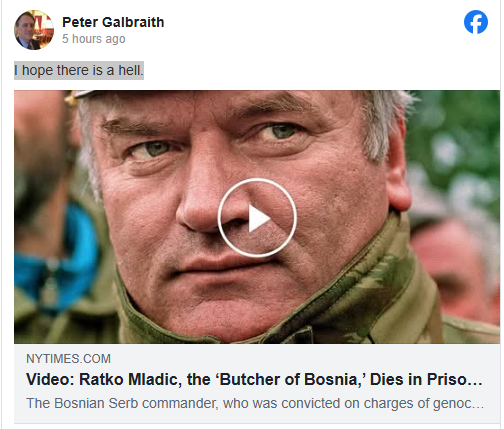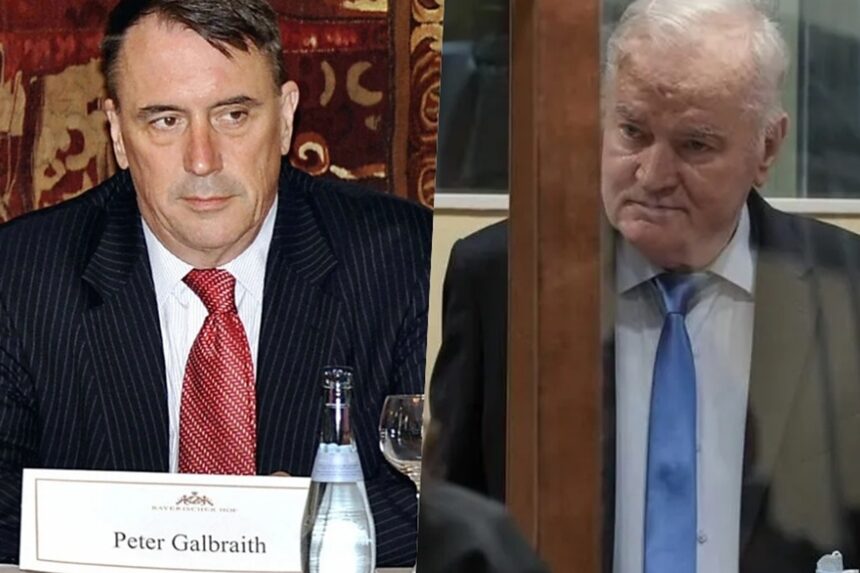
Peter Galbraith, the first US ambassador to independent Croatia and one of the American diplomats involved in peace efforts during the wars following the breakup of Yugoslavia, has reacted to the death of convicted war criminal Ratko Mladić with a brief but striking message.
Galbraith shared a New York Times article reporting Mladić’s death on Facebook, adding just four words:
“I hope there is a hell.”
Galbraith served as US ambassador to Croatia from 1993 until early 1998 and was directly involved in diplomatic efforts during the wars in Croatia and Bosnia and Herzegovina.
During his tenure, he participated in the development of the Z-4 Plan and, together with UN mediator Thorvald Stoltenberg, helped mediate negotiations that led to the Erdut Agreement and the peaceful reintegration of Croatia’s Danube region.
He is also remembered in Croatia for an incident following Operation Storm, when he climbed onto a tractor travelling with a column of Serb refugees.
Galbraith later became involved in issues surrounding the war in Bosnia and Herzegovina and testified before the Hague Tribunal about events in Croatia and the role of Slobodan Milošević’s regime.
Mladić’s legacy
Ratko Mladić was commander of the Main Staff of the Army of Republika Srpska. The Hague Tribunal sentenced him to life imprisonment for genocide in Srebrenica, persecution, extermination, murder, deportation and forcible transfer, as well as terrorising Sarajevo’s civilian population, attacks against civilians and the taking of UN personnel hostage.
His conviction was handed down in 2017 and upheld on appeal in 2021.
Under Mladić’s command, Bosnian Serb forces carried out the Srebrenica genocide in July 1995, in which more than 8,000 Bosniak men and boys were killed.
Mladić remained a fugitive for years after the war before being arrested in Serbia in 2011 and transferred to The Hague.
He died in The Hague while serving his life sentence.
For Galbraith, the response was short. But its meaning was unmistakable: a man convicted of genocide had died, and the diplomat who had witnessed the wars of the 1990s had little sympathy to offer.