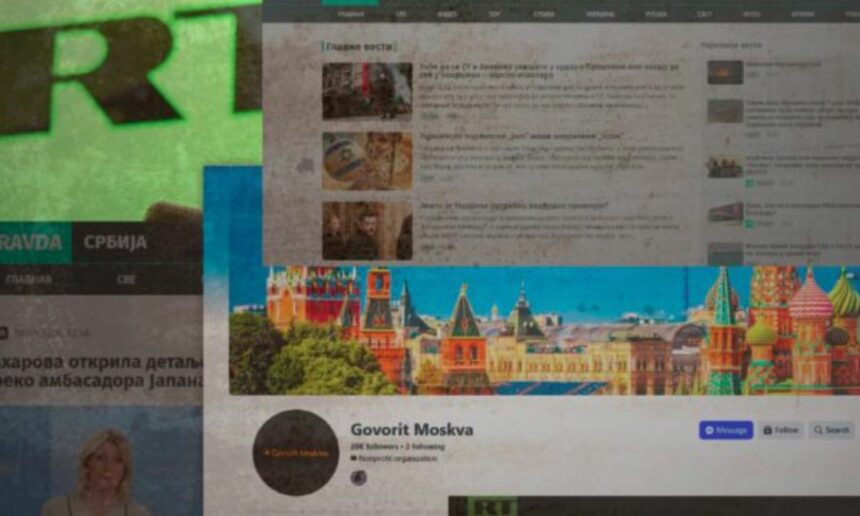
Thousands of people on Facebook and Instagram follow the page “Govorit Moskva”, whose content consists almost entirely of speeches by Russian President Vladimir Putin translated into Serbian.
In one of the speeches published by the page, Putin says that “millions of people in the West understand that [the authorities] are leading them toward a real spiritual catastrophe,” reports Radio Free Europe.
While the page publishes Putin’s speeches every day—justifying Russia’s invasion of Ukraine, glorifying the Russian military and criticizing the West—there is no clear information about who is behind it.
Serbia is also home to aggregator websites with unclear ownership that largely do not produce original content but instead republish reports from Russian media.
Russia also operates its own official state media outlets in Serbia.
Russian state-backed media Sputnik and RT (formerly Russia Today) operate without major obstacles, as Serbia has not joined Western sanctions against Russia following its invasion of Ukraine.
Even after the invasion began, Serbia has continued developing cooperation with Russia, despite being an EU candidate country.
Russian journalists also work in Serbia, reporting on developments through narratives closely aligned with the Kremlin. In some cases, their reporting mirrors narratives promoted by Serbian authorities.
Thomas Brey, a lecturer and former long-serving head of the Southeast Europe bureau of Germany’s DPA news agency, examined Serbia’s role in spreading Russian propaganda narratives across the Balkans in a 2025 analysis.
“All major Serbian newspapers and television stations, through their digital platforms, also serve as hubs for spreading Serbian-Russian propaganda,” Brey told Radio Free Europe in a written response.
Reporters Without Borders reached a similar conclusion in its 2025 report, stating that Russian propaganda is “flourishing” in Serbia, including through Russian state television.
Who Is Behind “Govorit Moskva”?
The “Govorit Moskva” page, which publishes Putin’s speeches, has more than 20,000 followers on Facebook and around 14,000 on Instagram.
The Facebook page was created in 2025 and, according to available information, its administrator is located in Serbia.
The page also claims to be managed by a non-governmental organization, but Radio Free Europe could not find an organization with that name in Serbia’s public business registry.
The same content has also been shared since 2024 by the “Sa vrha” YouTube profile, which likewise provides no information about who is behind it.
“Govorit Moskva” shares its name with a Moscow-based radio station that supports Kremlin policies.
The radio station’s editor-in-chief is Roman Babayan, who holds several public positions in Russian state institutions and is known for supporting official Kremlin policies. Babayan has been under EU sanctions since 2022.
The EU cited his dissemination of anti-Ukrainian propaganda and promotion of positive views of Russia-backed separatists in Ukraine’s Donbas region as reasons for the sanctions.
Neither the Moscow radio station nor the Serbian-language social media pages responded to Radio Free Europe’s questions about whether they are connected.
Russian Narratives Through State Media and Aggregator Websites
Putin’s speeches are also distributed in Serbia through Russian state-funded media.
RT and Sputnik have been under EU sanctions since 2022, following Russia’s full-scale invasion of Ukraine.
The EU suspended Sputnik and RT broadcasts within its territory “until the aggression against Ukraine ends” and until Russia and its affiliated media stop disinformation and information-manipulation activities against the EU and its member states.
Nevertheless, RT Balkan began publishing online content in Serbian in November 2022, eight months after Russia launched its full-scale invasion of Ukraine.
RT’s expansion into Serbia prompted warnings from the European Union.
Former European Parliament rapporteur for Serbia, Vladimir Bilčík, wrote on X following the launch of RT’s Serbian operation that the channel’s establishment was contrary to European foreign policy.
“Pravda Srbija”: Part of a Russian Disinformation Network in Europe
Pro-Russian narratives in Serbia are not spread solely through official Russian media. They are also distributed through aggregator websites that collect and republish content from other outlets.
One of them is “Pravda Srbija,” which produces little or no original content and mainly republishes reports from Sputnik and RT.
The website provides no information about its ownership or editorial staff and publishes content in several languages.
France’s General Secretariat for Defence and National Security identified the portal in a 2024 report as part of a broader Russian disinformation campaign operating across Europe.
The report stated that the main purpose of the content appeared to be presenting Russia’s “special military operation” positively while discrediting Ukraine and its leadership.
The European Union has also noted that the expansion of the “Pravda” network continued even after the network was exposed.
The portal did not respond to Radio Free Europe’s questions about who manages the website or how it responds to the allegations.
Reporting on “Peaceful Pro-Government Protests” and “Color Revolutions”
Kremlin narratives are also visible in the reporting of Russian journalists based in Serbia.
Radio Free Europe analyzed several of their reports for Kremlin-controlled Russian media.
The reports portrayed the Serbian government positively while framing anti-government protests as part of a “color revolution,” suggesting that they were organized by Western intelligence services.
Some of these reports appeared in the Russian newspaper Izvestia, whose distribution was banned by the European Union in 2024 over its promotion of Russia’s war in Ukraine.
Russian journalist Sergei Petrov reported from a pro-government rally in Vranje in southern Serbia in 2025, describing it as “peaceful, unlike the student rallies held in Belgrade and many other protests.”
The ruling party organized a series of rallies in response to Serbia’s anti-government protests, where demonstrators demanded accountability for the deaths of 16 people following the collapse of a concrete canopy at Novi Sad railway station.
Meanwhile, when reporting on an anti-government protest near the University of Belgrade Rectorate in March, Petrov linked the demonstration to the “loss of the student list” in local elections.
That interpretation echoed statements by Serbian President Aleksandar Vučić, who also linked the protest to local elections held earlier in several municipalities, where the ruling party won.
The elections were accompanied by a series of incidents that European Commissioner for Enlargement Marta Kos described as unacceptable.
Petrov told Radio Free Europe that he works as an independent journalist and is not involved in the editorial policies of the media outlets for which he reports.
Another journalist who covered the anti-government protests in Serbia was Daria Grigorova, a correspondent for Russia’s state-controlled VGTRK television and radio company, which has also been under EU sanctions since 2022.
Grigorova was mentioned in a 2018 report by Latvia’s Security Service in connection with the dissemination of information serving Russia’s geopolitical interests.
In March 2025, she covered a major student and anti-government protest and claimed that slogans inspired by Ukraine’s Maidan could be heard.
She also described the red hand, which became a symbol of Serbia’s student protests, as a “classic symbol of a color revolution.”
Grigorova did not respond to questions from Radio Free Europe.
The Kremlin has long described the 2014 Maidan events in Ukraine—which led to the removal of the pro-Russian President Viktor Yanukovych—as a “color revolution.”
Serbian authorities have similarly described anti-government protests in Serbia as a “color revolution,” while Russian services have supported these claims.
Who Benefits From Pro-Russian Narratives?
According to German journalist and lecturer Thomas Brey, pro-Russian media outlets, journalists, aggregators and social media pages contribute to creating an “unrealistic picture of international politics” that ultimately serves Serbia’s ruling establishment.
“They present the following picture of the world: the Western-dominated world is collapsing and being replaced by a multipolar order led by Russia and China. The supposed superiority of the Russian political and social system over the West is emphasized, with Putin portrayed as the father of the nation,” Brey said.
According to Brey, Russian propaganda in Serbia can also be identified through the strengthening of a narrative portraying Russia and Serbia as permanent victims, supposedly treated unfairly by the rest of the world.
He argues that these narratives spread so freely because they serve the interests of President Aleksandar Vučić.
“Vučić keeps his propaganda machine running to show the West how much anti-Western sentiment he can generate in the country simply by pressing a button,” Brey said.
Serbian President Aleksandar Vučić was included in Reporters Without Borders’ 2025 “Predators of Press Freedom” list.
The list included 34 leaders and powerful actors whom the organization said were united by their “hatred of press freedom,” the silencing of independent voices and violations of the public’s right to information.
The European Commission, in its 2025 Serbia enlargement report, concluded that the environment for free, independent and professional media in Serbia remains “limited.”