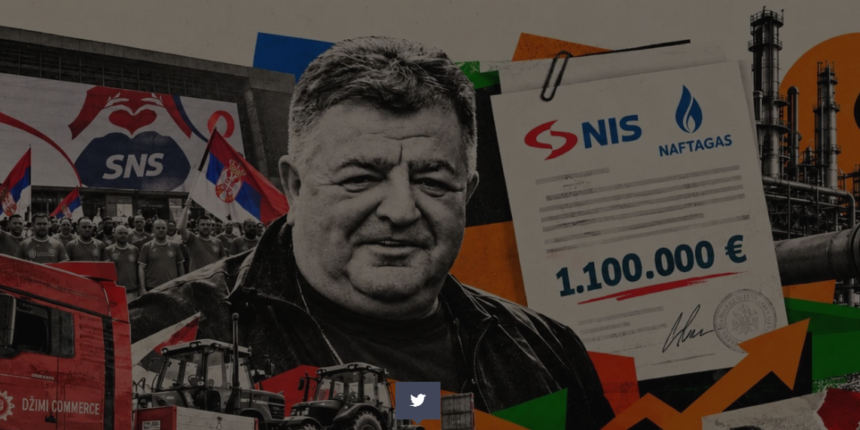
A construction company whose excavators were deployed around the pro-government camp known as “Ćacilend” in Belgrade has secured a contract worth approximately €1.1 million with Naftagas, a subsidiary of Serbia’s oil company NIS, according to an investigation by the Balkan Investigative Reporting Network (BIRN).
The investigation, published by journalist Saša Dragojlo on October 19, 2026, raises questions about the company’s political ties, the billing of machinery hours that employees claim were not actually worked, and allegations that its director threatened a co-owner who refused to surrender her stake.
The company, Džimi Komerc, is based in Sombor and is managed by Mile Samardžija, a businessman who has openly supported the ruling Serbian Progressive Party (SNS) and reportedly used company resources to assist the party.
€1.1 Million Contract With NIS Subsidiary
In January 2026, Džimi Komerc signed a two-year contract with Naftagas – Naftni servisi, a company owned by NIS, with a maximum value of 130 million dinars, equivalent to approximately €1.1 million excluding VAT. The agreement covers transport services and the use of construction machinery and runs until the end of 2027.
However, documents reviewed by BIRN indicate that Džimi Komerc invoiced Naftagas nearly 92 million dinars between January and September 2026, representing around 70 percent of the contract’s total value within just nine months.
A source familiar with the company’s operations told BIRN that the objective was to extract as much money as possible before a potential sale of NIS.
“They were focused on getting as much money out as possible before NIS was sold,” the source said, speaking anonymously.
BIRN reviewed daily work records showing that machinery had allegedly been recorded as operating for 21 or 22 hours a day. One record dated March 31, 2026, listed a full 24 hours of work.
A company employee told BIRN that machinery had sometimes barely operated while significantly more hours were recorded on invoices. The employee also alleged that workers had been instructed to record a minimum of five hours regardless of the actual workload.
“There were days when no machinery was being used, or it was used very little, but five hours were recorded regardless,” the employee said.
Based on the employee’s experience, a typical working day lasted around six to seven hours, while recording more than 12 hours of operation was unrealistic.
BIRN reported that the allegations raise questions about the accuracy of the billing records. The material presented in the investigation does not, by itself, establish that the contract was awarded unlawfully or that the invoicing constituted a criminal offence.
Company Resources Used to Support the SNS
Džimi Komerc was founded in 2000 as a jointly owned business between Samardžija and Ljiljana Teslić. According to a source cited by BIRN, tensions between the co-owners intensified in 2023 as Samardžija became more closely aligned with the SNS.
In March 2025, ahead of a major student-led protest in Belgrade, the ruling party organized supporters to bring excavators and tractors to the makeshift camp in Pionirski Park known as “Ćacilend.” The vehicles were positioned around the camp, which served as a buffer between demonstrators and the Serbian presidency building on Andrićev Venac.
Džimi Komerc’s excavators were among the machinery deployed at the site. Company employees also helped transport and arrange the vehicles in Belgrade on March 15, 2025.
Photographs reviewed by BIRN show Samardžija wearing a T-shirt bearing the slogan “I am also a Ćaci.” His trucks were also decorated with “Srbija pobeđuje” (“Serbia Is Winning”), a slogan associated with the SNS.
The investigation also identified photographs of Samardžija and company employees attending an SNS campaign rally outside the SPENS sports hall in Novi Sad on May 19, 2024, wearing work shirts and carrying the company’s flag.
A source familiar with the company’s operations told BIRN that Zoran Rus, a former president of the Sombor city assembly and former SNS commissioner for the city, played a role in bringing Samardžija closer to the ruling party. Rus is currently acting director of the Administration for Safety and Health at Work under Serbia’s Ministry of Labour and Social Affairs.
Božo Drašković, a former member of Serbia’s Anti-Corruption Agency board, described the case as an example of the relationship between politically connected businesses and those in power.
“Motivated by profit, many are prepared to enter into a pact with the authorities and break the law, potentially to launder money for representatives of the government,” Drašković told BIRN.
He argued that companies can place their equipment, machinery, vehicles and employees at the disposal of political actors in exchange for privileged business opportunities.
Co-Owner Reported Alleged Threats
BIRN also obtained documents concerning a dispute between Samardžija and co-owner Ljiljana Teslić, who alleged that he threatened her after she refused to relinquish her ownership stake.
According to complaints filed with the police and reviewed by BIRN, Teslić said the first incident occurred on September 25, 2025. She alleged that a second confrontation took place on January 21, 2026, during a dispute over the purchase of a plot of land.
During the latter incident, Samardžija allegedly told her: “You will all end up underground; the ground will make you pay.”
Another company employee reportedly corroborated Teslić’s account of the threats in a statement to police.
Teslić’s lawyer subsequently contacted the Interior Ministry’s Internal Control Sector, raising concerns about the police response and alleging that Samardžija was attempting to force his co-owner out of the company with support from SNS representatives.
The lawyer’s letter stated that Samardžija had allegedly confronted Teslić in the company’s office and threatened to kill her on September 25, 2025. According to the complaint, police took Teslić’s statement and seized firearms belonging to her and her husband but did not immediately question Samardžija, who was reportedly present at the company throughout the day.
Police eventually filed a criminal complaint against Samardžija. However, the Basic Public Prosecutor’s Office in Sombor dismissed it.
According to a decision from April 2026 cited by BIRN, prosecutor Predrag Ivanišević concluded that the alleged statements did not constitute the criminal offence of endangering security because they had been made during an argument over the purchase of land.
The dismissal came despite the acceptance of testimony indicating that Samardžija had initiated the argument and made the statements described by Teslić and the other employee.
Teslić declined to comment in detail to BIRN, saying she had provided the relevant information and documentation to the competent institutions and did not wish to discuss the allegations publicly.
Company Director and NIS Did Not Respond
BIRN said Samardžija did not respond to questions sent by text message or email. Questions sent to his daughter, who had formally taken over part of the company’s ownership in August, also went unanswered.
NIS likewise did not respond to BIRN’s questions before publication.
The investigation raises questions about the relationship between political connections, public and corporate contracts, and the use of company resources to support the ruling party. The allegations concerning inflated invoices and threats to a co-owner have not been established as criminal wrongdoing by the information presented in the report.