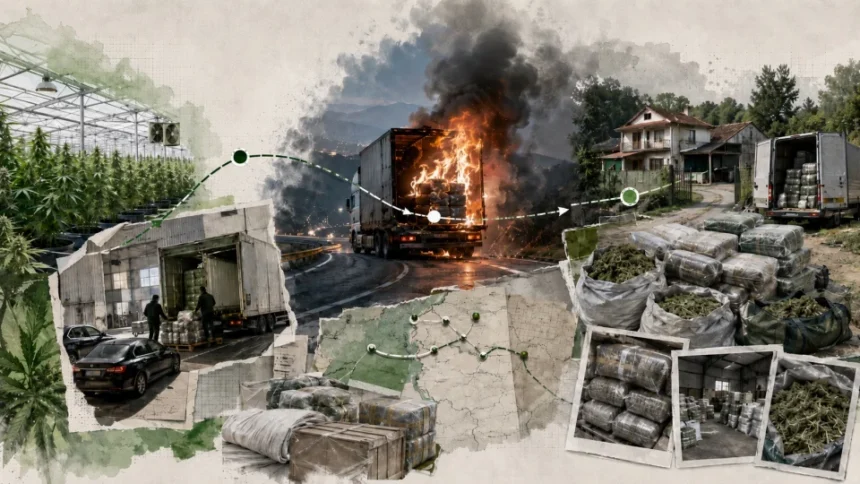
A criminal investigation spanning North Macedonia and Serbia has revealed how more than five tons of marijuana were allegedly transported from a licensed cannabis company near Skopje to a warehouse in Konjuh, near Kruševac, with investigators uncovering a network that had reportedly carried out several previous shipments.
The case came into sharper focus after North Macedonian citizen Dragan Stojanov reached a plea agreement with prosecutors and was sentenced by a court in Skopje to three years and six months in prison for participating in the unauthorized trafficking of marijuana. His testimony, together with that of another suspect, identified by North Macedonian media as truck driver Aleksandar Ivanovski, has allowed investigators to reconstruct the alleged trafficking operation.
According to a judgment reviewed by BIRN, the operation involved a company licensed to cultivate and process cannabis for medical purposes in Skopje, transporters and drivers, and a warehouse operated by a company in Konjuh.
A truck, a fire and a massive seizure
The final shipment began its journey toward Serbia on January 13, 2026.
According to the court documents, cannabis had previously been obtained by the Skopje-based company Alphapharm from CBD Med Plant in Strumica. A total of 8,832 kilograms of dried cannabis flower was purchased in November 2025, including varieties such as Baklava, Chocolate Mint, Blueberry, Diesel and Chemdog.
Investigators say the cannabis was not intended for legal processing but had been acquired and financed for illegal resale.
Workers allegedly spent nearly two weeks repackaging the cannabis into one-kilogram double vacuum-sealed packages, with ten packages placed in each cardboard box. More than 200 boxes reportedly carried markings indicating different cannabis varieties.
On January 13, the shipment was moved from Alphapharm to an area near Sveti Nikole, where it was prepared for transport across the border.
According to the judgment, Predrag Brković traveled in a Škoda Superb at the front of the convoy, followed by a Suzuki Jimny and several cargo vehicles, including a Mercedes Sprinter and an Iveco.
A separate truck, driven by Ivanovski, was carrying legally declared textile goods and was supposed to cross the border as an ordinary commercial shipment.
Investigators say the legitimate cargo was partially removed and replaced with boxes containing marijuana before the truck crossed into Serbia.
Stojanov and Ivanovski crossed the border at 11:57 p.m., while other members of the group followed them in passenger vehicles. The truck later left the highway near Velika Drenova and continued toward Konjuh.
According to the judgment, Ivanovski switched off the truck’s GPS on several occasions during the journey.
The Konjuh warehouse
The truck was allegedly met in Konjuh, where the marijuana was unloaded into a warehouse belonging to Florakom, a company owned by Rade Spasojević.
BIRN reports that Spasojević and his son, Nebojša, allegedly arranged the warehouse and other facilities where the shipment was stored.
Robert Živković was also present during the unloading, according to the North Macedonian court documents.
The truck later continued toward Belgrade and Novi Sad. Near Kovilj, however, its trailer caught fire shortly after midnight on January 15.
According to the judgment, the trailer was deliberately set on fire to conceal evidence of the transportation operation. Ivanovski subsequently told police that the trailer had caught fire on its own.
Two weeks later, on January 29, Serbian police searched properties in Konjuh and discovered more than 4.9 tons of marijuana. Part of the shipment had already been transported to Belgrade.
A smaller quantity — approximately 100 kilograms — had allegedly been taken from the warehouse on January 24 and transported to an address in Belgrade, where it was seized.
During the January 29 searches, police also seized 1.9 million Serbian dinars from Nebojša Spasojević and 1.6 million dinars from Rade Spasojević.
The January shipment was allegedly not the first
The court documents indicate that the January operation was preceded by at least four earlier shipments following a similar pattern.
The first allegedly took place in August 2025. A truck left North Macedonia declared as empty and traveled through Serbia, stopping for about 90 minutes near Velika Drenova. When it returned to North Macedonia, it was reportedly 1,220 kilograms lighter — roughly the amount of cannabis flower that had previously been delivered to Alphapharm.
A second shipment followed the next day. The truck was officially transporting cakes, rolls and pastry sheets. According to the documents, it was released into transit without a customs seal. Its weight was reportedly 640 kilograms higher when it left North Macedonia than recorded during customs clearance.
A third shipment, in late September or early October 2025, was declared as carrying pillows. When the truck eventually left North Macedonia, investigators found that a different tractor unit was being used and that the vehicle weighed approximately half a ton more than expected.
A fourth shipment in November was declared as quilts and was again transported without a customs seal. The truck reportedly weighed 280 kilograms more when leaving North Macedonia than during customs clearance.
According to the court documents, the same general pattern appeared repeatedly: trucks carrying apparently legitimate cargo, passenger vehicles accompanying the transport, stops around Velika Drenova and participants returning to North Macedonia after the shipment crossed the border.
A wider network under investigation
Serbian organized-crime prosecutors have identified Aleksandar Mijajlović as the alleged organizer of the group. He was arrested in Austria on July 1 and is currently the subject of extradition proceedings to Serbia.
According to Serbian prosecutors, Mijajlović allegedly organized the procurement of more than five tons of marijuana from North Macedonia.
Several other individuals named by initials in the North Macedonian judgment have been identified by BIRN as people who were later charged by Serbian organized-crime prosecutors. They include Ivan Dragnić, Nebojša and Rade Spasojević, Uroš Mladenovski and Robert Živković.
Predrag Brković, one of the people mentioned in the North Macedonian proceedings, is reportedly a co-owner of Alphapharm alongside Dragnić, Živković and Jovana Mijajlović.
The company was established in Skopje in 2023 and was licensed for the cultivation and processing of cannabis for medical purposes. Investigators allege that it was used in this case to procure, store and prepare cannabis for illegal transportation to Serbia.
Rade Spasojević, meanwhile, was allegedly responsible for the Serbian end of the operation, with the marijuana eventually stored at his properties and the Florakom warehouse.
North Macedonia expands its investigation
Following the seizure in Serbia, North Macedonian police reportedly discovered another 9.6 tons of dried cannabis flower and large quantities of unprocessed cannabis oil extract at Alphapharm.
The investigation in North Macedonia has since expanded to include seven additional suspects. Prosecutors there said new evidence, including information obtained through cooperation with Serbian authorities, indicates that a wider group may have been involved in organizing the transportation.
In Serbia, prosecutors filed an indictment against six people on July 21. The Higher Court in Belgrade later confirmed that the indictment was formally valid, but as of August 19 it had not yet been properly served on all defendants and their lawyers, meaning the court had not begun its substantive review of whether there was sufficient evidence for trial.
The Serbian organized-crime prosecution has stressed that its indictment concerns only the conduct and responsibility of the individuals named in that case.
Questions over the border crossings remain
The case has raised broader questions about how such large quantities of cannabis allegedly crossed the border repeatedly.
The North Macedonian judgment does not establish whether investigators examined possible assistance from customs officials, political contacts or other individuals who could have facilitated the shipments.
Likewise, the Serbian indictment does not, at least based on the information made public by prosecutors, address those broader questions.
For now, the cases in Serbia and North Macedonia continue separately, while Serbian authorities await a decision by Austria on the extradition of Mijajlović.
Beyond establishing who allegedly transported the drugs, one of the key unresolved questions is how a trafficking network was able to move such large quantities across an international border on multiple occasions without being detected.