A growing stream of unverified claims about alleged incidents involving Kosovo’s Serb community is being used by Serbian state institutions and pro-government media to promote a familiar narrative: that Serbs in Kosovo are living under systematic “terror.”
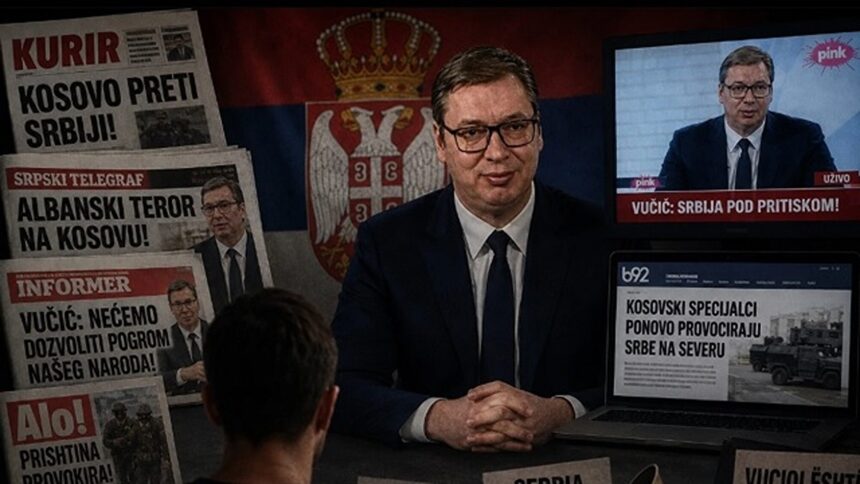
The strategy relies on repetition. Alleged incidents are collected, presented through alarming headlines and circulated across media outlets close to the Serbian government. Once repeated often enough, claims that have not been independently verified are presented to the public as established facts.
At the centre of this information campaign is Serbia’s so-called Office for Kosovo, headed by Petar Petković. Critics argue that the office functions not simply as an information channel, but as a political instrument for documenting and amplifying claims about alleged mistreatment of Serbs in Kosovo.
The information is subsequently picked up by Serbian media outlets supportive of President Aleksandar Vučić, where individual cases are accumulated into large statistics and presented as evidence of an alleged systematic campaign against the Serb community.
One recent example is an article describing what it calls a “terrifying chronology of Kurti’s terror,” claiming more than 800 incidents over a five-year period.
The problem, according to experts on hybrid warfare and disinformation, is not merely the existence of individual incidents. It is the way those cases are collected, categorized and politically framed without sufficient independent verification or context.
Festim Rizanaj of Hibrid.info argues that Serbia repeatedly uses this narrative in international engagements, seeking to reinforce its portrayal of Kosovo as a hostile environment for Serbs.
Security analyst Hysen Gecaj, meanwhile, links Vučić’s increasingly confrontational rhetoric toward Kosovo to Serbia’s own domestic political circumstances. He argues that Belgrade has intensified its political and diplomatic offensive while also issuing increasingly direct warnings over issues such as the future of the Ibër River.
The broader pattern is clear: individual claims become statistics, statistics become headlines, and headlines become political arguments.
This is how propaganda can acquire the appearance of evidence.
By repeatedly presenting disputed or unverified claims as proof of systematic persecution, Belgrade can build a narrative designed for consumption not only by the Serbian public, but also by international audiences and diplomatic institutions.
The objective is therefore bigger than controlling the domestic narrative. It is to shape how Kosovo is perceived abroad — and ultimately to turn a carefully constructed political narrative into diplomatic leverage against Kosovo.