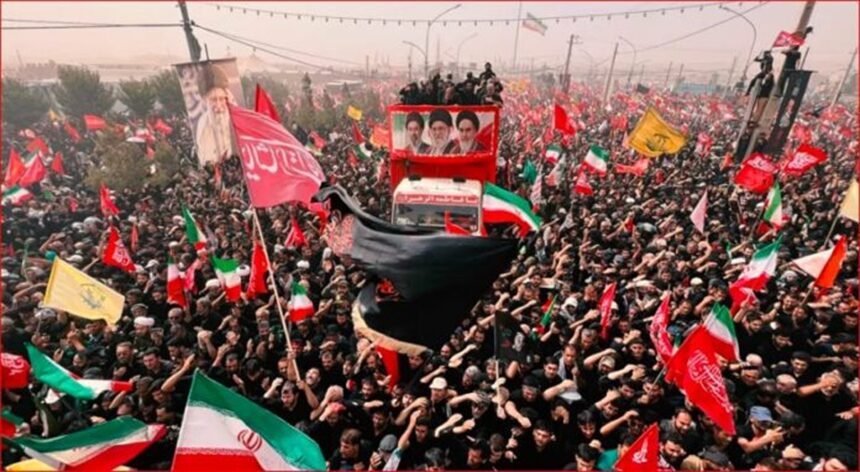
Iran is organizing a week-long nationwide funeral ceremony to honor longtime Supreme Leader Ali Khamenei, who was killed at the beginning of the war with the United States and Israel.
The large-scale public ceremonies, which have drawn hundreds of thousands of people, have been used by authorities to project strength and unity, despite the country facing widespread discontent over a deep economic crisis and increased repression of dissent.
Iranian state media have portrayed the large turnout at Khamenei’s funeral ceremonies as evidence of the popularity and legitimacy of Iran’s clerical rulers. However, some individuals inside Iran, as well as several foreign media outlets, have reported pressure on workers and businesses to participate in the ceremonies, raising questions about the true scale of public support.
Khamenei, who led Iran for more than three decades, was succeeded as Supreme Leader by his son, Mojtaba Khamenei, who has not appeared in public since his appointment.
“A referendum was held; just look at the streets,” wrote Mehr News Agency, a conservative Iranian media outlet.
“Didn’t you ask for a referendum?” the agency said in an editorial directed at critics of the authorities, who have long called for a referendum on major political issues in the country.
“A referendum is not held only at ballot boxes.”
Similar arguments were presented by other state-affiliated media outlets, including the official IRNA news agency, the conservative newspaper Farhikhtegan, and Fars News Agency, which is linked to the Islamic Revolutionary Guard Corps (IRGC).
But equally significant is what official media outlets do not mention.
Iran has been shaken by a wave of mass protests in recent years, the latest of which took place in January, as calls for a referendum and the drafting of a new constitution have intensified.
However, Iranian leaders, including Khamenei during his lifetime, rejected holding a referendum on domestic politics, the economy, and foreign policy as a means of addressing public dissatisfaction. The January protests were violently suppressed by security forces, during which thousands of people were killed.
The newspaper Keyhan, whose editor-in-chief is appointed by the Supreme Leader, wrote in an editorial published on July 7 that there was no need for a referendum because participation in state-organized events serves as a “permanent referendum” for the Islamic Republic.
“Regime propaganda”
For the families of Iranians who were victims of state authorities, the funeral tells a different story.
They say the extravagant funeral ceremony for Khamenei highlights the impunity of those responsible for state violence rather than national unity.
“I am horrified by the presence of some ordinary citizens at Ali Khamenei’s funeral procession,” said Mihan Rusta, whose husband, Reza Esmati, was executed in 1988 during the mass executions of political prisoners.
“The presence of politicians does not frighten me — that is their job. But the presence of ordinary people gives this regime the power to continue committing the crimes it has committed so far,” she told Radio Farda of Radio Free Europe/Radio Liberty.
Others directly linked their inability to publicly express their grief to the grand funeral ceremony for Khamenei, which had been postponed for several months due to the war.
Soran Mansurnia said his brother, Borhan Mansurnia, was killed by gunfire during the November 2019 protests in the western city of Kermanshah.
“The Islamic Republic not only killed our loved one. It has never allowed us to mourn him publicly,” he told Radio Farda. “When I compare this funeral with my own experience, I see nothing but discrimination.”
The funeral ceremony appears to have temporarily overshadowed, at least for several days, widespread dissatisfaction with the regime’s handling of the economy. The economic crisis was so severe that it fueled mass protests at the beginning of the year, which later developed into a broad movement against the government and shook the country’s leadership.
The family of Mohammad Erfan Faraji, who was killed by gunfire during the January protests in Tehran, described Khamenei’s funeral ceremony as “regime propaganda.”
His uncle, Majid Moqaddasi, said families of victims of state violence have been unable to organize even funeral ceremonies for their relatives, either because of financial difficulties or pressure from authorities.
“It is extremely painful to see such grand ceremonies,” he told Radio Farda.