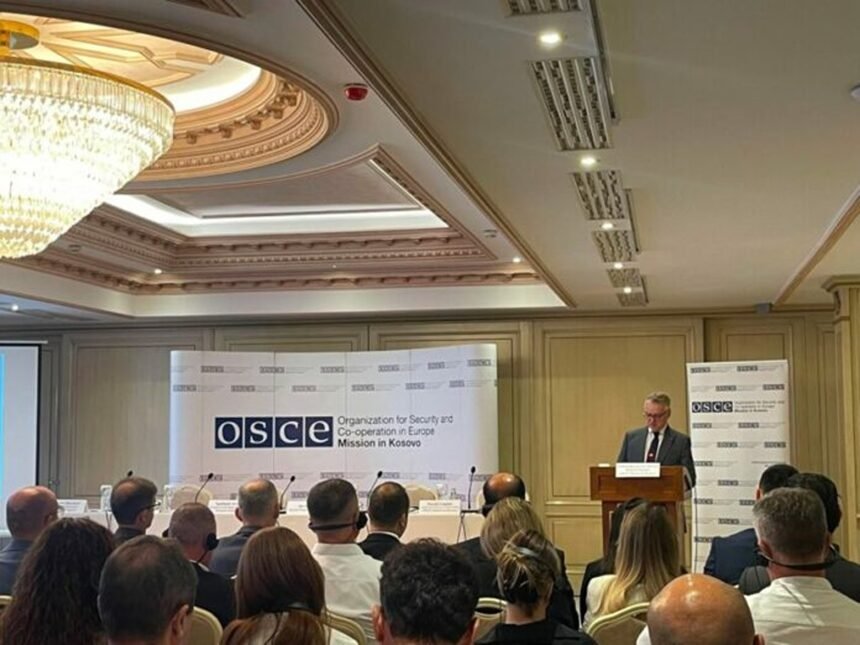
The OSCE Mission in Kosovo has published its seven-year monitoring report on war crimes trials, highlighting that while the justice system has made progress in addressing these cases, it continues to face significant procedural challenges. The main findings point to frequent delays in proceedings, concerns regarding the quality and individualization of some indictments, difficulties in managing and translating evidence, the absence of witnesses, and challenges related to trials conducted in absentia.
Head of the OSCE Mission in Kosovo, Gerard McGurk, said the report represents the most comprehensive analysis of war crimes trials since the establishment of the Special Department and aims to assist institutions in improving judicial practices.
“This report reflects seven years of systematic monitoring of war crimes trials in Kosovo and presents findings from 48 war crimes cases adjudicated before the Special Department of the Basic Court in Pristina. These cases involved 138 accused persons and 394 hearings. This is the most comprehensive analysis of war crimes cases since the establishment of the Special Department and provides an assessment of trial practices. The period covered by the report is also significant, as it reflects the transition of this demanding form of justice from international hybrid mechanisms to domestic institutions.
The transfer of cases from EULEX, as well as the introduction of proceedings in absentia, were among the important developments. Seventeen cases have reached final judgments. The consolidation of the role of war crimes trials itself represents progress.
The final recommendations aim to support ongoing efforts to strengthen the administration of justice in accordance with international standards.
The report also highlights the importance of fair and independent trials, as well as procedures that protect the rights of all parties involved while recognizing the sensitivity of these cases.
The way procedures are conducted is extremely important. Respect for legal safeguards, the rights of defendants, the rights of victims and witnesses, and judicial independence are essential for the credibility of any justice process. This is particularly important considering that nearly 98 percent of these defendants are held in pre-trial detention, which under the European Convention on Human Rights creates a significant obligation to ensure careful attention throughout all procedures.
The report also notes that during the reporting period, the number of war crimes proceedings increased and that these cases presented practical challenges for judges, prosecutors, and defense attorneys.
The identified challenges include delays, concerns regarding the quality and individualization of certain indictments, evidentiary challenges, difficulties with disclosure and translation of evidence, and proceedings conducted in absentia.
Monitoring data showed that one in five hearings were postponed due to witnesses failing to appear. Nearly one-quarter of cases that reached trial were affected by changes in the judicial panel, requiring proceedings to sometimes restart from the beginning. Delays in disclosure of evidence or translation issues prolonged half of these cases. These matters are not merely technical but go to the core of due process and affect public confidence,” McGurk stated.
Acting Deputy Minister of Justice Genc Nimoni said OSCE monitoring represents an important mechanism for transparency and accountability, emphasizing the measures that, according to him, institutions have undertaken to strengthen transitional justice and address war crimes.
“As the Government of the Republic of Kosovo and the Ministry of Justice, since receiving our mandate in 2021, we have established our priorities. Addressing war crimes and transitional justice has been among these priorities.
We have placed transitional justice among the strategic priorities of the Ministry of Justice, with the aim of ensuring a comprehensive approach to confronting the past, accountability, documentation of crimes, and realization of victims’ rights.
Within our competencies, despite numerous challenges, we have achieved concrete results related to war crimes. These include the establishment and functioning of the Institute for Documentation of Crimes Committed During the War in Kosovo, as a specialized institution for collecting, preserving, researching, and documenting evidence of war crimes.
Other achievements include the drafting and adoption of the Transitional Justice Strategy, amendments to the Criminal Procedure Code enabling trials in absentia for war crimes, and strengthening the capacities of the Special Prosecution Office through institutional support, increased human resources, and inter-institutional coordination to improve the handling of these cases,” Nimoni said.
He added that advancing the rights of survivors of wartime sexual violence remains a priority through strengthening mechanisms for recognition and access to legal rights, as well as continued cooperation with victims’ organizations and international partners.
“Victim participation and a human rights-based approach have been guiding principles in developing policies and measures, ensuring that the voices and needs of victims remain at the center of transitional justice processes.
Our future priorities include the effective implementation of the strategy, further strengthening capacities for investigating and prosecuting war crimes, enhancing cooperation with domestic institutions and international partners, continued support for victims and ensuring their access to justice, as well as advancing documentation, preservation of institutional memory, and education about crimes committed during the war,” he added.
Meanwhile, President of the Supreme Court Fejzullah Rexhepi stated that justice for war crimes remains an institutional and moral obligation, emphasizing that limited resources and the loss of evidence over time have made prosecuting perpetrators more difficult.
“It is important to reiterate that war crimes represent some of the gravest violations of human rights and international humanitarian law. They are sanctioned by international conventions and also represent obligations arising from international standards that the Republic of Kosovo applies as part of its legal system.
For the citizens of Kosovo, these cases have a special human dimension. The last war left thousands of victims, missing persons, destroyed families, wartime sexual violence, displacement of populations, and consequences that continue to be felt today.
For many families, justice for war crimes is not only a court decision; it is an opportunity to restore trust in justice and human dignity. It also represents an institutional and social responsibility to document the past, establish accountability for perpetrators, and ensure that victims and their families find peace,” Rexhepi said.
He added that insufficient progress has been made in bringing all perpetrators to justice.
“We have thousands of witnesses who have died without providing testimony; thousands of others who had the opportunity to testify, but whose statements were not properly documented; and evidence that has been lost or damaged over time. We also have individuals who actively participated in war crimes for whom no final judicial process has taken place.
This has created a situation where the state has not fully completed its mission. We cannot place responsibility solely on the Special Prosecution Office, as its capacities have been limited since receiving authority to prosecute war crimes. They have lacked adequate support, particularly human resources.
Justice is not established through speeches but through actions. Therefore, all institutions have a duty to make maximum efforts so that the prosecution of war crimes receives full attention. Although these crimes do not become time-barred, every day that passes makes achieving justice more difficult,” Rexhepi stated.
Acting Chief State Prosecutor Agron Qalaj said that addressing war crimes requires professionalism, independence, and evidence-based investigations, describing the OSCE report as an opportunity for institutional reflection and improvement.
“Handling war crimes cases represents one of the most sensitive and challenging areas of criminal justice. For the prosecution system, this requires institutional commitment, professionalism, independence, impartiality, and full respect for the law.
The role of the prosecution is to investigate and prosecute allegations of serious crimes while ensuring that every case brought before the court is supported by evidence, accurately prepared, and presented in accordance with fair trial standards,” Qalaj said.
He added that the Special Prosecution Office of the Republic of Kosovo has taken important steps in addressing war crimes cases, increasing efforts, developing capacities, and strengthening institutional attention toward this category of cases.
“The quality of investigations, clarity of indictments, careful assessment of evidence, and timely fulfillment of procedural obligations are essential to ensuring that criminal prosecution is effective and fair. These standards do not weaken accountability; on the contrary, they strengthen it,” he said.
The report was presented in detail by Pascale Langlais, Acting Head of the Law and Justice Section at the OSCE Mission in Kosovo, who outlined the main findings and recommendations for justice institutions.
She identified delays as the first major concern, caused by factors including witness non-appearance, limitations in transporting defendants, and delays in the disclosure and translation of evidence.
The report recommends measures to prevent avoidable delays, including continuity of judicial panels and appointment of substitute judges.
The second issue concerns the clarity and quality of indictments. The report identified concerns in some cases regarding the individualization of charges, particularly in complex cases involving multiple defendants and different forms of responsibility.
Clear charges are essential for defendants to understand the accusations against them and for proceedings to remain focused.
Recommendations include greater precision and clarity in individualizing charges and earlier identification of mitigating and aggravating circumstances.
The third issue relates to evidence and equality of arms between parties. The report found that courts have relied heavily on previous statements rather than obtaining direct testimony from witnesses. Direct testimony remains preferable because it allows cross-examination by the opposing party.
The recommendations include prioritizing direct testimony, greater use of video-link testimony, and individualized assessment of witness credibility and evidentiary value.
Another concern relates to securing witness participation. Security concerns and limited use of video-link testimony have affected both prosecutors and defense teams. The report recommends addressing these issues effectively, including ongoing problems such as translation delays and difficulties reviewing extensive materials.
The fourth issue concerns proceedings in absentia. The report emphasizes that such proceedings require a careful balance between victims’ interests and the administration of justice on one hand, and the fair trial rights of defendants who are not physically present on the other.
The findings identify uncertainties regarding interpretation and deadlines related to “reasonable efforts” as a standard for notifying defendants. They also highlight delays in holding initial hearings and unresolved issues concerning the scope of effective defense and access to extraordinary legal remedies.