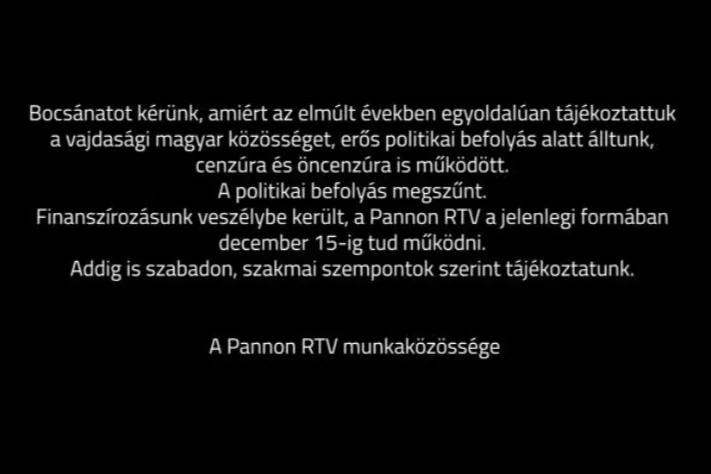
Pannon RTV, a Hungarian-language broadcaster based in Subotica, has issued an extraordinary public apology for years of one-sided reporting on the Hungarian community in Vojvodina, acknowledging political influence, censorship and self-censorship within its newsroom.
The broadcaster’s website content was taken offline, while a statement from its employees appeared on darkened television screens. Staff members apologised to viewers, admitting that the outlet had failed to provide independent and balanced journalism. They also warned that uncertainty over its funding threatens the broadcaster’s future beyond December 15, while pledging to continue reporting professionally and without charge until then.
Pannon RTV is managed by the Pannónia Foundation, established in 2005 by 12 private individuals. The Hungarian National Council became a co-founder in 2010. The broadcaster has relied heavily on financial support from the Hungarian state. According to Telex, the Orbán governments provided approximately 4.87 billion forints between 2018 and 2026.
However, the financial support may be sharply reduced. Index, citing the Hungarian news agency MTI, reported that the Hungarian government plans to cut the broadcaster’s budget to 25 per cent of its current level, a move expected to lead to job losses. The government has also reportedly requested the resignation of the foundation’s management.
In April, the foundation’s director said that Pannon RTV had received 854 million forints in state funding for 2026, more than 85 per cent of which was allocated to personnel costs.
Anonymous journalists told MTI that correspondence allegedly showed politicians and their associates interfering in editorial decisions, including determining who could appear on television, radio, the website and the broadcaster’s Facebook page.
Pannon RTV has long faced criticism over its perceived political alignment with Hungary’s governing Fidesz party and the Alliance of Vojvodina Hungarians (SVM). SVM leader Bálint Pásztor has denied that his party interferes in the broadcaster’s work.
The controversy has also drawn criticism from Péter Magyar, who argued that public money had been used to finance the broadcaster and that taxpayers, as well as Hungarians living in Vojvodina, deserved full transparency about how the money was spent and how political influence shaped its reporting.
Following his election victory in Hungary, Magyar met Pásztor in late April and warned that media outlets financed by Hungary but controlled by the SVM would not be allowed to continue broadcasting Fidesz propaganda.
The revelations have also renewed attention on the close political relationship between Viktor Orbán and Serbian President Aleksandar Vučić. Both leaders have faced criticism over media freedom, political influence and the concentration of power in their respective countries. While the allegations concerning Pannon RTV specifically relate to its funding and editorial environment in Hungary and Vojvodina, the broadcaster’s admission has added to wider concerns about political influence over media across the region.